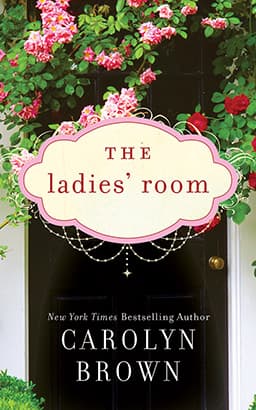

I was grading sophomore essays on The Great Gatsby - the ones where they all think Nick is "just the narrator" and miss everything Fitzgerald was doing - when I needed something to keep me from writing increasingly sarcastic margin notes. Eight hours of Carolyn Brown's small-town Oklahoma drama seemed like the right antidote to adolescent literary analysis.
I wasn't wrong. But I also wasn't prepared for how much this book would remind me of the women I grew up around in the Midwest.
What Gets Said in Ladies' Rooms Stays With You
The premise is deceptively simple: Trudy overhears something devastating in the church ladies' room during her great-aunt Gertrude's funeral. Her husband has been cheating. Not once, not a fling - their entire marriage. Twenty-plus years of lies, whispered between relatives who assumed she already knew.
Brown doesn't rush past this moment. She lets it sit there, heavy and awful, the way real betrayal does. Trudy's reaction isn't the dramatic confrontation you might expect. It's quieter. More devastating. She inherits Gert's crumbling house and decides to rebuild it - and herself - in Tishomingo, Oklahoma, population: everybody knows everybody's business.
This is where the novel could have gone wrong. Could have become a revenge fantasy or a saccharine romance. Instead, Brown gives us something messier. Trudy has a rebellious teenage daughter who resents being dragged to small-town nowhere. A mother with Alzheimer's who sometimes recognizes her and sometimes doesn't. And Billy Lee Tucker, the neighbor who's loved Trudy since childhood and never said a word.
Donna Postel Gets the Oklahoma of It
Here's the thing about Southern and Midwestern accents in audiobooks - they're easy to get wrong. Narrators either go full caricature or flatten everything into generic "country." Donna Postel does neither. Her Trudy sounds like a woman who grew up somewhere specific, moved away, and is now coming back to a place that shaped her whether she wanted it to or not.
The Oklahoma drawl isn't performed. It's inhabited. When Trudy's voice hardens during confrontations with her soon-to-be-ex-husband, you hear the steel underneath the sweetness. When she softens around Billy Lee, there's vulnerability without weakness.
Postel's male voices are where some listeners apparently checked out - I've seen the complaints about finding the narration "boring" - but I disagree. Her Billy Lee is gentle without being simpering. He's a man who's spent decades watching the woman he loves from a respectful distance, and Postel captures that patient longing in how she paces his dialogue. There's restraint there. Deliberate restraint.
(My students would absolutely hate this book. Too slow, Mr. Williams. Nothing happens. They'd be wrong, but they'd say it. This is why we still read the classics - and listen to books that understand pacing isn't the same as rushing.)
The House as Metaphor (Yes, I'm That Teacher)
Look, I can't help it. Twenty years of teaching literature means I see symbols everywhere. But Brown isn't subtle about this one, and she doesn't need to be. The house is Trudy. Crumbling foundation, outdated systems, beautiful bones hidden under decades of neglect.
The renovation scenes work because they're specific. Not just "they fixed the house" but actual decisions about walls and windows and what to preserve versus what to tear down. Billy Lee knows construction. Trudy learns alongside him. The relationship builds through shared labor, through arguments about paint colors and whether the original hardwood is worth saving.
This is what Hemingway would call the iceberg theory in action - the emotional work happening underneath the surface conversation about crown molding.
Where It Wobbles
The pacing does drag in the middle third. There's a stretch where the domestic renovation details start feeling like filler rather than foundation. I found myself speeding through a faculty meeting email chain during one particularly slow chapter about sourcing period-appropriate light fixtures. (Principal Martinez, if you're reading this - I was paying attention to both. Mostly.)
And Trudy's daughter's rebellion arc resolves a bit too neatly. Teenagers don't usually come around that cleanly, that quickly. I've watched enough of them pretend to read assigned novels to know that adolescent grudges have staying power.
But these are quibbles. The emotional core holds.
Who This Is (and Isn't) For
Skip this if you need plot-driven pacing or can't stand renovation details. But if you loved Steel Magnolias or Fried Green Tomatoes, this is their spiritual successor - less famous, maybe, but cut from the same cloth. Small-town women holding each other up while everything falls apart. Secrets that wound and secrets that heal. Tattooist of Auschwitz explores that same tension between devastating secrets and the healing power of human connection, though in circumstances infinitely darker.
Class Dismissed
Carolyn Brown understands something important about women's fiction that gets dismissed as "beach reads" or "easy listening." She understands that starting over in middle age isn't a fantasy - it's terrifying. That choosing yourself after decades of choosing everyone else requires courage most people never acknowledge.
Trudy isn't a heroine because she's special. She's a heroine because she's ordinary and she chooses to rebuild anyway.
The narrator understands that pause is punctuation. Postel gives Trudy's silences weight. The moments between words matter as much as the words themselves. And a love story that earns its happy ending by not rushing toward it.
I finished it at 1 AM, essays still ungraded, and I didn't regret a single hour.