
"¿Cuál es la mejor manera de vivir?" That question hit me somewhere around hour six, sitting cross-legged on my apartment floor surrounded by a half-assembled copy of Gloomhaven, pieces everywhere, thesis document open on my laptop with exactly zero new words since Tuesday. Nora Seed is asking herself whether she wasted her life, and I'm over here like... yeah, Nora, let's not go there right now.
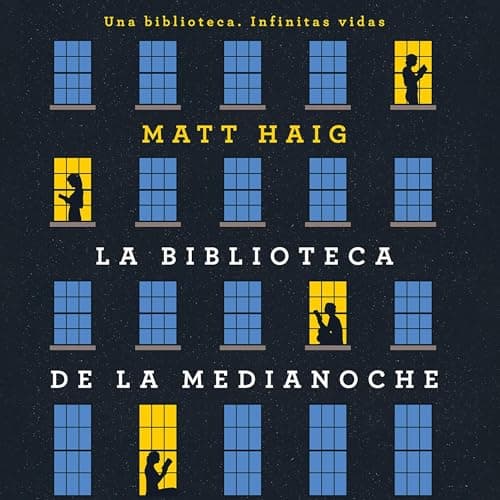
So look - La Biblioteca de la Medianoche is Matt Haig's The Midnight Library in Spanish, narrated by Conchi Ramírez de Haro, and it's the kind of book that shouldn't work for me. No magic system. No progression mechanics. No stat blocks. The premise is basically a cosmic character select screen: Nora dies (sort of), ends up in a library between life and death where every book lets her live an alternate version of herself based on different choices. Became a glaciologist in one life. Olympic swimmer in another. Rock star. Cat owner in Australia. Each book is a save file she can load into.
The Premise Is Basically a Multiverse Campaign with One Player Character
Here's where Haig got me - the structure is pure RPG logic even if he'd never describe it that way. Nora's root life is her base build, and every book in the library is a respec. Different stats, different skill trees, different party members. The librarian, Mrs. Elm, functions like a quest-giver NPC who nudges without dictating. And the mechanic works because there are actual rules: if Nora feels genuine disappointment in an alternate life, the book slams shut and she's back in the library. If she finds contentment, she stays. That constraint gives the whole thing stakes. Without it, you're just watching someone tourism through parallel lives with no consequence.
The Spanish translation by Miguel Marqués Muñoz reads clean - I didn't catch any moments where the prose felt awkwardly translated or lost its rhythm, which matters when the whole book leans hard on Nora's internal monologue. And Haig writes depression with a specificity that surprised me. Nora's spiral at the beginning isn't vague sadness. It's the cat dying, the brother not returning calls, the feeling of being replaceable at work. Small concrete failures that stack.
Conchi Ramírez de Haro and the Challenge of Narrating Quiet Desperation
I'll be honest - I don't have a ton of reference points for Conchi Ramírez de Haro's other work, so I can't compare this performance to a broader catalog. What I can say is that the narration does what this specific book needs: it stays measured and warm without tipping into melodrama. Nora's emotional register shifts constantly as she jumps between lives, and the narrator tracks those shifts without making each alternate life sound like a different audiobook. The pacing felt right for a 9.5-hour listen - not rushed, not dragging. But I'll also say this isn't a performance that demands attention the way Steven Pacey commands a scene. It's quieter. More restrained. Which fits the material, but if you're coming from epic fantasy narration expecting vocal fireworks, recalibrate.
(Steven Pacey walked so other narrators could run, but not every book needs a sprint.)
Where the Library's Shelves Get a Little Thin
My biggest issue is that some of Nora's alternate lives feel like sketches rather than fully realized worlds. The glaciology life gets maybe twenty minutes before she's bouncing to the next one. Compare that to something like Sanderson-level world-building where you'd get three chapters on the political structure of the research station alone. Haig is going for emotional impact over depth, and that's a valid choice, but it means certain lives feel like channel-surfing rather than immersion.
Also - and this is the D&D player in me talking - the rules of the library get conveniently flexible toward the end. The "disappointment closes the book" mechanic is clean early on, but the climax introduces some stakes that don't quite track with the established logic. It's not a deal-breaker, but if you're the type who notices when a DM fudges the rules mid-session, you'll feel it. I noticed the same kind of convenient rule-bending in Charming, where the internal logic holds up just well enough to carry you through but starts wobbling the moment you poke at it.
The book's message lands somewhere between "your choices matter" and "no single choice defines you," which is genuinely comforting without being saccharine. Haig earns it because Nora's depression is treated seriously, not as a plot device to be solved but as a lens through which she evaluates every possible self.
Who Gets a Library Card (And Who Doesn't)
If you want hard fantasy or complex systems, this isn't your book. If you need constant external conflict and action sequences, you'll be bored. But if you've ever stared at your own life and done the "what if" math - what if I'd stayed in that relationship, moved to that city, finished that degree (don't look at me like that, Dr. Patel) - this book puts that feeling into a structure that actually works.
I read this instead of writing my thesis. But honestly? Nora's whole arc is about stopping the "what if" spiral and choosing to be present where you are. So maybe the book is telling me to go write the thesis.
...I'll start tomorrow.
Roll for Emotional Damage
La Biblioteca de la Medianoche is a 9.5-hour argument for forgiving yourself, wrapped in a multiverse premise that's more Black Mirror than Brandon Sanderson. It won the Goodreads Fiction Award in 2020 for a reason - it hits hard for people who are tired of optimizing their life build and just want permission to play the character they already are. Not my usual lane, but I'm glad I wandered into this particular library.