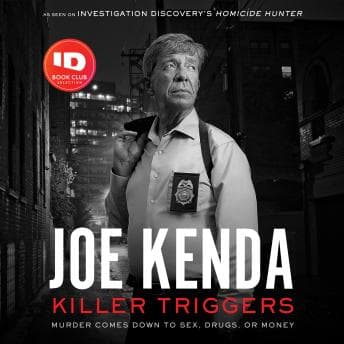

I have a bone to pick with Joe Kenda. Not about the book—we'll get there—but about the fact that this retired homicide detective has basically ruined my ability to watch fictional crime shows. After 200+ episodes of my podcast dissecting horror in every medium, I thought I was immune to being thrown off my game. But there's something about Kenda's deadpan delivery of actual murder cases that makes even the best fictional serial killers feel like they're trying too hard.
And honestly? That's the highest compliment I can give.
The Voice That Haunts Differently
Here's the thing about author-narrated true crime: it can go so wrong. You get someone who lived these cases, who saw the bodies, who knocked on doors at 3 AM—and sometimes they just can't translate that weight to audio. They either overdo it with dramatic pauses or they sound like they're reading a grocery list.
Kenda does neither. His voice is dry. Phlegmatic, even. There's this underlying current of dark humor that surfaces at the strangest moments—like when he's describing the absolute stupidity of a killer's plan, and you can practically hear him shaking his head. Some listeners apparently find this monotone for such dark material. I get it. But I'd argue that's exactly why it works.
Horror isn't about gore—it's about dread. True crime operates on the same principle. Kenda's measured, almost casual delivery makes the horror land harder. When he describes a crime scene, he's not performing shock for you. He's just... telling you what he saw. The tremor that occasionally creeps into his voice? That's not acting. That's a man who still carries these cases decades later.
I listened to most of this during late-night library shifts (yes, I'm that librarian—the one reading true crime at the reference desk while everyone else has gone home). Kenda's voice in an empty library at 11 PM hits different. Shirley was unimpressed when I came home slightly more paranoid than usual.
When the Why Matters More Than the How
The premise here is what grabbed me: Kenda organizing cases by their triggers. Fear. Rage. Revenge. Money. Lust. Madness. It's not a revolutionary concept, but the execution—pun intended, sorry—is what elevates it.
Kenda isn't just cataloging murders. He's doing something most true crime fails at: humanizing the moment before everything breaks. That's the real horror, right? The trigger. The instant where someone crosses from person-with-a-problem to killer. He's not sensationalizing; he's examining. There's a difference.
Some reviewers wanted more connective tissue between the cases. More developmental editing to weave everything into a grander narrative. And yeah, I can see that criticism. The book does feel episodic—you could shuffle some chapters and not lose much. But for audiobook consumption, that structure works. I could pick it up during a commute, put it down, come back a week later without feeling lost.
The pacing relaxes you, which sounds counterintuitive for murder stories. But Kenda's not trying to give you whiplash. He's sitting across from you, coffee in hand, walking you through decades of death with the patience of someone who's told these stories a thousand times and knows exactly which details matter.
The Psychology Beneath the Badge
What I didn't expect—and what my podcast listeners are absolutely going to hear about—is how much this book functions as a psychological profile of Kenda himself. The way he talks about his "joy in solving crimes" isn't celebratory. It's almost defensive. Like he needs you to understand that finding meaning in this work was the only way to survive it.
There's a line in his description about "the demons that lie within our own psyche—the triggers waiting to be pulled." That's not just about the killers. That's Kenda looking in the mirror.
For true crime that actually respects both the victims and the investigator's humanity, this delivers. It's not exploitative. It's not trauma porn. That same restraint shows up in Ice Princess, where the Scandinavian approach to crime fiction prioritizes atmosphere over spectacle. It's a cop who saw too much, trying to make sense of it by sharing what he learned.
Who This Is (and Isn't) For
Skip if you need theatrical narration or can't handle graphic crime details delivered matter-of-factly. But if you want true crime that treats you like an adult and doesn't manipulate your emotions with cheap tricks? Kenda's your guy.
Filed Under: Horror Adjacent
I'm adding this to my "horror adjacent" recommendations. Because the scariest thing about Killer Triggers isn't the murders—it's how ordinary the killers sound when Kenda describes them. These weren't monsters. They were people who hit a trigger.
That's the kind of horror that stays with you.