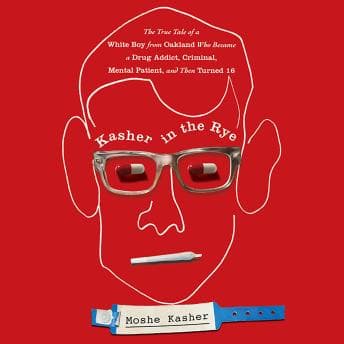

Everyone kept telling me this was a comedy memoir. Hilarious, they said. Laugh-out-loud. And it is — Moshe Kasher is genuinely, dangerously funny. But I finished this book during a late Friday night grading session, red pen frozen mid-stroke, and what I actually felt wasn't amusement. It was something closer to awe at how a kid survives the unsurvivable and still finds a punchline.
Let me be clear about something first: the title is doing a LOT of work. "Kasher in the Rye" — and yeah, my English teacher brain immediately went there, the Holden Caulfield comparison. But Kasher earns it, kind of. Where Salinger gave us disaffected prep school angst, Kasher gives us a deaf mother walking her son around Oakland on a literal leash. A leash he chewed through. At age — what, five? six? The image alone is worth the listen. It's funny and it's devastating and it's both at exactly the same time, which is basically this entire book's operating frequency.
When the Comedian Is the Narrator and the Subject and the Wound
Here's what I didn't expect: Kasher narrating his own memoir works not because he's a polished audiobook performer, but because he isn't one. His comedic timing — the pauses he drops before a dark revelation, the way his voice speeds up when he's describing something genuinely scary like it's a bit he's workshopping — that's not narration technique. That's a stand-up comic's survival instinct translated into prose. The narrator understands that pause is punctuation, but Kasher uses it differently than a trained voice actor would. He uses silence the way comics use it on stage — to let the audience catch up to the horror before he hits you with the joke.
And the drug stuff. Listen, I've taught in Chicago public schools for twenty years. I've watched kids go through versions of what Kasher describes — the escalation from experimentation to dependency, the revolving door of institutions, the adults who are supposed to help but are barely holding themselves together. When he talks about being 12 and already deep into substances, already cycling through mental health facilities, there's no dramatic music, no narrator putting on a Serious Voice. It's just Kasher, talking the way you'd tell a story at a bar to someone you trust. Raw and fast and sometimes uncomfortably casual about things that should probably make you cry.
Oakland as a Character With No Chill
The Oakland sections hit different for me — and I say this as someone who's spent two decades in neighborhoods that polite society drives around. Kasher doesn't romanticize it. He doesn't turn it into a gritty backdrop for his coming-of-age. He describes the war zone of Oakland public schools with the specific, granular detail of someone who actually sat in those classrooms. The white kid in Oakland angle isn't played for easy fish-out-of-water laughs, though there are laughs. It's more complicated than that. It's about belonging nowhere — not white enough for the suburbs his father inhabited, not Black, not fitting any category that would've given him a script to follow.
This reminds me of what Hemingway said about writing — that what you leave out matters as much as what you put in. Kasher's instinct is the opposite. He puts everything in. Every embarrassing detail, every ugly moment. And somehow the excess works because you trust him. You trust that he's not performing vulnerability for applause. He's just... telling you what happened. At eight hours and forty-three minutes, it's compact enough that the relentlessness feels intentional rather than exhausting. Though I'll admit — some listeners find the constant comedy exhausting. If you need your memoirs to breathe, to have quiet reflective passages where the author stares at a lake and finds meaning, this is not that book.
The Ending Problem (And Why I Almost Don't Care)
Here's my honest criticism: the book's final stretch doesn't stick the landing. The falling action feels rushed, like Kasher got to "and then I turned 16" and realized, oh right, the subtitle promised this would end here. The thematic closure — if you can call it that — is more shrug than revelation. My students would recognize this move. It's the kid who writes a brilliant essay and then ends with "So that's what happened." After everything he puts you through, you want more reflection, more of the adult Kasher looking back and making sense of the chaos. You don't really get it.
But here's the thing — maybe that's honest too. Maybe at 16, you don't have a thesis statement for your life. Maybe the absence of a neat bow IS the point. I'm still deciding if I'm being generous or if Kasher actually pulled something sneaky there. (Denise says I'm overthinking it. She's probably right. She usually is.)
Who Gets This Assignment
If you loved Augusten Burroughs' "Running with Scissors" — this is its spiritual successor, but funnier and less polished and somehow more trustworthy for it. Britney Spears' Woman in Me gave me a similar feeling — someone telling their own wreckage with a directness that makes the polished celebrity memoir format look cowardly by comparison. If you teach teenagers, work with teenagers, or remember being a teenager who was pretty sure the world was designed to destroy you specifically — yes. Listen to this. My students would hate this. Actually no — my students would love this. It's the parents who'd hate it. Worth pausing the faculty meeting for, and I say that knowing Principal Martinez is definitely not reading Audiobooks4soul.com.
If you need content warnings: drugs, mental health crises, violence, and language that — as one listener put it — will make you roll up your car windows. Fair warning. But the heart underneath all of it is enormous and beating hard.