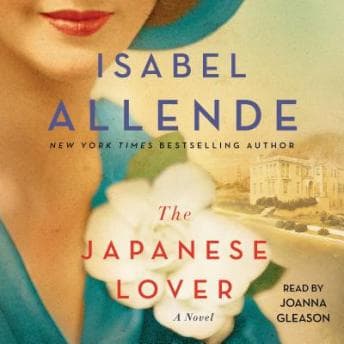

What does it mean to love someone your whole life when the world keeps telling you that love is wrong?
I was working on a wedding invitation suite—all blush pinks and gold foil—when Alma and Ichimei's story started breaking my heart. The irony wasn't lost on me. Here I am designing someone's happily-ever-after while listening to two people who never got to have theirs in the open. Frida was curled up on my keyboard (as usual), and I had to pause the audiobook twice because I couldn't see my screen through the tears.
The Love That Haunted Me for Days
Isabel Allende does this thing where she makes you fall in love with a love story that's fundamentally about loss. Alma and Ichimei meet as children in 1939 San Francisco—she's a Jewish refugee from Poland, he's the son of the family's Japanese gardener. And the way their connection builds is so quiet, so tender. It's not dramatic declarations. It's stolen glances in a garden. Notes passed between hedges. The kind of love that grows in secret because it has to.
Then Pearl Harbor happens, and Ichimei's family gets sent to an internment camp. Just like that. One day they're there, the next they're "enemies." My abuela used to tell me stories about families torn apart—different circumstances, same cruelty. This hit close.
The multigenerational structure works beautifully for the most part. Under the Magnolias uses a similar approach to weave past and present together, though with a Southern setting that feels worlds away from San Francisco. We get Alma as an old woman at Lark House (this wonderfully eccentric nursing home in San Francisco), and her story unfolds through Irina, a care worker with her own ghosts. There's something about watching a young woman piece together an elderly woman's secret love affair that just... ugh. That dynamic of uncovering hidden histories hit me the same way it did in Into the Forest, though that book takes the discovery in a completely different direction. The parallels between their pain. The way trauma echoes across generations.
Where Joanna Gleason Shines (And Where She Fades)
Okay, so here's the thing about the narration. Joanna Gleason is incredible during the historical sections. When she's in WWII Poland or describing the internment camps, her voice carries this weight, this urgency. She made me feel the cold of Alma's journey across Europe, the dust and despair of the camps where Ichimei's family was held. During these parts, I forgot I was designing anything. I just sat there, frozen, listening.
But—and I hate saying this because I genuinely loved so much of her performance—the modern timeline sections lose some of that magic. The pacing drags. Irina's story, while important, sometimes feels like it's pulling us away from what we really want: more Alma and Ichimei. Gleason's energy dips in these sections, and I found myself speeding up to 1.15x (which, for me, is basically sacrilege).
The romance between Irina and Seth, Alma's grandson? It's fine. Sweet, even. But it can't compete with seventy years of forbidden love. How could it?
The Ugly-Cry Moments
I'm adding this to my spreadsheet because yes, I cried. Multiple times. The ending especially—I won't spoil it, but let's just say I was a mess. Mascara everywhere. Diego actually came over to check on me, which never happens because he's the antisocial cat.
There's a letter near the end that Ichimei writes to Alma, and the way Gleason reads it... my heart. MY HEART. It's the kind of love letter that makes you believe in love letters again. In a world of texts and DMs, here's this man pouring his soul onto paper for decades.
Abuela would have loved this one. She would've gasped at the internment camp sections, clutched her rosary during the romantic parts, and definitely cried harder than me at the end. I could almost hear her saying "Ay, mija" when certain revelations hit.
Who Will Love This (And Who Should Skip)
If you love historical fiction with real emotional weight, this is your book. Multigenerational sagas that span continents and decades? Absolutely yes. A love story that's more about longing than consummation, more about what could have been than what was? This will wreck you in the best way.
But if slow pacing makes you antsy, or if you need constant forward momentum, you might struggle with the middle sections. The modern timeline does drag, and there are moments where I wished Allende had trusted us to stay with Alma and Ichimei's past a little longer.
Heads up on content: there's racism (obviously, given the historical context), child abuse, AIDS, and homophobia woven through various characters' stories. Allende doesn't shy away from hard truths.
Still Thinking About It Over My Third Coffee
I finished this audiobook three days ago and I'm still thinking about it. That's the mark of something real, right? The story isn't perfect—the pacing issues are real, and the modern timeline sometimes feels like an interruption rather than an enhancement. But the core love story? The way Allende captures what it means to love someone across an entire lifetime, through war and prejudice and impossible circumstances?
That stays with you.
Listen to this on a rainy afternoon when you have nowhere to be. Keep tissues nearby. And maybe don't be working on wedding invitations, because the contrast will absolutely destroy you.