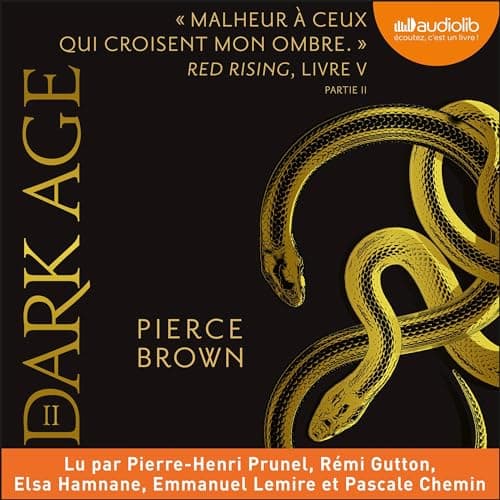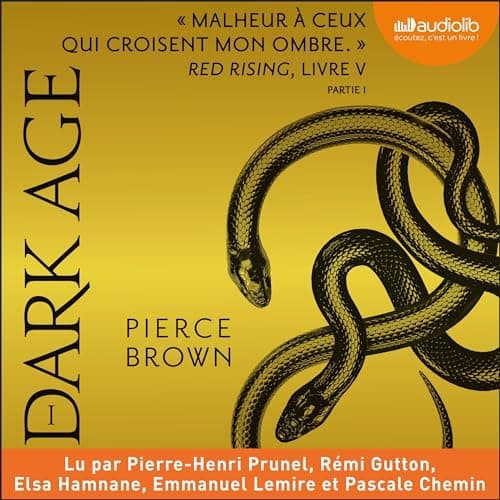

What happens when a revolution wins but nobody feels free?
I was signing for a client at a tech accessibility summit downtown, hearing aids cranked, captions running on my phone in my pocket between sessions, when Darrow's opening lines hit me through the bone conduction of my hearing aids. «Je ploie sous le fardeau du chaos que j'ai déchaîné.» I carry the burden of the chaos I unleashed. And I thought — yeah, Pierce Brown gets it. Victory is just the beginning of a different kind of suffering. That same weight of hard-won revolution curdling into something darker runs through Discovery of Witches too — different world, same reckoning with what it costs to upend an old order.
Four Voices, Four Volume Knobs
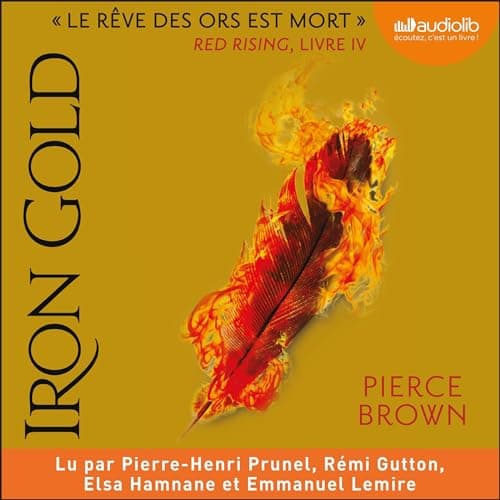
Here's where I need to be brutally honest. The polyphonic narration concept — four narrators, four POV characters — is exactly the kind of ambitious audio design I champion as a consultant. Each narrator owns a character: Pierre-Henri Prunel stays locked in as Darrow, Rémi Gutton takes Lysander, Elsa Hamnane voices Lyria, Emmanuel Lemire handles Ephraïm. On paper? Chef's kiss for accessibility. You never lose track of whose head you're in.
In practice? The volume equalization between narrators is a mess. As a hard-of-hearing listener this hit different — and not in a good way. I had to adjust my hearing aid settings almost every time the POV switched. Driving with this would be genuinely dangerous. Sitting still with it requires patience. The production team either didn't master the tracks together or didn't care enough to normalize levels across the four recordings. That's not a narrator problem. That's an engineering failure, and it's the kind of thing that makes me want to write angry emails to audio directors at 2 AM.
Prunel Performs, Gutton Recites
Pierre-Henri Prunel continues to be the anchor of this French production. His Darrow carries ten years of war weariness in the grain of his voice — there's a rasp, a heaviness that wasn't there in earlier installments. This narrator actually performs, not just reads. You hear the guilt. You hear the stubbornness of a man who can't stop fighting even when the cause has outgrown him.
Rémi Gutton as Lysander, though — and I say this with no pleasure — sounds like someone reading a philosophy dissertation at a podium. The character is supposed to be an exiled Gold, aristocratic and calculating, sure. But there's a difference between performing aristocratic detachment and just... sounding detached. Gutton's delivery is flat where it should be cold, monotone where it should be precise. Lysander's sections became the ones where I'd check my caption sync because I kept losing the emotional thread through audio alone.
Elsa Hamnane's Lyria is the most divisive element and I get it both ways. She goes big — really big — with the emotional swings. Lyria is a Red who got "freed" and found freedom to be its own kind of cage, and Hamnane leans hard into that rawness. Some listeners call it melodramatic. I call it a performance choice that mostly works, especially in her early chapters where Lyria's naivety and anger are at war with each other. But she doesn't always modulate. The emotional layers come through even without sound in the text, yet Hamnane sometimes pushes so hard she flattens them into one register: loud anguish. Lyria's quieter moments of realization needed space to breathe.
Emmanuel Lemire's Ephraïm is solid, maybe the most consistent of the new additions. There's a wry bitterness to his delivery that fits the mercenary archetype without tipping into caricature.
21 Hours at 1.25x? Yeah, Probably
At natural speed, this drags. Brown's prose in Iron Gold is denser than the first trilogy — more political, more introspective, fewer arena fights and more committee rooms. The pacing asks for patience. At 1.25x, the narrator performances actually tighten up. Gutton sounds less like he's lecturing. Hamnane's peaks feel more natural. Prunel barely changes because he was already calibrated right. Clarity over speed — always — but in this case, a slight speed bump serves clarity.
Who Should Listen (And Who Should Skip)
If you loved the first Red Rising trilogy and want to see what revolution costs the revolutionaries, this rewards your commitment — but you're trading momentum for political depth. If you listen primarily while driving or doing anything that prevents manual volume adjustment, skip this version until they fix the production. And if inconsistent narrator quality across POVs frustrates you more than it intrigues you, the single-narrator English version might serve you better.
Bottom Line: Close, But Not Gold
The four-narrator structure is accessibility done right in concept — instant POV identification without needing visual chapter headers. But the volume inconsistency undermines everything. Caption sync was perfect on my end, which saved the experience more than once. I wish the audio engineering matched the ambition of the narrative design. Prunel alone would've earned this a higher mark. The production gaps pull it down to something I'd stream rather than spend a credit on. Fix the levels, equalize the masters, and you'd have something worth owning.