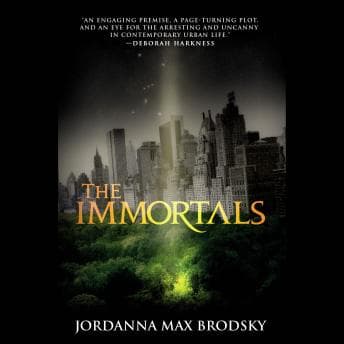

I was sitting in the kitchen at quarter past eleven, Denise already asleep, half a stack of sophomore essays on The Odyssey still ungraded beside me, when Selene DiSilva found a mutilated body on the banks of the Hudson. And I thought: well, this is going to be a different kind of homecoming story.
Brodsky's Immortals grabbed me in that moment because it does something I rarely see done well — it takes the Greek pantheon and drops them into modern Manhattan without turning the whole thing into a costume party. Selene is Artemis, fading, losing her divine power century by century, living alone in a Harlem apartment like some retired boxer who still shadow-boxes at dawn. She's not the gleaming goddess from your mythology textbook. She's weathered. Bitter. Still dangerous, but diminished. And that tension — between who she was and who she's becoming — is the real engine of this book.
When the Goddess Won't Let You Like Her (And Why That's the Point)
Here's where I have to address the elephant in the room. A lot of listeners bounced off Selene because she's cold. One-note. Unlikeable. And look — I get it. She's not warm. She doesn't crack jokes. She doesn't have a charming sidekick energy. But here's what I keep coming back to: she's Artemis. The virgin huntress who turned a man into a stag for seeing her bathe. She's not supposed to be your best friend.
This reminds me of what Hemingway said about writing characters — you don't have to like them, you have to believe them. And I believed Selene completely. The scenes with her sick mother Leto and her twin brother Apollo — who's gone full bohemian musician in this version, by the way — those family dynamics carry real weight. There's a moment where Selene realizes she's losing not just her powers but her ability to connect to the people who knew her when she was something more. That hit me somewhere around hour six, and I had to stop grading entirely.
But I'll be honest with my 47 podcast listeners and whoever's reading this: if you need your protagonist to be likeable in the first three hours, you're going to struggle. Selene earns your investment slowly. Like Middlemarch slowly. (Principal Martinez, that's not a faculty meeting reference. Definitely not.)
An Author Reading Her Own Gods
So Brodsky narrates her own book, and this is where it gets interesting. Author-narrated audiobooks are a gamble — for every Neil Gaiman there's someone who writes beautifully but reads like they're ordering sandwiches. Brodsky lands somewhere genuinely good. She knows these characters from the inside, and you can hear it. Her Selene has this low, guarded quality that fits the character's emotional armor. The differentiation between characters is subtle — tone shifts rather than full-on voice acting — but it works for this kind of story. You're not listening to a performance so much as an interpretation.
Robert Petkoff handles some of the narration too, and the split gives the book a nice rhythmic variety across sixteen hours. The emotional scenes — particularly anything involving Selene's fading immortality and what it means to watch your family lose what made them gods — those land with real conviction in Brodsky's delivery.
Is it great narration? It's good. Really good for an author performance. But if you're someone who needs distinct vocal fireworks for every character, you might want more. The narrator understands that pause is punctuation, and Brodsky uses silence well. I just wish she'd pushed harder in a few of the action sequences, which sometimes feel a half-beat too measured.
The Mythology Homework You Actually Want to Do
Brodsky's Harvard background shows — not in a showy way, but in the details. The mystery plot involves ancient Eleusinian rites, and she doesn't dumb it down. She trusts you to keep up. The pagan ritual elements are specific and researched, and the way she maps the Greek divine hierarchy onto modern New York power structures is genuinely clever. Gods as fading immigrants in their own city. There's something there.
If you loved Madeline Miller's Circe, this is its spiritual successor — but darker, more urban, more murder mystery than literary meditation. My students would hate the pacing. I love it. It's a slow burn that rewards patience, and at sixteen hours, you need to commit. This is not a background listen. I tried during a faculty meeting once and lost the thread of both the plot and the quarterly budget review.
Who Gets an Invitation to Mount Olympus
Classics lovers who want their mythology with grit and a body count. Mystery readers who don't mind their detective being a literal goddess. Anyone who's ever wondered what happens to a god when nobody prays anymore. Skip it if you need fast pacing or a protagonist who smiles before chapter ten. That said, if you can handle a story that makes you work for every emotional payoff, Storm of Swords operates on the same patient, brutal logic — no one smiles much there either, and it's one of the most rewarding sixteen-hour commitments I've ever made to a piece of fiction.
The Annotation in the Margin
This is why we still read the classics — because someone like Brodsky can crack them open and find something new inside. Immortals isn't perfect. It asks for patience it doesn't always earn, and Selene's emotional register could use another gear or two. But the central question — what does a god owe the world that forgot her? — that's worth every one of those sixteen hours. The prose deserves to be savored. I'll be starting the sequel next week, probably during another budget presentation.