
What happens when a writer reads their own work aloud—and you're not sure if it's revelation or punishment?
I was grading sophomore essays on Mrs. Dalloway at 11 PM, which is exactly when you shouldn't start listening to a novel that's essentially a love letter to Woolf. But Denise was asleep, the lakefront walk wasn't happening, and I had forty-seven papers about "the symbolism of flowers" still to mark. So I put on The Hours.
And here's the thing. Cunningham reading Cunningham is either brilliant or maddening, depending on how much you trust an author to perform their own prose.
The Author Hears What We Cannot
There's a listener quote that stuck with me: "Hearing a book the way an author hears it is an interesting experience." That's the most diplomatic phrasing I've encountered. Because Cunningham doesn't read like a narrator. He reads like a poet at a lectern—slow, deliberate, with the kind of pauses that make you wonder if your Bluetooth disconnected.
The rhythm is genuinely unusual. His sentences in The Hours are already long, winding things that circle back on themselves the way Woolf's do. Hearing him read them, you realize he wrote these sentences to breathe a certain way. The pacing isn't wrong—it's intentional. But intentional doesn't always mean comfortable.
I'll be honest. Around hour two, I caught myself grading faster just to have something to do with my hands. The narration demands a kind of patience I don't always have at 11 PM.
Three Women, One Voice—And That's the Problem
Here's where author-narration gets complicated. We have Virginia Woolf in 1920s London, Laura Brown in 1950s LA, and Clarissa Vaughan in contemporary New York. Three women across three timelines, their stories braiding together like—well, like something Woolf would write.
Cunningham's voice doesn't really differentiate them. Not the way a trained narrator would. You don't get distinct tones for Virginia's fragile intensity versus Laura's quiet desperation versus Clarissa's party-planning anxiety. It's all filtered through one authorial consciousness.
Some listeners called this "awful." Others found it revelatory. I'm somewhere in between. That same authorial intimacy—though in a completely different register—shows up in Neon Gods, where the narrator's closeness to the characters creates its own kind of intensity. There's an intimacy to hearing the author's empathy for these characters—you can feel how much he loves them, how carefully he's considered their interior lives. But when you're trying to track three parallel narratives, that sameness becomes genuinely difficult.
My students would hate this. They want clear signals. They want to know who's talking. Cunningham gives you something more ambiguous—the sense that all three women are, in some essential way, the same woman. The narration reinforces that thematically. Whether that's worth the confusion is a personal calculation.
When Prose Becomes Poetry (For Better and Worse)
At six hours and sixteen minutes, this is a slim novel performed at a meditative pace. Cunningham reads like he's giving a poetry reading, and honestly? Some passages deserve that treatment. His language is gorgeous. The way he describes Virginia Woolf beginning to write Mrs. Dalloway—the tentative first sentences, the terror of the blank page—lands differently when you hear the author's own breath behind it.
But poetry readings require focus. This is not background listening. This is not grading-papers listening, despite my attempt. I found myself rewinding sections because I'd drifted, because the narration doesn't grab you back the way a professional performance might.
No production trickery here. No music, no effects. Just Cunningham's voice and Cunningham's words. Pure in a way that feels almost old-fashioned.
Who Should Brave This, and Who Should Run
If you love Woolf—really love her, not just survived her in grad school—this audiobook offers something rare: a Pulitzer-winning novelist interpreting her influence through his own voice. There's genuine literary value in that experience.
If you want a crisp, engaging performance that makes the three timelines easy to follow? Read the print edition. Or wait for a different audiobook version if one ever exists.
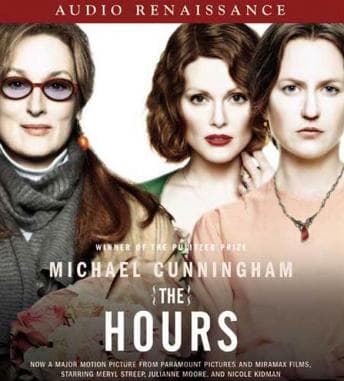
If you've seen the film with Meryl Streep and Nicole Kidman, you already know the emotional architecture. The audiobook won't give you their performances. It gives you something stranger and more intimate—the author alone in a room, reading the book he hears in his head.
The Bell Rings, Class Dismissed
I finished The Hours at 1 AM, essays half-graded, thinking about Virginia Woolf walking into a river and Cunningham's voice describing it with such tenderness I had to pause.
This is why we still read the classics—and why we read the books that love them. But the audiobook version is a specific experience. Demanding. Sometimes frustrating. Occasionally transcendent.
The prose deserves to be savored. Whether Cunningham's voice is the right vessel for that savoring depends entirely on your patience and your devotion to authorial intent. I'm glad I listened. I'm not sure I'd recommend it to anyone but my most literary-minded colleagues.
Principal Martinez would definitely fall asleep. But then again, so does my mom during my Faulkner episodes, and she still claims to be proud.