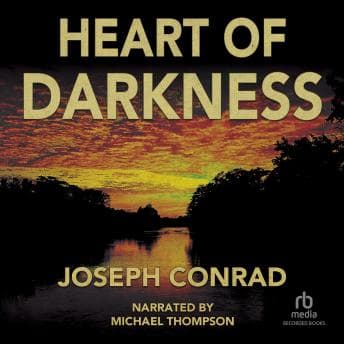

I was making my mother's rajma recipe at midnight — the kind of elaborate, meditative cooking that requires you to stand over a pot and stir and think about your life choices — when Marlow started describing the Company offices in Brussels. The two women knitting black wool in the waiting room. And I stopped stirring because I recognized what Conrad was doing. He was giving us a psychological intake assessment disguised as a travel narrative. Every person Marlow meets before he even reaches Africa is a diagnostic marker. The doctor who measures his skull. The aunt who speaks of "weaning those ignorant millions from their horrid ways." This is a fascinating case study in how an entire civilization constructed a mythology of benevolence around systematic brutality — and how one man slowly watches that mythology collapse.
At 4 hours and 20 minutes, this is a short listen. Don't let that fool you. Conrad packs more psychological density per sentence than most authors manage in 400 pages. And that density is both the gift and the problem in audio format.
The Darkest Character Study Ever Written (And I Mean That Literally)
Let me be direct about what this book actually is, psychologically speaking. Marlow's journey upriver isn't adventure fiction. It's a prolonged exposure to moral disintegration. The protagonist exhibits classic patterns of cognitive dissonance — he works for the Company, he sees what the Company does, and he spends the entire narrative trying to reconcile those two facts. What makes this character compelling is that he never fully succeeds. He doesn't have some tidy epiphany. He just... accumulates horror.
And then there's Kurtz. Oh, Kurtz. The research actually shows that people who are granted unchecked authority in isolated environments don't gradually become monsters — they reveal what was always possible. Kurtz isn't an aberration. He's an endpoint. Conrad understood this in 1899, a solid century before the Stanford Prison Experiment and Abu Ghraib. The line "the horror, the horror" gets quoted endlessly by people who haven't read the book, but hearing it in context — after hours of Marlow's winding, evasive narration building toward this man — it lands differently. It's not dramatic. It's diagnostic.
Michael Thompson's Voice and the Problem of Dense Prose in Your Ears
Here's where I have to be honest. Thompson has a sonorous, brooding quality that genuinely fits Marlow's narration. His voice sounds like a man sitting on a boat at dusk telling you something he wishes he could forget. The tone shifts between Marlow's present-tense storytelling voice and his remembered experience are subtle but real — you can hear when Marlow is editorializing versus when he's reliving.
But. And this is a significant but.
Conrad's prose is already a challenge on the page. Sentences that loop back on themselves, triple-nested clauses, ideas that arrive sideways. I had a related but opposite experience with Anna Karenina (Dole translation), where the translator's choices actually smoothed Tolstoy's syntax into something almost too comfortable — you stop feeling the original's weight. Some listeners have described this audiobook as feeling like listening to a foreign language they mostly but not entirely understand, and psychologically, this doesn't track as a narrator failure — it's a Conrad problem amplified by the audio format. Your eyes can re-read a sentence. Your ears cannot. Thompson doesn't rush, which is the right choice for this material, but his deliberate pacing means you're processing complex Victorian syntax at a speed that can feel glacial if your attention drifts for even thirty seconds.
I found myself asking: why does this narration work for some people and completely alienate others? And I think it comes down to whether you've read Heart of Darkness before. If you know the architecture of the story, Thompson's performance becomes atmospheric and immersive. If you're coming in cold, you might drown in it.
My recommendation — and I say this as someone who has taught Conrad in seminars — bump it to 1.25x. It tightens the pacing without losing Thompson's tonal quality, and it helps your brain keep up with the syntax.
Who Will Survive This River Trip
This audiobook is for you if: you want literature that treats colonialism not as backdrop but as psychology, you've read the text before and want to experience it aurally, or you're the kind of person who listens with focus and doesn't mind rewinding. It's a dedicated-listening book. Do not attempt this while driving through Connecticut. You will miss Kurtz entirely and end up in Rhode Island confused.
Skip this version if: you need distinct character voices (Thompson keeps things close to Marlow's perspective, which is faithful to the text but means other characters blur together), you want something that moves with urgency, or dense 19th-century prose gives you a headache even in print.
My Therapist Would Have Thoughts About Marlow
Here's what stays with me, stirring rajma at 1 AM with my headphones in: Conrad wrote a story about a man who witnesses atrocity, returns home, and lies about it. Marlow tells Kurtz's fiancée that his last word was her name. It wasn't. And that lie — that choice to protect comfortable European ignorance rather than speak truth — is the real darkness. Not the jungle. Not Kurtz. The willingness to look away.
The human mind has patterns. Conrad mapped one of the most disturbing ones over a century ago. Thompson's narration serves the text with quiet, steady gravity. It's not a perfect audiobook experience — the density-to-audio translation has real friction — but the source material is so psychologically rich that even an imperfect delivery carries weight.
Just don't try to multitask. Conrad demands your full attention. He earned it.









