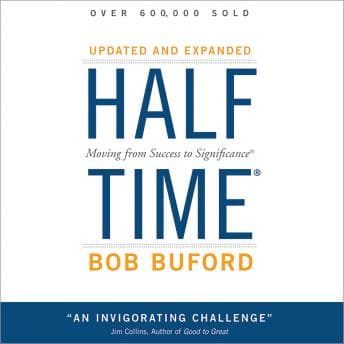

"The first half of life is a quest for success; the second is a quest for significance."
I listened to most of this on a long Sunday cook - the kind where you're making dal from scratch and have three hours to kill. Which, in retrospect, was either perfect or deeply ironic, because Buford's whole argument is that at some point, you stop optimizing and start asking what any of it is for. I was optimizing a lentil recipe. He was asking me to examine my soul. We met somewhere in the middle.
For context: I'm not Buford's target demographic. He's writing for successful mid-career professionals - think cable TV executives, which is literally what he was - who've hit their forties, checked all the boxes, and feel an unsettling suspicion that the boxes were wrong. I'm a thirty-something academic who reads psychological case studies for fun and eats elaborate meals alone by choice. But here's the thing about good self-help: if the underlying psychology is sound, it crosses demographic lines. And Buford's core insight actually holds up.
The Psychological Argument Buried Inside the Business Metaphor
Buford frames midlife not as crisis but as halftime - a pause between two distinct games with two distinct objectives. The first half: accumulation, achievement, external validation. The second half: meaning, contribution, legacy. This is not a new idea. Erik Erikson mapped this exact tension in his stages of psychosocial development - generativity versus stagnation, if you want the technical term. What Buford adds is a practical framework for actually doing something about it, rather than just naming the feeling.
What makes this character - and Buford is very much a character in his own book - compelling is that he doesn't pretend the transition is easy or that significance is some vague spiritual upgrade. He lost his son. He walked away from a lucrative business trajectory. The grief and the cost are present in the text, and they give the framework weight it wouldn't otherwise have. I found myself asking: why does this book feel different from the usual midlife reinvention genre? And I think it's because Buford isn't selling you a fantasy. He's selling you a reckoning.
The explicitly Christian framing is real and you should know going in. Buford's version of significance is specifically about serving God's purposes, not just "giving back" in the secular sense. The research on meaning-making actually shows that having a transcendent framework - religious or otherwise - significantly strengthens the psychological shift he's describing. So even if you're not Christian, the underlying mechanism is valid. But if religious language actively puts you off, about forty percent of this book will feel like it's not talking to you.
Max Bloomquist and the 5h 38m Question
Here's my honest assessment of the narration: it's fine. Bloomquist reads with calm authority, which suits Buford's reflective, mentor-ish tone. Nothing about the performance distracted me or made me want to switch to text, which is genuinely the baseline requirement for self-help narration. But nothing about it elevated the material either. No particular moment where his delivery made an idea land harder than it would on the page. For a book this meditative, I'd have wanted a narrator with a bit more texture - someone whose voice itself communicates the weight of a life examined. Bloomquist is competent. The content deserves slightly more.
At under six hours, this is not a long commitment. I'd actually recommend 1.25x for most of it - Buford's prose is clear and unhurried, and the extra pace keeps the momentum without losing anything.
Who This Is Actually For (And Who Should Skip It)
If you are: professionally successful by conventional metrics, somewhere between 40 and 60, vaguely Christian or at least not hostile to it, and sitting with a nagging sense that you've been optimizing for the wrong thing - this book was written for you specifically. Buford is basically your older mentor who's already done the thing you're scared to do.
If you are: younger and still figuring out your first half, or you want psychological depth without religious scaffolding, or you need the research citations to trust the framework - you'll find this too anecdotal and too faith-specific. Try something in the Erikson-adjacent lane instead.
My therapist would have thoughts about Buford's halftime model - probably something about how the binary of "success then significance" risks devaluing the first half entirely, and whether that framing creates unnecessary shame. She'd be right to push on it. But as a map for people who feel genuinely stuck at the midpoint, it's more useful than most maps I've seen. The same quiet reckoning with what a life is actually adding up to runs through Every Day, though it arrives through a much stranger premise.