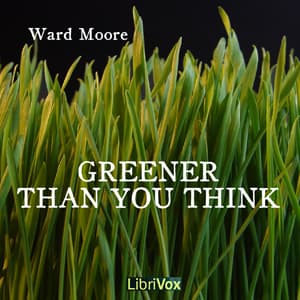

A 1947 novel about killer crabgrass destroying civilization shouldn't feel this relevant in 2024.
I started this one on a Monday morning, 6:12 AM, standing room only on the Caltrain because some genius decided to run single-car service. I was tired, cranky, and looking for something weird enough to keep me conscious. Ward Moore's Greener Than You Think delivered on weird. Whether it delivered on everything else... let's debug this.
The Premise Is Basically a Git Merge Conflict That Destroys the World
Here's the setup: a pushy, self-aggrandizing salesman named Albert Dodd teams up with a broke scientist who's invented a chemical that supercharges plant growth. They test it on a patch of Bermuda grass. The grass doesn't stop growing. Ever. It consumes lawns, then neighborhoods, then cities, then continents. It's basically the "this is fine" meme stretched into a 14-hour apocalypse.
The satire is the real payload here. Moore wrote this in 1947 and somehow perfectly predicted our modern cycle of crisis response: denial, blame-shifting, grifting, performative concern, more denial. Albert Dodd is narrating his own story, and he is - and I cannot stress this enough - an absolutely insufferable human being. He watches civilization crumble and his primary concern is whether he can monetize the situation. He's every founder who pivots to "disaster tech" during a pandemic. The social commentary is sharp, and the low-key humor lands in that dry, mid-century way where you're chuckling at the absurdity before you realize Moore is actually furious underneath.
But - and this is a big but - the 1947 prose style is dense. We're talking long, winding sentences full of flowery Victorian-adjacent language that Moore uses partly for satirical effect (Dodd is pretentious and his narration reflects that) and partly because... that's how people wrote in 1947. By hour 6, I caught myself zoning out during particularly ornate passages, and I'm someone who finished Anathem without blinking. The pacing is genuinely slow. The grass spreads in real time, and so does your patience.
Lee Elliott's One-Accent Show
Okay, the narration situation. Lee Elliott reads clearly, enunciates well, and captures the deadpan humor of Dodd's oblivious self-narration pretty effectively. You can hear the smug self-satisfaction dripping off every sentence Dodd delivers, which is exactly right for the character.
The problem: every single character sounds Southern. The scientist? Southern. The military general? Southern. Random New Yorkers? Also Southern. It's a LibriVox recording, so my expectations were calibrated accordingly, but when your story features dozens of characters across the entire country responding to an apocalypse and they all sound like they're ordering sweet tea at the same diner in Alabama, it flattens the world-building. You lose the class distinctions that are central to Moore's satire - Dodd's social climbing, the contrast between scientists and politicians, the media circus. It all blurs together vocally.
This is NOT a Ray Porter situation. (If Ray Porter narrated this, the Dodd character alone would be worth the listen - imagine that smug, slightly nasal voice he does so well. I'm getting emotional just thinking about it.) Elliott is competent and clear, but this story needed more vocal range to land its satirical punches.
Who Should Brave the Grass
If you love eco-horror with satirical teeth - think The Day of the Triffids meets a Jonathan Swift essay about Silicon Valley - this scratches an itch that very few books can reach. Moore was doing cli-fi seventy years before we had a name for it, and Dodd is a genuinely memorable unreliable narrator. Atwood's MaddAddam scratches a similar itch - ecological collapse filtered through deeply unreliable, self-interested human narrators - and if the satire here is clicking for you, that trilogy's conclusion is worth the investment. The surprise ending apparently hits hard for people who make it there.
Skip if: you need pacing faster than actual grass growing, you listen at commute speed and can't dedicate real focus, or uniform narrator voices will pull you out of the story. At 14 hours, the ROI on this audiobook is lower than I'd like - there's maybe 8 hours of excellent satire buried in 14 hours of period prose.
Perfect for: focus listening, maybe a long flight. Skip for: train, gym, anything where your attention splits. I bumped it to 1.5x by hour 3 and honestly should've gone 1.75x.
Commit Message: "Interesting Artifact, Imperfect Port"
Ward Moore wrote something genuinely ahead of its time. The concept is killer, the satire still cuts, and Dodd is the kind of narrator you love to hate. But this specific audio version - free LibriVox recording, single narrator doing one accent for all of humanity - is more like reading the source code than running the polished app. I'm glad I listened. I wouldn't listen again. And I really, really wish someone would give this book the full production treatment it deserves.