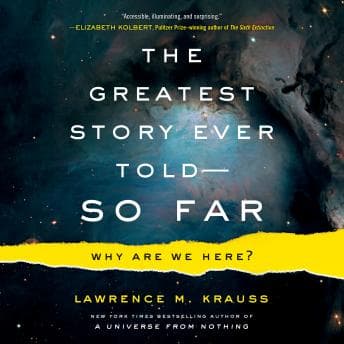

What happens when a theoretical physicist who genuinely believes he's telling the greatest story ever told... is also the one reading it to you at bedtime pace?
I picked this up because I'd burned through Krauss's A Universe from Nothing last year and loved the ambition of it — the audacity of a physicist trying to answer "why is there something rather than nothing" in under 6 hours. So when I saw Greatest Story Ever Told — So Far sitting in my library, I figured it'd be a natural sequel. And it kind of is. But it's also a very different beast, and your mileage will vary dramatically depending on how much quantum field theory you can absorb while a stranger's elbow is in your ribs on the 6:47 AM Caltrain.
The Physics Is Real, the Pacing Is... Patient
TL;DR: Worth your commute, but only if you bump the speed and bring your A-game brain.
Krauss is tracing the arc of modern physics — from Maxwell's equations through symmetry breaking to the Higgs boson — and he's doing it chronologically, which means you spend a LOT of time in the early 20th century before you get to the payoff. The structure reminded me of reading through a really well-commented legacy codebase: you can tell the author cares deeply about every function, every historical commit message, every contributor. But sometimes you just want to skip to the part where the tests pass. The pacing tension between depth and momentum reminded me of something I noticed reading On the Origin of Species — another book written by a true believer who assumes you're as patient with the argument as he is.
The science actually holds up. Like, genuinely. Krauss doesn't dumb things down the way pop-sci books often do — he walks you through gauge symmetry, spontaneous symmetry breaking, and the Standard Model with real conceptual depth. If you've ever wanted to understand why the Higgs field matters beyond "the God particle" headline bait, this is your book. But that depth comes at a cost: there are stretches in the middle — particularly around the development of quantum electrodynamics — where the density ramps up and you absolutely cannot be half-asleep. I had to rewind three times during one commute because I zoned out somewhere between Dirac and Feynman and suddenly Krauss was talking about renormalization like I'd been following along. I had not been following along.
Author-as-Narrator: A Feature and a Bug
Here's the thing about author-narrated science books — they're basically a live lecture from someone who's been thinking about this stuff for 40 years. Krauss sounds like a professor who genuinely loves his subject and occasionally forgets he's supposed to be telling a story, not giving a colloquium. His delivery has this warm, almost conspiratorial quality, like he's letting you in on the secrets of the universe over coffee. That part's great.
The part that's less great: the pacing. Oh, the pacing. At 1x speed, this book feels like it's running on a single-threaded processor with no optimization. I bumped to 1.5x pretty quickly and honestly should've gone to 1.75x for some of the more polemic-heavy sections where Krauss pivots from physics to editorializing about science vs. religion. Those tangents aren't bad exactly — he's a passionate advocate for empiricism — but they pull you out of the physics narrative and into territory that feels more like a TED talk sidebar.
Compared to A Universe from Nothing, this one's more ambitious in scope but less focused in execution. The earlier book had a cleaner thesis: here's why something from nothing isn't crazy. Greatest Story is trying to be a history of physics, a philosophy of science, and a personal manifesto simultaneously. It's basically A Brief History of Time but for the Standard Model, with more personality and more opinions.
Who Gets ROI Here (And Who Doesn't)
Perfect for: dedicated listening sessions where you can actually focus. Maybe a long flight, or a weekend where you're coding something mindless and want background-level physics.
Skip for: bedtime. Unless you want to dream about gauge bosons. Actually, skip for the gym too — you need too much cognitive bandwidth for this to work alongside deadlifts.
If you're a physics enthusiast who already knows the difference between the strong and weak nuclear forces, the ROI on this audiobook is solid — Krauss connects dots between historical developments in ways that gave me genuine "oh THAT'S why" moments. If you're coming in cold with no physics background, this might break you somewhere around hour 5. It's not that Krauss is bad at explaining — he's actually quite good — but the cumulative complexity stacks up like technical debt, and by the time he gets to the Higgs mechanism, he's referencing concepts from four chapters ago.
I finished this in about 5 commutes at 1.5x, plus one Saturday morning coding session. Would I relisten? Probably not the whole thing. But chapters 8 through 12 — where he gets into electroweak unification and the experimental confirmation at CERN — those I might revisit. That's where the "greatest story" part actually earns its title.
The Commit Message
Krauss wrote a love letter to physics and then read it aloud to you himself. It's sincere, it's dense, and it's occasionally slow enough to test your patience. But when it clicks — when you finally grok why symmetry breaking matters, or why empty space isn't actually empty — it's the kind of understanding that makes your commute feel like it was worth something beyond just getting to Mountain View. Not his best work, but not a skip either. Just bring caffeine and set your playback speed accordingly.








![Steve Jobs [unabridged audiobook] audiobook cover](/_next/image?url=https%3A%2F%2Fcovers.audiobooks.com%2Fimages%2Fcovers%2Ffull%2F9788499923406.jpg&w=1920&q=75)