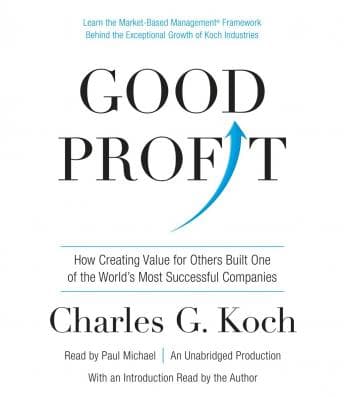

I was halfway through a batch of dal makhani — the kind that needs you to stand there stirring for forty minutes or it'll punish you — when Charles Koch started explaining why Koch Industries doesn't do five-year strategic plans. And I found myself asking: why does a man worth tens of billions feel the need to convince me he's earned it ethically? That question carried me through all nine hours and fifteen minutes of this audiobook. It also made the dal burn. Worth it? Debatable.
The Psychology of "Good" Profit (and the Need to Define It)
Let me be direct. This is a fascinating case study in self-narrative construction. Koch frames his entire management philosophy — Market-Based Management, or MBM — as a moral framework, not just a business one. "Good profit" versus "bad profit." The distinction matters to him deeply: good profit comes from creating real value for customers, bad profit comes from cronyism, subsidies, corporate welfare. He's remarkably insistent on this point, returning to it again and again like someone who knows a significant portion of his audience has already made up their minds about the Koch name.
The protagonist exhibits classic motivated reasoning patterns here. Koch wants you to see Koch Industries as a principled enterprise built on voluntary exchange and mutual benefit. And look — some of this genuinely tracks. The discussion of how Koch Industries empowers employees to act like entrepreneurs within the company, giving decision rights based on demonstrated comparative advantage rather than title, is legitimately interesting organizational psychology. The research actually shows that autonomy and competence are core drivers of intrinsic motivation (hello, self-determination theory), and Koch articulates a version of this that predates its mainstream popularity.
But the book struggles with its own contradictions. Koch spends significant time denouncing corporate welfare and government favoritism while leading a company that has, shall we say, a complicated relationship with political spending and lobbying. He doesn't ignore this entirely — there are acknowledgments — but the treatment is thin. Psychologically, this doesn't track as fully honest self-examination. It reads more like managed disclosure.
Nine Hours of Framework, Light on Surprise
Here's where the listener complaints land, and I mostly agree with them. If you've read Koch's earlier book The Science of Success, you'll recognize a lot of the core material here. The five dimensions of MBM — vision, virtue and talents, knowledge processes, decision rights, incentives — are laid out systematically, almost textbook-style. Which is both the book's strength and its biggest problem.
It's dense. Not in a rewarding way, like reading Kahneman, where density rewards attention. Dense in a corporate-training-manual way, where you get the principle, then the example, then the restatement, then another example. By hour six, I was stirring nothing and still felt like I was stirring. Some listeners have called it a slog, and I wouldn't argue with that characterization — though I'd soften it to "demanding without adequate emotional payoff." The anecdotes from Koch Industries' history (acquisitions, pivots, failures) are the best parts, grounding abstract principles in actual decisions. But there aren't enough of them relative to the framework exposition.
The book is also oddly self-congratulatory for something that claims humility as a core value. Koch repeatedly positions MBM as the reason for Koch Industries' extraordinary growth from a $21 million company to one worth over $100 billion. And maybe it is! But the absence of serious engagement with luck, timing, market conditions, or the advantages of being privately held (no quarterly earnings pressure, no activist shareholders) — that silence is loud.
Paul Michael Carries the Weight
Koch himself narrates only the preface, and honestly, that's the right call. His delivery is earnest but flat — the voice of a man who thinks in frameworks, not stories. Paul Michael takes over for the main content, and his voice is comfortingly authoritative in exactly the way a business audiobook needs to be. He doesn't make the material exciting — I'm not sure anyone could — but he makes it listenable across nine-plus hours. No weird pronunciations, no stumbles that I caught. Just steady, professional narration that doesn't get in the way.
The dual-narrator structure is barely a structure, though. Koch's preface runs maybe fifteen minutes. So if you're buying this expecting some kind of alternating perspective between the founder's voice and a professional narrator, temper that expectation. It's essentially a single-narrator book with an author cameo.
Who This Is Actually For (And Who Should Run)
If you're a mid-career manager looking for a management philosophy that goes beyond quarterly metrics, there's genuine utility here. The emphasis on hiring for values alongside talent, on structuring incentives around value creation rather than seniority — that's actionable stuff. Business school students could benefit too, if only as a counterpoint to whatever case studies they're drowning in.
But if you've read The Science of Success, you can skip this. The overlap is significant enough that several listeners describe it as a repackaging, and I can see why. And if you're coming to this with strong political opinions about the Koch family — in either direction — this book probably won't change your mind. Koch doesn't engage with that conversation in any meaningful way.
At 1.25x speed, the pacing felt much more natural. Just saying.
My Clinical Assessment
I found myself treating this less like a management book and more like a psychological document — a billionaire's attempt to construct a coherent moral narrative around immense wealth and power. On that level, it's genuinely interesting. As practical business advice, it's solid but overlong and under-edited. As an audiobook experience, Paul Michael saves it from being a chore, but he can't save it from being... well, a lot. My therapist would have thoughts about a man who builds an entire management philosophy around the word "good" and then names the book after it.