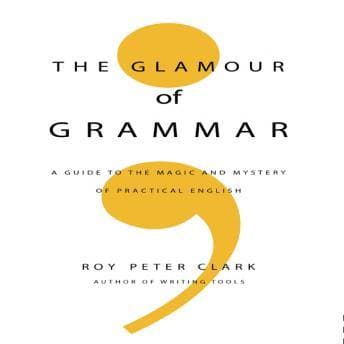

"Grammar and glamour were once the same word."
I stopped grading papers when Clark dropped that line. Set down my red pen and just sat there. Twenty years teaching English, and I'd never made that connection. The etymology geek in me was absolutely delighted - both words trace back to the Scottish "gramarye," meaning occult learning and magic. Somewhere along the way, we stripped all the enchantment out of grammar and turned it into a cudgel for language bullies.
Clark wants to give it back.
A Fellow Teacher Who Actually Gets It
Here's what I appreciated most about listening to Roy Peter Clark read his own work: he sounds like someone who's spent decades in classrooms, watching eyes glaze over at the mention of dangling modifiers. He knows the enemy isn't grammar itself - it's the way we've weaponized it. The way we've made students feel stupid for ending sentences with prepositions (which, by the way, is perfectly fine and always has been).
His delivery is warm, conversational, occasionally funny. Not performative-funny, but the dry wit of someone who genuinely loves language and can't help but share the joy. When he talks about the "lively verb to be" - defending it against the writing-guide orthodoxy that treats it like a crime - you can hear the smile in his voice.
I'll be honest, though. Around hour six, I started to feel the drag. Clark narrates at a steady, professorial pace that works beautifully for the first few hours but can become... well, monotonous isn't quite fair. Let's say "hypnotic in a way that doesn't always serve the material." I found myself rewinding a few times during faculty meetings. (Sorry, Principal Martinez. The budget presentation was riveting. I'm sure.)
Where the Magic Actually Lives
The book is organized into fifty short chapters, which makes it perfect for commute listening. Each one tackles a specific aspect of grammar or style - concrete nouns, active verbs, the proper deployment of semicolons. Clark treats each topic like a small gift to unwrap rather than a rule to memorize.
What I loved: he's not a prescriptivist tyrant. He acknowledges that language evolves, that context matters, that sometimes breaking the rules is exactly the right move. He talks about "hyper-grammar" - the obsessive rule-following that makes writing stiff and lifeless - with the kind of gentle disdain I wish I could muster when my students ask if they can use contractions in essays. You'll find that same conversational confidence in Talk Like TED, which treats communication rules as tools rather than commandments. (Yes. Please. For the love of Hemingway, yes.)
What I didn't love: if you already know your grammar, some of this will feel basic. I found myself nodding along to familiar territory more often than I was genuinely surprised. The magic etymology moments were highlights, but they're scattered among chapters that cover ground any English major has walked before.
My students would actually enjoy this. Which is saying something, because they've made it very clear they'd rather do literally anything else than discuss grammar. Clark makes it feel less like medicine and more like... I don't know. A really good conversation with someone who reads the same weird stuff you do.
The Author-Narrator Question
There's always a gamble when authors narrate their own work. Some writers have voices that don't match their prose. Clark, thankfully, sounds exactly like he writes - accessible, enthusiastic, occasionally self-deprecating. The production is clean, no weird audio artifacts or jarring edits.
But I'll say this: a professional narrator might have brought more dynamic range to the material. Clark's delivery is consistent, which is both a strength and a limitation. You know exactly what you're getting. For educational content, that consistency works. For nearly nine hours of listening, it can feel like a long seminar.
I listened at 1.0x because I'm that person, but I could see bumping it to 1.25x if you're finding the pace too leisurely. The content doesn't suffer from a slight speed increase.
Who Should Listen (And Who Should Skip)
Writers who want to sharpen their tools without feeling lectured at. Students who've been traumatized by grammar instruction and need someone to make it feel human again. Anyone who's ever wondered why we capitalize some words and not others, or where the semicolon actually belongs, or whether it's okay to start a sentence with "And."
(It is. Clark gives you permission. I've been giving my students permission for years.)
Skip it if you want advanced linguistic theory or if you need a narrator who performs rather than teaches. This is a classroom, not a theater.
I finished it walking the lakefront with Denise, who asked what I was smiling about. "Grammar and glamour," I said. "They're the same word."
She looked at me like I'd finally lost it. But I could tell she was a little charmed.