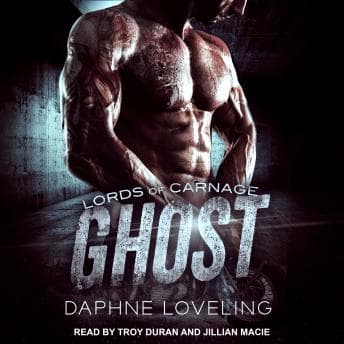

MC romance with a secret baby and a hero named Ghost. I know. I know. But hear me out, because I was chopping onions for a chana masala at 9 PM on a Tuesday when I hit play on this, and by the time the onions were caramelized, I'd already formed three separate hypotheses about Jenna's attachment style.
Here's the thing about Ghost by Daphne Loveling — it's a book that knows exactly what it is. Secret baby trope, forbidden romance with your best friend's sister, motorcycle club danger, the whole nine yards. And within that framework, it actually does some interesting psychological work. Not groundbreaking work. But interesting.
The Psychology of Running (And Why Jenna Can't Stop)
Jenna exhibits classic avoidant attachment patterns — she lost her father, her mother, her brother, all connected to the Lords of Carnage MC, and her response is to flee. Every single time. Which tracks. The research actually shows that individuals who experience repeated loss within a specific social structure develop what we'd call context-specific avoidance. She's not avoidant in general; she's avoidant about this world. The problem is that her child's father lives squarely inside it.
What makes her compelling is that she's not running from Casper as a person. She's running from the pattern. She watched the MC consume everyone she loved, and she's terrified of the cycle repeating with her son. That's not brain-dead decision-making — that's trauma logic. I found myself doing the same kind of attachment-theory spiral with the protagonist in Losing Hope, which also asks you to sit with someone whose self-protective logic is completely coherent and completely self-defeating at the same time. Now, do I think the book could've explored this with more depth? Absolutely. At under six hours, it moves fast, and some of Jenna's internal processing gets flattened into "I should leave" → "but I can't" → repeat. I found myself asking: why does Jenna really believe she can outrun a world that literally defines her entire relational history? The book gestures at the answer but doesn't quite sit with it long enough.
Casper — Ghost — is a fascinating case study in controlled masculinity within hypermasculine spaces. He's the quiet one. The watcher. The guy who doesn't move until he's sure. That's not just a personality trait; that's a survival strategy for someone embedded in a volatile organization. The book earns points for making his stillness feel intentional rather than passive.
Troy Duran's Baritone Does Heavy Lifting (Jillian Macie, Less So)
Troy Duran. Okay. His voice is warm and smoky — genuinely good for Casper's character, this low rumble that suggests a man who chooses his words carefully. But here's where it gets complicated: some listeners found him too soft for a biker, and I can see it. There's a gentleness in his delivery that works for the romantic beats but undercuts the threat level you'd expect from an MC enforcer. When Casper is supposed to be dangerous, Duran sounds like he's about to make you breakfast. Which — fine, that's kind of the appeal of the character. But it creates a tonal dissonance during the thriller-adjacent moments.
Jillian Macie's performance is where things get rocky. Her Jenna didn't land for me the way it needed to. Some of Jenna's dialogue came across flat in a way that made the character seem less intelligent than she's written to be, and I think that's a delivery issue more than a writing issue. When your protagonist is making fear-based decisions, the narrator needs to sell the fear. Without that emotional undercurrent, the choices just sound... irrational. And I say this as someone who studies irrational decision-making for a living — there's a difference between psychologically motivated irrational and narratively unconvincing irrational.
The dual narration format itself is fine. Alternating POVs, him and her. Standard for the genre. No sound effects, no production gimmicks. Clean audio, at least.
What This Book Gets Right About Secrets
The secret baby reveal is the emotional centerpiece, and Loveling handles the aftermath better than the setup. Ghost's reaction — the anger, the betrayal, but also the immediate pivot to protectiveness — is psychologically honest. People who grew up in unstable environments often have this paradox where they're furious about being excluded from something important but simultaneously hardwired to protect. The protagonist exhibits classic approach-avoidance conflict, and Loveling lets that tension breathe for at least a few chapters before resolving it.
But if you're coming in expecting the raw violence and chaos of harder MC romances, you'll be disappointed. This is MC-lite. The club is backdrop more than battlefield. The danger exists but it's not visceral. My therapist would have thoughts about why readers crave that intensity, but that's another conversation. Field Trip scratches that higher-stakes emotional itch more effectively, for what it's worth.
Who Should (And Shouldn't) Bother
If you love MC romance and you're okay with the softer end of the spectrum — more emotional stakes than physical danger — this is a solid listen for a long commute or a cooking session. If you need your biker heroes to sound like they've been in actual bar fights, Duran's warm delivery might frustrate you. And if flat female narration pulls you out of a story, that's a real risk here.
At 5 hours and 51 minutes, it's a quick commitment. Not a bad way to spend an afternoon. Not a book I'll be citing in my next paper, either.
Case Closed, File Under "Entertaining But Surface-Level"
Daphne Loveling understands the emotional architecture of the secret baby trope and builds a functional story around it. The character motivations mostly track — mostly — and the romance has genuine heat. But the audiobook performance is uneven enough that it kept pulling me out of the psychological immersion I was looking for. I wanted to study these characters. The narration kept reminding me I was listening to a performance instead.