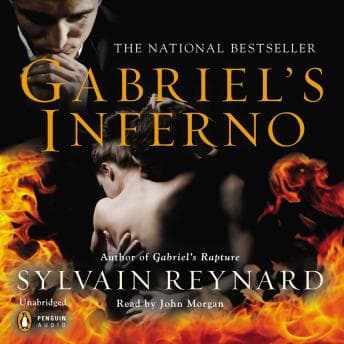

Look, I'm going to be honest with you. Twenty hours. Twenty hours and twenty-seven minutes of a Dante scholar wrestling with his demons while falling for his graduate student. My wife Denise caught me listening to this during our lakefront walk and asked why I was blushing. I blamed the wind chill. It was June.
Here's the thing about Gabriel's Inferno - it's basically what would happen if you took the Inferno, stripped out the nine circles of Hell, and replaced them with one very tortured professor's bedroom. And somehow Sylvain Reynard makes it work. The Dante references aren't just window dressing; they're threaded through the narrative in ways that actually matter. Gabriel Emerson isn't just a brooding academic - he's a man who genuinely understands Dante's journey from darkness to light because he's living his own version of it. As someone who's taught the Divine Comedy more times than I can count, I appreciated that the literary framework wasn't just pretentious decoration.
When Morgan's Voice Becomes Gabriel's Soul
John Michael Morgan has the kind of voice that makes you understand why audiobook romance is a thing. Deep, warm, with this quality that manages to be both sophisticated and wounded at the same time. He captures Gabriel's arrogance without making him insufferable - and trust me, that's a needle to thread. The man is supposed to be this impossibly handsome, brilliant, tortured Dante specialist who uses women and then discards them. On paper, he should be hateable. But Morgan finds the vulnerability underneath all that armor.
The character differentiation is solid. Julia sounds distinct from Gabriel, and the secondary characters each get their own flavor. When Gabriel shifts from cold professor to someone desperately trying to be worthy of love, you can hear it in the cadence, the softness that creeps into Morgan's delivery.
Now. The Italian. I need to address the Italian. As someone who spent a semester in Florence during grad school (mostly drinking wine and pretending to study Brunelleschi, if I'm being honest), the mispronunciations made me wince. It's not a dealbreaker, but when you're building a story around Dante and Renaissance culture, the Italian matters. Every time Morgan stumbled over a phrase, it pulled me out of the moment. Minor complaint in the grand scheme, but worth mentioning.
The Slow Burn That Tests Your Patience
This is a slow book. I mean genuinely, deliberately, almost frustratingly slow. The romance doesn't rush anywhere. The tension builds across hours and hours of listening. Some people will love this - the anticipation, the longing, the way Reynard makes you wait for every meaningful touch. Others will want to throw their phone into Lake Michigan.
I found myself listening at my usual 1.0x (the author chose those words, after all), but I'll admit there were moments during faculty meetings where I wished things would move along. Principal Martinez's budget presentation was somehow more engaging than certain stretches of Julia's internal monologue. (That's not a compliment to the budget presentation.)
But when the story hits its emotional beats? It hits. The connection between Gabriel and Julia isn't just physical attraction dressed up in literary references - there's genuine history there, genuine pain, genuine stakes. The forbidden nature of their relationship - professor and student, the power imbalance, the career consequences - actually gets examined rather than just used as a titillating setup.
Who Should Listen (And Who Should Skip)
This is for readers who want their romance literary. Who don't mind spending twenty hours with characters before they get their resolution. Who appreciate that Reynard clearly did her research on Dante, on Florence, on the academic world (even if some of the university politics feel a bit melodramatic). It's character-driven in the truest sense - you're here for Gabriel's redemption arc, for Julia's awakening, for the slow unraveling of their shared past. Nine Perfect Strangers operates on a similar wavelength—slow character work that rewards patience, though Moriarty trades Dante for damaged people in a wellness retreat.
If you're looking for something fast-paced, if you get impatient with introspection, if you don't care about the Inferno references - skip this one. Not everything is for everyone, and that's fine.
I listened to this over about three weeks of evening grading sessions. By the end, I was genuinely invested in whether Gabriel could escape his own personal hell. That's what good storytelling does - it makes you care about fictional people making fictional choices. Morgan's narration elevated material that could have felt overwrought in lesser hands.
My students would absolutely roast me for enjoying this. They'd call it "professor romance fantasy" and they wouldn't be entirely wrong. But sometimes you want a book that takes itself seriously, that believes in redemption, that treats love as something worth fighting for. Gabriel's Inferno delivers that, even if it takes its sweet time getting there.