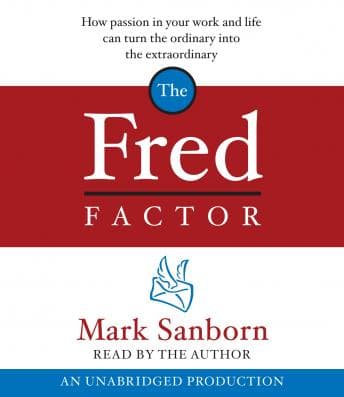

Most business books are 300 pages of fluff wrapped around one good idea. Seriously. I usually have to crank those to 2.0x speed just to extract the signal from the noise before my train hits Redwood City.
So when I saw The Fred Factor was only 2.5 hours long? I almost cried tears of joy.
I finished this entire thing on a single morning commute—San Francisco to Mountain View—even with a signal delay at Millbrae. And honestly? It's kind of the perfect length. It doesn't try to be a "comprehensive framework for paradigm shifts" or whatever buzzword my PM is using this week. It's just a simple story about a guy delivering mail.
Optimizing the Human Interface
Here's the premise: Mark Sanborn meets a postman named Fred. Fred doesn't just shove mail in the box; he gets to know the residents, hides packages so they don't get stolen, and basically treats his route like he's the CEO of Mail Delivery, Inc.
As someone who spends her day debugging distributed systems, I usually roll my eyes at "passion" talks. Passion doesn't fix a segfault at 3 AM. But the engineering brain in me actually liked this. Think of it as latency reduction for human interactions. Fred isn't working harder necessarily; he's optimizing his workflow to increase user satisfaction.
The book breaks this down into four principles—making a difference, building relationships, creating value, reinventing yourself. Standard stuff? Maybe. But hearing about a guy who treats a government service job with the care of a craftsman was... actually kinda nice. It made me look at my own ticket queue a little differently. If Fred can get excited about sorting envelopes, I can probably summon a little more empathy for the user who forgot their password for the third time this week.
The Keynote in Your Ear
Mark Sanborn narrates this himself. Usually, author-narrated books are a gamble—either they're incredibly authentic or they sound like they're reading a hostage note.
Sanborn is a professional speaker, and you can tell. He's got that polished, "I'm on a stage with a headset microphone" cadence. At first, I was worried it would feel too sales-y, like an infomercial for being a good person. But because the book is so short, it works. It feels like you grabbed coffee with a mentor who's really, really caffeinated and wants you to succeed.
He's clear, warm, and moves fast enough that I didn't even need to bump him past 1.5x speed. (Okay, maybe 1.6x during the intro.)
Who This Is For (and Who Should Skip)
Perfect for: anyone needing a quick reset on work attitude, especially if you're burned out on dense business frameworks. Skip it if you want rigorous methodology or deep philosophy—this is motivational, not academic.
Closing the Loop
Look, is this going to revolutionize your tech stack? No. Is it deep philosophy? Also no. It's a simple reminder that "good enough" is usually boring, and adding a little flair to your work—even if it's just code comments or better documentation—actually makes the day go faster.
If you're looking for something with a bit more philosophical weight on prosperity and work, Fundamentals of Prosperity explores similar themes but from an early 20th-century mindset—it's interesting to see how these ideas have evolved.
It's a solid palate cleanser. If you've just finished a heavy 40-hour fantasy epic or a dense biography on the history of semiconductors, this is a nice, light snack. It's motivational without being gross about it.
I walked into the office feeling slightly less zombie-like than usual. And for a Tuesday morning, that's a win.









