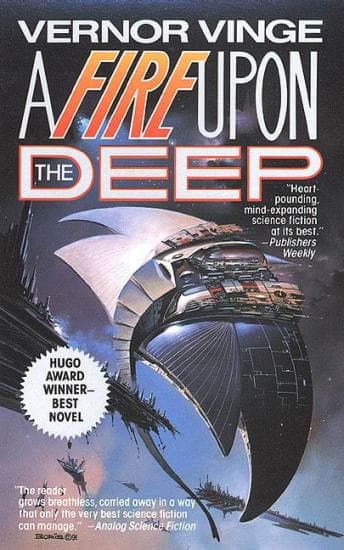

Look, I need to vent about something first: why does nobody warn you that this book requires your entire brain? I made the rookie mistake of starting this on a Monday morning commute after a weekend on-call rotation. Three chapters in, I had no idea what was happening. The Zones of Thought concept—where intelligence literally depends on your location in the galaxy—is genuinely one of the most creative hard sci-fi ideas I've encountered. But Vinge throws you into the deep end with alien races, galactic geography, and what amounts to Usenet-style message boards IN SPACE, and expects you to swim.
I had to restart this book. At 6AM on the Caltrain, surrounded by other tech zombies, I was not equipped to process pack-mind aliens called the Tines where each "individual" is actually four to eight dog-like creatures thinking as one unit. That's not a complaint about the book—that's a complaint about my own hubris.
The Science Actually Holds Up (Mostly)
Vinge was a CS professor, and it shows. The Zones of Thought concept is basically distributed systems theory applied to the entire universe. The closer you get to the galactic core, the dumber everything gets—including your AI, your ships, your ability to think. It's like debugging code that only works in production but breaks in staging, except the staging environment is an entire region of space. The "Blight"—this ancient superintelligence that gets accidentally unleashed—spreads like the worst malware you can imagine, except it enslaves entire civilizations instead of just your laptop.
The Tines are where Vinge's computer science brain really flexes. Each pack shares thoughts through ultrasonic communication, and when pack members die or new ones join, the "person" literally changes. It's consciousness as a distributed system with no single point of failure. I spent an embarrassing amount of time on a Thursday commute thinking about how you'd even architect something like that.
Peter Larkin: The Controversial Choice
Here's where I have to be honest—the narration is polarizing, and I get why. Larkin reads with this consistently upbeat, almost amiable tone that... doesn't always match the material? There are scenes of genocide, of children being held hostage by alien pack-minds in a brutal medieval society, and Larkin delivers them with the same energy as a nature documentary. Some listeners apparently gave up three chapters in because of this.
I didn't hate it, but I noticed it. He's clear enough with character differentiation—you can tell who's talking—but there's not a lot of emotional range. For a 21-hour commitment, that flatness adds up. I found myself wishing Ray Porter had gotten his hands on this one. (I know, I know, I have a problem.)
That said, Larkin's quick pacing actually works for the plot-heavy sections. When you're trying to track multiple storylines across different zones of the galaxy, you don't necessarily want a narrator who lingers. The ROI on his pacing is decent even if the emotional investment isn't quite there.
Usenet But Make It Galactic
One thing that absolutely delighted my engineer brain: Vinge wrote this in 1992 and basically predicted internet culture. The "Known Net" in this book is galactic-scale message boards with flame wars, trolls, and information propagation delays based on physical distance. There are characters who are basically shitposters. In 1992! Before most people had email! The man was a prophet.
The rescue mission plot is solid if not spectacular—a crew of humans and aliens racing to save two kids who hold the key to stopping the Blight. But the real draw is the worldbuilding. Vinge builds out multiple alien civilizations, each with their own communication styles and cultural quirks, and somehow makes it all feel coherent.
Who Should Commit 21 Hours (And Who Should git stash)
Perfect for: dedicated listening sessions, long road trips where you can actually focus. This is NOT a background book. This is NOT a half-asleep-at-6AM book. I learned that the hard way.
Skip if: you need your narrator to carry emotional weight, or if you're looking for something you can dip in and out of. The plot threads are too interconnected for casual listening.
If you loved The Three-Body Problem's hard sci-fi ambition or The Bobiverse's playful approach to galactic-scale problems, this scratches a similar itch. Nightfall operates on that same scale of cosmic ambition, though Asimov's approach is more philosophical than Vinge's technical. It's older and the pacing is different, but the ideas are just as big.
git push --force
Bottom Line: Worth your commute—but only if you're actually awake for it. A Fire Upon the Deep is a Hugo winner for a reason. The Zones of Thought concept alone is worth the 21-hour investment. Larkin's narration is serviceable but emotionally flat, which might be a dealbreaker for some. I finished this across maybe eight focused listening sessions, and I'm already eyeing the sequel. Just... don't start it on a Monday morning. Trust me on this one.