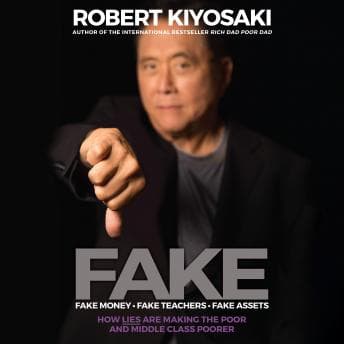

Twelve hours and forty-three minutes. That's how long Robert Kiyosaki takes to tell you that the financial system is rigged, gold is real money, and your 401(k) is a scam. I could've told you that in twelve minutes. My parents figured it out running a dry cleaning business in Koreatown without ever reading a single finance book.
Look, I've recommended Rich Dad Poor Dad to probably fifty clients over the years. The asset vs. liability framework? Genuinely useful. Changed how a lot of people think about money. But FAKE feels like Kiyosaki took that one core insight and stretched it across three hundred pages of repetition, conspiracy-adjacent ranting, and enough self-promotion to make a LinkedIn influencer blush.
The Same Song, Twelfth Verse
Here's my problem. If you've read Rich Dad Poor Dad, you've already absorbed maybe 70% of what's in FAKE. The "fake money" section? It's the same fiat currency critique he's been making since 1997, now with more references to Nixon and the gold standard. The "fake teachers" section? Academics don't understand real-world money. Got it. The "fake assets" section? Your house isn't an asset, paper investments are risky, buy real estate and precious metals. We know, Robert. We've known for twenty-five years.
What's genuinely useful gets buried under hours of what feels like grievance airing. There's a section where he essentially complains about his critics for what felt like forty minutes. I was doing dishes at 2.0x and still couldn't escape it. Jenny walked in, asked what I was listening to, and I said "a man yelling at clouds about the Federal Reserve." She nodded like that explained everything about our marriage.
When He Actually Teaches
I'll give credit where it's due. The CASHFLOW quadrant breakdown—Employee, Self-Employed, Business Owner, Investor—remains a useful mental model. His explanation of why the rich use debt differently than the middle class is worth hearing, especially for people who've never been exposed to these concepts. And his point about financial education being absent from schools? Valid. I've seen MBAs from top programs who couldn't read a balance sheet with any real intuition.
But here's the thing. My parents understood the difference between good debt and bad debt without any framework. They borrowed to buy the dry cleaning equipment because it generated income. They paid off the house because it didn't. No TED talk required. Every time Kiyosaki presents something as revolutionary insight, I think about my mom doing the books at 11 PM after a fourteen-hour day, instinctively understanding what he's now selling for $25.
William LeRoy Does His Job
The narration is... fine. LeRoy has a straightforward delivery that matches Kiyosaki's conversational writing style. He's not doing character work or dramatic interpretation—this is straight business audiobook narration. Nothing memorable, nothing offensive. The production is clean. If you're listening at 1.5x or higher (and you should be), you won't notice any audio issues.
But at nearly thirteen hours, even competent narration can't save repetitive content. By hour eight, I was genuinely checking how much time remained. Never a good sign.
The Conspiracy Problem
Kiyosaki flirts with some ideas that made me uncomfortable. Not because they're entirely wrong—central banks do manipulate currency, the financial system does favor the wealthy, schools do fail to teach financial literacy. But the way he frames everything as a deliberate conspiracy to keep the poor down starts to feel less like education and more like grievance entertainment. It's the financial equivalent of talk radio.
I've seen this playbook fail at multiple companies I've consulted for. The CEO who blames "the system" for everything eventually stops doing the work of actually building something. Kiyosaki's framework can become an excuse for inaction as easily as it can be a catalyst for change.
Who Gets Value Here (And Who Doesn't)
If you've never read Rich Dad Poor Dad and want a comprehensive (if bloated) introduction to alternative financial thinking, this delivers that. If you're already skeptical of traditional financial advice and want validation, you'll feel very validated. If you're a Kiyosaki completist, you're going to listen anyway.
Skip this if you've read his other books or if you value your time at anything above minimum wage. The key takeaways are worth maybe two hours. The other ten? Padding.
The ROI Calculation
Kiyosaki has one genuinely important message—think differently about assets, liabilities, and financial education. He's been saying it for decades. He's still saying it here, just louder and longer. The insight-to-runtime ratio is brutal. At 2.0x speed, you're still looking at over six hours for content that could fit in a long podcast episode. SuperFreakonomics packs more counterintuitive economic insights into a shorter runtime without the repetition fatigue.
Jenny would say I'm being harsh. Jenny is right. But I'm also right. This is a three-hour audiobook trapped in a thirteen-hour body, and no amount of gold standard history lessons changes that math.