
I was shelving returns at the library — last hour before close, that dead-quiet stretch where the fluorescents start buzzing louder than they should — when I hit the chapter where Victor Vale wakes up after his near-death experiment and realizes he can feel pain differently now. Not his own. Everyone else's. And I stood there between the 800s and 900s holding a copy of The Joy of Cooking and genuinely forgot where I was for a second. That's the kind of book this is.
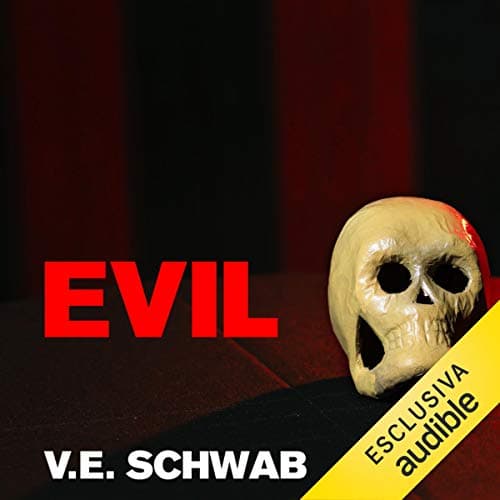
Now, a caveat: this is the Italian-language audiobook. Evil is the Italian edition of V.E. Schwab's Vicious, the first Villains book, narrated by Alessandro Pili. So if you're here expecting the English version — different conversation entirely. But if you're consuming this in Italian, or you're bilingual and curious how this particular story translates? Stay with me.
Two Villains, Zero Heroes, and That's the Point
Schwab does something with Vicious that most superhero-adjacent fiction is too cowardly to attempt: she builds a story around two protagonists who are both, unambiguously, terrible people. Victor Vale and Eli Ever aren't antiheroes in the sexy, brooding way that gets romanticized on BookTok. They're genuinely dangerous, petty, obsessive men whose rivalry started in a college dorm room and escalated into something that leaves bodies behind.
The structure is non-linear — jumping between the college-era experiments with near-death experiences and the present-day prison break and revenge plot — and it works because Schwab trusts you to keep up. She doesn't hold your hand. The ten-year gap between past and present means the characters you meet in one timeline are almost unrecognizable in the other, and that slow reveal of what happened between then and now is where the real horror lives. Not in the superpowers. In the choices.
This understands that horror isn't about gore — it's about dread. Eli's descent from charismatic golden boy to someone who hunts and kills people with abilities like his own, all while believing he's doing God's work? That's the scariest thing in this book. Not the violence. The conviction.
Pili's Clean Read in a Dirty Story
Alessandro Pili delivers a clean, measured performance that actually serves this material better than a more theatrical approach might have. Schwab's prose is already precise — almost clinical in places — and Pili matches that energy without flattening it. His character distinction is subtle. No cartoonish voice shifts, no cheeseball accents. You know who's speaking because the cadence changes, the emotional temperature shifts. Victor gets this controlled, coiled-spring quality. Eli slides toward something warmer on the surface but hollow underneath.
Is it a performance that'll pin you to your seat the way some narrators do? Honestly, no. It's workmanlike in the best sense — the narrator commits to clarity and lets the text do the heavy lifting. For a story that's this structurally complex, bouncing between timelines and perspectives, that clarity matters more than drama. I would've loved slightly more menace in Victor's scenes — the man literally controls pain, give me a little edge in the voice — but it's a minor gripe.
The Schwab Problem (It's a Good Problem)
Here's what I kept thinking about during my late-night listen — Shirley (my cat) was unimpressed, I was wired — Schwab writes villains the way Shirley Jackson wrote haunted houses. The building isn't evil. The people aren't evil. But something about the architecture of their choices makes the whole thing feel wrong in a way that gets under your skin. Victor's sidekicks — a twelve-year-old girl named Sydney who can raise the dead and her enormous dog — should be endearing. And they are. But they're also deeply unsettling, because you realize Victor collected them the way Eli collects kills. Strategically.
At ten hours, the pacing is tight. The non-linear structure means you're constantly recontextualizing what you think you know, which keeps the momentum up even during the slower university flashbacks. I never felt the urge to speed up, which for a ten-hour fantasy is saying something.
Who Should Listen (And Who Should Skip)
If you want moral clarity or a traditional hero's journey, this will frustrate you — skip it. Schwab isn't interested in redemption arcs here. She's interested in what happens when brilliant people convince themselves they're exceptional enough to break the rules of mortality — and then have to live with the results. American Gods wrestles with that same corrosive certainty — the idea that proximity to power warps people into something that only looks human from a distance. If that premise makes you lean forward, you're in the right place. Listeners who want their dark fantasy morally tangled and structurally sharp, with zero hand-holding — this is yours.
My podcast listeners are going to love this — especially the ones who've been asking me for horror-adjacent fantasy that doesn't rely on monsters to be monstrous.
The Shelf This Belongs On
Solid adaptation of a sharp, mean little book. Pili's narration serves the story well without transcending it. If you're an Italian-language listener looking for dark fantasy that respects your intelligence, this earns its spot in your library. I listened in the dark. Mistake? Maybe. Worth it? Absolutely.