
"The problem isn't that economists disagree about the facts. The problem is that they disagree about the right way to think."
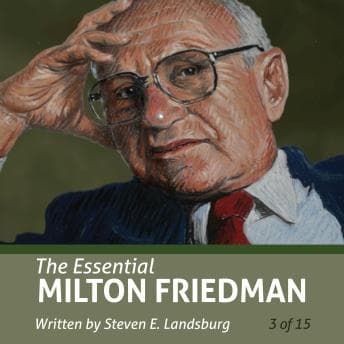
That line hit me somewhere around minute 40, sitting in Kevin's car in a Costco parking lot on a Saturday afternoon while he ran in for "just one thing" (sure, Kevin). And it basically summarizes why this tiny audiobook exists: Milton Friedman didn't just have different answers than other economists - he had a fundamentally different method of asking questions.
Two Hours That Could've Been a Blog Post (But Shouldn't Have Been)
Okay, I know what you're thinking. Two hours? That's barely one commute leg. And yeah, at 1.75x - my default speed for econ books - I got through this in about 70 minutes. But here's the thing: Landsburg is doing something genuinely useful. He's not writing a Friedman biography or a libertarian manifesto. He's writing a technical summary of Friedman's actual intellectual contributions - permanent income hypothesis, the natural rate of unemployment, the monetarist framework - and he's doing it in a way that respects your time without insulting your intelligence.
The permanent income chapter alone is worth the listen. Landsburg walks through how Friedman looked at the same consumption data everyone else had and basically said "you're all measuring the wrong thing." People don't spend based on what they earn this year - they spend based on what they expect to earn over their lifetime. It sounds obvious now, but that's the mark of a genuinely good idea: it rewires your intuition so completely that you forget it was ever counterintuitive.
The section on monetary policy and the Fed is where Landsburg earns his keep as a translator. He takes Friedman's argument that the Great Depression was caused by the Federal Reserve shrinking the money supply - not by some inherent failure of capitalism - and lays it out so clearly that even my 6AM train-zombie brain could follow the logic chain. If you've ever tried reading "A Monetary History of the United States" (I have, I gave up around page 200), this is the CliffsNotes version you actually wanted.
Where It Gets Thin
But - and this is a real but - there's a cost to being this concise. Landsburg essentially treats each of Friedman's major contributions as an independent module. Consumption theory. Money supply. Unemployment. School vouchers. Each gets its chapter, each is tidy, and each kind of just... ends. There's very little connective tissue. You don't really get a sense of how these ideas built on each other or how Friedman's thinking evolved over decades. It reads like a well-organized Wikipedia page narrated aloud, which is both its strength and its limitation.
Also, the book barely acknowledges Friedman's critics in any substantive way. Keynesian economists didn't just roll over when Friedman published his monetarist papers - there were decades of fierce academic battles. Landsburg mentions disagreements exist but doesn't really engage with them. For a book by a fellow economist, that felt like a missed opportunity. You're getting Friedman's greatest hits, not the full discography with all the B-sides and feuds. The closest thing I've read that actually sits with the ideological opposition is Capital: A Critical Analysis of Capitalist Production — I rated it a middling 3.5 and never fully warmed to it, but at least Marx doesn't pretend his critics don't exist.
Satauna Howery vs. The Invisible Hand
Satauna Howery's narration is... competent. That's not a diss, exactly - she reads clearly, paces well, and doesn't stumble over economic terminology, which is more than I can say for some narrators I've suffered through on business audiobooks. But she reads this like a well-prepared news anchor reading a teleprompter. There's no variation in energy between the dry statistical methodology sections and the moments where Friedman's ideas genuinely upended conventional wisdom. When Landsburg describes Friedman proving that professional forecasters couldn't predict consumption patterns better than his simple theory could, that should land with some punch. It doesn't, quite.
No Ray Porter. No Steven Pacey. No narrator personality to speak of. She's fine. She's a 3.
Who Gets the ROI
Perfect for: You've heard "Milton Friedman" dropped in every econ podcast and you want the actual substance behind the name in under two hours. Also great if you took Econ 101 and want a refresher on why monetarism matters without re-reading a textbook.
Skip for: Anyone who's already read Friedman directly, or anyone looking for a real intellectual biography. This is the API documentation, not the deep dive.
The Commit Message
TL;DR: A lean, efficient primer on Friedman's intellectual contributions that respects your time but leaves you wanting more depth. The ROI on this audiobook is high per minute but low per dollar if you're paying full credit price for two hours. Stream it, don't buy it. I finished it before Kevin came back with his cart full of things that were definitely not "just one thing."