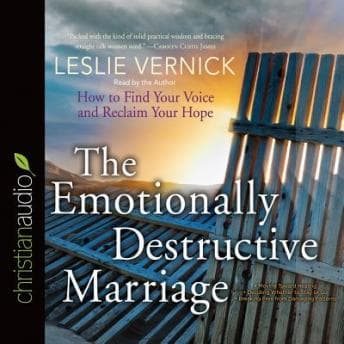

My parents never talked about their marriage. Thirty-two years, same dry cleaning business, same apartment above the shop, same silence about whatever happened behind closed doors. I was listening to this at 2 AM—insomnia, quarterly projections due, the usual—and found myself wondering what my mother would have done with a book like this in 1987. Probably nothing. But that's not the point.
The point is Leslie Vernick wrote something that actually respects the intelligence of women in crisis. And that's rarer than you'd think.
Not Another "Submit Harder" Manual
Bottom line: This is a practical framework disguised as a faith-based marriage book. Vernick spends the first hour establishing what emotional destruction actually looks like—the criticism cycles, the gaslighting patterns, the way chronic disrespect erodes your sense of reality. She's not vague about it. She names specific behaviors and specific consequences.
What surprised me? The business logic underneath the biblical language. Vernick essentially teaches boundary-setting as risk management. She walks through decision trees: if he does X, you respond with Y. If Y doesn't work, escalate to Z. Same framework I'd use for a difficult stakeholder engagement, just applied to whether you should stay married to someone who's destroying you.
My 2.0x speed couldn't save the repetitive sections—she circles back to the same concepts multiple times, which I assume works for listeners who need reinforcement but made me impatient. Skip to chapter 5 if you already know your marriage is in trouble. Thank me later.
When the Author Reads Her Own Work
Vernick narrates this herself, which is either a strength or a limitation depending on what you need. Her voice is warm, measured, deliberately calm—like she's used to talking to people in crisis, which she is. Thirty years of clinical social work comes through. No dramatic flair here, no vocal fireworks. Just steady, credible delivery.
The trade-off: six hours of one person's voice, one emotional register. No sound design, no chapter breaks that feel distinct. If you're driving through the night on a road trip, you might lose focus. This is focused listening material—Jenny would say I'm being harsh, but I'm not. It's just honest. The format matches the content: serious, practical, designed for someone who needs answers, not entertainment.
The Opportunity Cost of Staying
Here's what I kept thinking about: the opportunity cost of staying in a destructive relationship. Vernick addresses this directly, which most Christian marriage resources won't touch. She distinguishes between "difficult" marriages (work harder, communicate better, the usual advice) and "destructive" ones (different playbook entirely). That distinction alone is worth the listen. The other five hours? Useful if you need the full framework, but the core insight lands in the first two.
She also addresses the guilt loop—the "what if I'm not trying hard enough" spiral that keeps people stuck. This is what my parents did instinctively, by the way. They stayed. They worked. They didn't have language for whether that was the right call. Vernick gives language. Whether you use it is your business.
Who Gets Value Here (And Who Doesn't)
This works for: women in emotionally destructive marriages who need permission to take action, counselors who want a framework to recommend, anyone supporting someone in this situation.
Skip it if: you're looking for general marriage improvement (wrong book), you're allergic to faith-based framing (the biblical foundation is real, not decorative), or you need audiobook production value to stay engaged.
The faith component is woven throughout—Vernick explicitly addresses the "God hates divorce" guilt that keeps Christian women trapped in abusive situations. If that's your context, she speaks directly to it. If it's not, you can extract the practical framework and ignore the theological scaffolding. I did both.
Net Assessment
I've seen this pattern fail at three different companies: leaders who confuse loyalty with tolerance, who stay in destructive dynamics because leaving feels like failure. The personal version is worse. Vernick's framework—CORE strength, she calls it—is essentially a self-assessment rubric for whether you're capable of making hard decisions. Clarity about your values, ownership of your choices, responsibility for your actions, empathy without enabling.
It's not revolutionary. It's just organized. And sometimes organized is exactly what someone in chaos needs.
The same principle applies to Breakfast with Buddha—another book that wraps a serious framework in accessible packaging and trusts the reader to do something with it.A self-help book that respects your time. Mostly. Trim 90 minutes and it's a 4.5.









