
This is not a business book. Let me get that out of the way immediately.
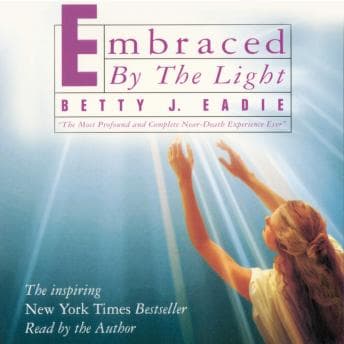
Betty Eadie died on a hospital table at 31, came back, and wrote about what she saw on the other side. And somehow this 3-hour-and-30-minute audiobook ended up in my queue because Jenny added it while I was sleeping. She does this. Last month it was the romance novel. This month it's near-death experiences. I'm starting to think she's trying to tell me something about my cortisol levels.
But here's the thing - I finished it. In one sitting. On a Sunday morning while Jenny was at church and I was making kimchi jjigae, which is about the most Korean-son-home-alone thing I could possibly be doing. And I need to be honest about what happened.
The ROI on Dying (Temporarily)
My usual framework doesn't apply here. There's no competitive strategy. No TAM analysis. No "actionable takeaways for Q3." Betty Eadie floated out of her body, traveled through darkness, met beings of light, and received what she describes as comprehensive knowledge about why humans exist. Standard Tuesday stuff.
At 3.5 hours, this is mercifully short. Finally, a book that respects your time. Or at least doesn't waste it with the padding that plagues every business book trying to stretch a blog post into 12 hours. Betty says what she experienced, describes it with surprising specificity - the garden she visited, the way she perceived communication as instant knowledge transfer rather than words, the moment she was told she had to return to her body and fought against it - and then she's done. The garden sequence in particular has that same quality of vivid, unhurried detail I found in Secret Garden - worlds described not to impress you but because the person describing them genuinely can't help it.
The structure is simple: surgery, death, experience, return, aftermath. No filler chapters. No "here's what my experience means for YOUR morning routine." She just... tells you what happened. My parents would appreciate that. They never had time for preambles either.
When the Consultant's Armor Cracks
Here's where I lose credibility with every McKinsey alum who follows my reviews: parts of this got to me. Not in a "I now believe in the specific metaphysical framework presented" way. More in a "my mom called me last week and I let it go to voicemail because I was on a client call" way.
Eadie narrates her own book, which matters. This isn't some voice actor interpreting someone else's spiritual experience. It's a grandmother from a mixed Sioux-Indian and Scots-Irish background telling you, in her own voice, about the most important thing that ever happened to her. Her delivery is emotional without being performative - there's a steadiness to it, like she's told this story a thousand times but still means every word. When she describes the moment of being embraced by what she calls a being of total love and acceptance, her voice doesn't crack dramatically. It just... softens. Which is somehow more convincing than theatrics would've been.
Compare this to the dozens of self-help audiobooks I've consumed where professional narrators deliver someone else's "life-changing insights" with manufactured gravitas. There's no manufacturing here. Whether you believe her account or not, Betty Eadie believes it completely, and that sincerity comes through the speakers.
The Skeptic's Dilemma
I've spent my career in evidence-based decision making. I've told founders their unit economics don't work. I've killed projects with spreadsheets. So do I believe Betty Eadie literally visited the afterlife? That's not really the point.
What I kept thinking about - stirring gochugaru into the pot, phone propped on the counter - was my dad. Sixty-hour weeks pressing other people's clothes. Never once complained. Never once questioned whether it "meant something." He just did it. And Eadie's central message, stripped of the spiritual framework, is basically: the hard stuff is the point. You chose this. The struggle is the curriculum.
This is what my parents did instinctively. Now it has a TED talk. Or in this case, a near-death experience.
The book has limitations. Eadie presents her experience as universal truth rather than personal interpretation, which will bother anyone with a different theological framework. Some of her claims about receiving "all knowledge" are - look, I'm being generous here - hard to verify. Jenny would say I'm being harsh. Jenny is right. But also, this is a 1992 book describing a 1973 experience, and the cultural context around NDEs has evolved considerably since then.
Who Gets Value Here
If you're grieving, this book will hit different. If you're curious about NDE literature, this is the ur-text - most modern accounts reference Eadie whether they know it or not. If you're a hard-charging type-A consultant who's forgotten the last time he sat still for three hours without checking Slack - well, that's oddly specific, but the shoe fits.
If you need evidence and citations, skip it. If you're looking for business frameworks, you're in the wrong aisle entirely.
The Bill on This One
Bottom line: At 3.5 hours, the commitment is minimal. The content is either going to land with you or it won't, and you'll know within the first 30 minutes. I can't give this the same rating I'd give a rigorous business book because it's playing a completely different game. But Betty Eadie did something most business authors can't do - she held my attention for her entire runtime without a single framework, case study, or acronym. The kimchi jjigae turned out great, by the way. And I called my mom back.