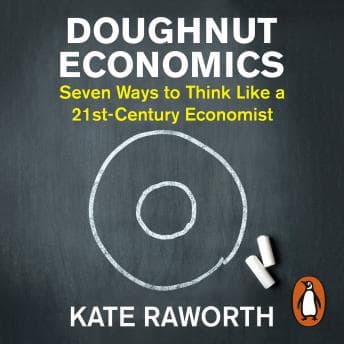

Ever wonder why we treat the global economy like a shark that dies if it stops moving forward?
I was listening to this while waiting for a tire rotation at Costco—a place that is simultaneously a shrine to consumerism and a lesson in bulk efficiency. The smell of burnt rubber and $1.50 hot dogs is a weird backdrop for a book telling you that endless consumption is a suicide pact, but here we are.
The McKinsey Deprogramming Tool
Look, I spent eight years building slide decks that worshipped the altar of GDP. If the line didn't go up and to the right, we panicked. Raworth basically takes that entire worldview, puts it in a blender, and hits purée. Her concept of the "Doughnut"—a safe zone between social misery and ecological disaster—sounds like hippie nonsense at first glance. I almost returned it based on the title alone.
But the ROI on this listen is surprisingly high. Raworth isn't just complaining; she's dismantling. She takes the concept of "Rational Economic Man"—that selfish, calculating robot we learn about in Econ 101—and exposes him for the fraud he is. My parents ran a dry cleaner for thirty years; they weren't "maximizing utility" in a vacuum. They were navigating community, fatigue, and church obligations. Raworth's model actually accounts for human messiness in a way my old MBA textbooks never did.
Good to Great tries to do something similar—strip away the mythology of corporate success and find the real human patterns underneath—though Collins never quite escapes the worship of the upward line the way Raworth does.The Author-Narrator Gamble
Usually, when an academic narrates their own book, I reach for the refund button. Professors tend to drone. But Raworth is the exception. She reads with the energy of someone who's tired of explaining the same obvious thing to a room full of dense policymakers.
I ran this at my standard 2.0x speed, and her diction held up perfectly. She's crisp. She's British (which adds +10 IQ points automatically), but she doesn't sound like she's reading from a podium. There's a specific urgency in her voice when she talks about the "agnosticism" of growth that a hired voice actor would've missed. You can tell she's personally offended by the current state of economics. I respect that.
The PDF Problem
Here's the rub. This is a visual book. It's literally named after a shape. There are seven diagrams that form the backbone of her argument. While Raworth does a decent job describing the curves and loops, you're going to need the accompanying PDF. Listening to the section on "The Embedded Economy" without looking at the diagram is like trying to assemble an IKEA dresser in the dark. You get the gist, but you might end up with extra screws.
Who Gets Value Here (And Who Doesn't)
If you're a startup founder trying to figure out your Series B, this won't help you next week. But if you're trying to figure out if your business model will be illegal or irrelevant in ten years, listen to it. Skip it if you need tactical advice or hate anything that smells like systems thinking.
Jenny saw the cover and asked if it was a baking book. I told her it was a recipe for not destroying civilization. She told me I'm dramatic. Maybe. But honestly, this is the first economics book I've finished in years where I didn't feel like I was being sold a bridge.
The P&L on This One
It's dense, it requires actual focus (don't listen while coding), but it's a necessary software update for your brain.