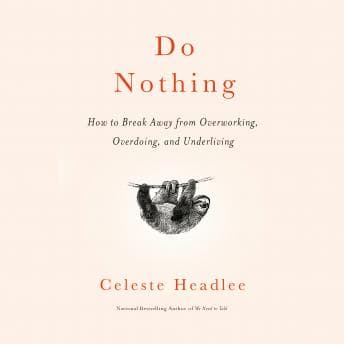

So here's the irony. I'm listening to a book called Do Nothing while meal-prepping Sunday's lunches for the week because I refuse to lose 15 minutes on weekday mornings. Jenny caught me and just stared. Didn't say a word. Didn't have to.
Bottom line: Headlee spends about five and a half hours telling you WHY you're overworked and roughly two hours telling you what to do about it. If you're the kind of person who picks up this book, you probably already know the "why." That ratio is... frustrating. But the "why" is genuinely better researched than 90% of the productivity-guilt genre, and the final stretch actually delivers.
The First Five Hours Are a History Lesson You Didn't Ask For (But Probably Need)
Headlee traces our obsession with busyness back to the Industrial Revolution and the Protestant work ethic - specifically how factory owners weaponized the idea that idle hands are the devil's workshop to squeeze more hours out of laborers. She pulls in paleontology data showing that hunter-gatherers worked roughly 20-hour weeks and spent the rest of their time socializing, resting, and doing basically nothing productive. There's a section on how Benjamin Franklin's "time is money" quote metastasized from practical advice into a cultural pathology. It's smart stuff.
But here's where I got restless. I've sat in enough McKinsey engagement rooms to know that when the diagnosis runs three times longer than the prescription, the consultant doesn't actually have a great prescription. Headlee goes deep on Taylorism, the history of leisure, how social media hijacks our reward systems, neuroscience on why multitasking is a lie - all solid research, all well-sourced. But if you've read or listened to anything in this space in the last five years, you're nodding along going "yes, I know, I KNOW, now tell me how to stop."
The practical advice doesn't really show up until the last couple hours. When it arrives, it's surprisingly modest: set a specific time to stop working each day. Schedule unstructured social time. Take breaks without your phone. Stop tracking every minute. No apps, no systems, no "hack." Just... stop doing things.
This Is What My Parents Did Instinctively. Now It Has a TED Talk.
Here's what got under my skin in a good way. Headlee talks about how pre-industrial communities measured wealth by the strength of their social connections, not their output. And I'm sitting there thinking about my dad closing the shop on Sundays - not because business was slow, but because his church community mattered more than the revenue he was leaving on the counter. My parents worked brutal hours, yes. But they never confused work with identity the way I do. They worked to live. I've been living to work and calling it ambition.
Headlee makes a sharp observation about how we've turned hobbies into side hustles and friendships into networking. She calls it the "instrumentalization of leisure" - every moment has to produce something or it feels wasted. That hit different. I literally track my audiobook consumption like it's a KPI. (Jenny, if you're reading this: you were right about the spreadsheet being weird.)
The book is strongest when it's dismantling specific myths with data rather than vibes. The section on how longer work hours actually decrease productivity after about 50 hours per week is backed by solid research, and Headlee delivers it with the confidence of someone who's done the journalism. She's not guessing. Gladwell does something similar in Outliers — building a case so methodically with research and data that by the time he lands his actual argument, you feel like you arrived at the conclusion yourself rather than being told it.
Headlee Narrating Headlee - An Advantage With One Catch
Author-narrated business books are usually a coin flip. Headlee's a professional broadcaster and it shows. Her delivery is conversational and warm without being saccharine - she reads like she's talking to you at a dinner party, not lecturing from a stage. No vocal fry, no over-performed dramatic pauses. Just clean, confident delivery. Given that her previous career includes hosting a daily news show, none of this is surprising. She knows how to use a microphone.
The one catch: her pacing matches the book's structural problem. The early chapters feel leisurely (ironic, given the subject) and could've used tighter editing. At 2.0x speed it was manageable, but at 1.0x I can see why some listeners checked out before reaching the payoff.
Who Gets the ROI
If you're a recovering productivity junkie who's read Deep Work, Atomic Habits, and Four Thousand Weeks but still can't stop optimizing - this is a useful mirror. If you want a step-by-step action plan, you'll be annoyed for five hours before getting what you came for. Skip to the last third if you're impatient. I won't judge. (I did it, rewound, then listened properly because guilt.)
If you've never questioned why you feel guilty for sitting on the couch on a Saturday, start here.
The Consulting Debrief
The key takeaway is worth the listen. The other 5+ hours? They're good context, but they're context. Headlee's core argument - that our worship of productivity is historically recent, biologically unnatural, and making us miserable - is correct and well-defended. I just wish the book practiced what it preached about efficiency. Still, it's the first productivity-adjacent book that made me want to close my laptop and call a friend. I didn't. But I wanted to. Progress.