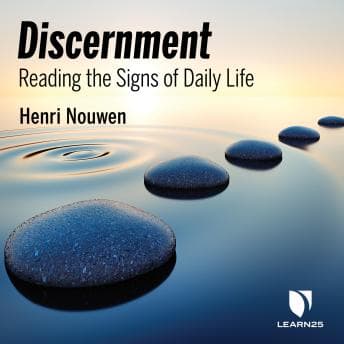

Henri Nouwen wasn't a psychologist, but he understood something most psychologists spend careers circling around: the human need to make meaning out of noise.
I started this audiobook on a Saturday morning while making dal tadka — the kind of elaborate, slow-simmering project that requires attention but not your whole brain. And honestly? That's exactly the energy Discernment demands. Not passive background listening. Not white-knuckle focus. Something in between. Something contemplative.
A Dead Priest's Unpublished Notes Shouldn't Work This Well
Here's the thing that fascinates me about this book from a psychological standpoint. Nouwen died in 1996. This material was compiled posthumously by Michael Christensen and Rebecca Laird from unpublished homilies, interviews, class lectures, and speeches. That's a Frankenstein situation. It should feel stitched together, disjointed, like reading someone's filing cabinet. But it doesn't — or at least, not often. The editors did something genuinely difficult: they found the throughline in a dead man's scattered thoughts and made it feel intentional.
Nouwen's framework for discernment isn't the mystical hand-waving you might expect. He breaks it into recognizable cognitive patterns — how do you distinguish between impulse and intuition? Between fear dressed up as wisdom and actual wisdom? The research actually shows that decision-making under uncertainty is one of the hardest things the human brain does, and Nouwen was essentially writing a spiritual manual for exactly that problem. He just used different vocabulary.
What makes his approach compelling is that he doesn't pretend it's easy. He talks about sitting with ambiguity, about how the desire for certainty can itself become a trap. My therapist would have thoughts about this — specifically, she'd probably assign it as homework. The emphasis on community discernment over individual gut-checking is where Nouwen diverges from most self-help frameworks, and it's where I found myself most engaged. He argues you can't do this alone, that spiritual clarity requires other people as mirrors. Psychologically, this tracks. We're terrible at reading our own motivations accurately.
Joe Abbey-Colborne Does the Quiet Part Right
So here's an interesting wrinkle: the book description says "narrated by Henri Nouwen," but the actual narrator is Joe Abbey-Colborne. I assume Nouwen's name is attached because the source material is his. Abbey-Colborne has a soothing, steady delivery — one listener called it exactly that, and I agree. He doesn't try to dramatize the material or inject false urgency. For a book about learning to listen to quiet signals, that restraint is the right call.
But — and I'll be honest — at seven hours and fourteen minutes, the steadiness can become a liability. There were moments, particularly in the middle sections where Nouwen covers familiar ground about prayer and solitude, where the narration's evenness made my attention drift. No vocal shifts to signal "this part matters more than the last part." Everything gets the same reverent treatment. I found myself rewinding more than once, and not because the content was dense. It's because the audio experience is so consistently calm that your brain starts to treat it like ambient sound.
No sound effects, no music, no production flourishes. Just voice. Which is fine — appropriate, even. But at 1x speed, it dragged for me. 1.25x felt right.
The Trilogy Question
This is the third volume in a trilogy alongside Spiritual Formation and Spiritual Direction. I haven't listened to the other two, which means I came in without context. The book mostly stands alone, but there were moments where concepts were referenced as if I should already be familiar with them. If you're already in the Nouwen ecosystem, this is apparently a satisfying capstone — one listener called it "a phenomenal end to the trilogy." If you're new to Nouwen, like me, it still works. But you might feel like you walked into the third act of a conversation.
I found myself asking: why does this material still land when so much spiritual self-help from the same era feels dated? I think it's because Nouwen was genuinely interested in the mess of being human. He doesn't offer five easy steps. He offers a way of paying attention. That's a different project entirely, and a harder one to dismiss. That same orientation toward attention over action — toward sitting with yourself rather than fixing yourself — is what drew me to When You're Ready, This Is How You Heal, though that one comes at the same territory from a much more secular, emotionally raw angle.
Who This Is For (And Who Should Keep Scrolling)
If you want actionable productivity frameworks, skip this. If you're looking for interfaith spiritual content, this is pretty specifically Christian — Catholic, in fact — and doesn't pretend otherwise. But if you're someone who makes decisions by overthinking until your brain short-circuits (hi, it's me), and you're open to a faith-based framework for sitting with uncertainty, Nouwen's approach is worth the seven hours. Best consumed slowly. Maybe across several cooking sessions. Maybe during those quiet morning hours when the world hasn't started yelling at you yet.
The Case File, Closed
Nouwen understood something about the human mind that I spend my professional life studying: we are meaning-making machines, and we're often making meaning out of the wrong inputs. Discernment is his argument for learning to read the right signals. It's not flashy. It won't change your life in a weekend. But it's honest and — rare for posthumous compilations — it feels like the person who wrote it actually meant every word.









