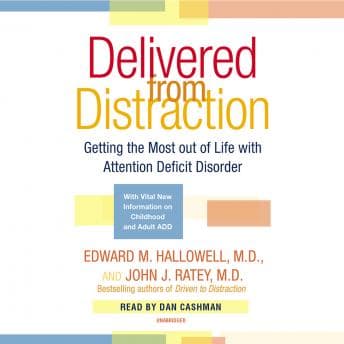

Quick Verdict: Worth your commute if you have ADHD or love someone who does. Less worth it if you need a tight, actionable playbook.
Look, I started this one because my boyfriend Kevin got diagnosed last year and I wanted to understand what's going on in that chaotic brain of his. Thirteen and a half hours later, I have... complicated feelings.
Here's the thing about Hallowell and Ratey: they clearly love people with ADHD. Like, genuinely love them. And that warmth comes through even in audio form. But this book is basically a sprawling encyclopedia of ADHD knowledge wrapped in a slightly meandering package. Which is ironic, given the target audience.
The Good News About Your Scattered Brain
What I actually appreciated was the reframing. These doctors don't treat ADHD like a disease to be cured—they treat it like a different operating system. (As someone who debugs systems for a living, I can work with that metaphor.) The sections on ADHD as a trait rather than a disorder? Genuinely helpful. They talk about the creativity, the hyperfocus superpower, the entrepreneurial energy that often comes with the package.
The patient profiles scattered throughout are pretty compelling too. Real stories of people who figured out how to work WITH their brains instead of constantly fighting them. I found myself thinking about Kevin during a lot of these—recognizing patterns, understanding why he does certain things that used to just frustrate me.
Dan Cashman's narration is... fine? He's got this calm, steady voice that works well for dense material. Easy to follow at 1.5x, which is my default. But I wouldn't call it a standout performance. He reads it like what it is—a medical self-help book. Nothing wrong with that, but Ray Porter he is not.
Where the Signal Gets Noisy
Okay, so here's my complaint. This book is 13+ hours long and could've been... way less. The organization is kind of all over the place. You'll get a chapter on medication, then relationship stuff, then back to diagnosis, then exercise, then sexual issues (yes, there's a whole section on that), and it starts to feel like the book itself has attention issues.
For a book aimed at people who struggle with focus, the structure doesn't do them any favors. I kept losing the thread of what the main argument was supposed to be. It's more of a reference guide than a narrative, which means it's hard to absorb passively on a crowded Caltrain at 6 AM.
And the actionable advice? It exists, but it's buried. I wanted more concrete "do this, then this" frameworks. Instead you get a lot of "here are all the options, talk to your doctor." Which, fair, but I was hoping for more ROI on my time investment.
Who Should Queue This Up (And Who Should Skip)
Perfect for: Long drives where you can rewind, or anyone newly diagnosed who wants comprehensive context. Skip for: Half-asleep morning commutes where you need to track complex info, or ADHD veterans looking for cutting-edge strategies.
I finished this over maybe 9 or 10 commutes, and honestly I zoned out during chunks of it. Not because it's bad—it's not. It's comprehensive and compassionate and clearly written by experts who know their stuff. But it's dense. It's long. And it doesn't have the narrative hooks that keep you locked in during passive listening.
The book was published in 2005, so some of the "new" research isn't exactly new anymore. The production quality is clean—no weird audio artifacts or anything. Cashman's pacing is maybe a touch slow, which is why I bumped it up to 1.5x without losing anything.
My Debug Report
Would I recommend it to Kevin? Yeah, probably. Would I tell him to also get the physical book so he can flip to the sections he actually needs instead of listening linearly? Definitely yes.
It's a good book that could've been a great book with tighter editing. But the core message—that ADHD brains aren't broken, just different—is worth hearing. That same reframing approach shows up in Awaken the Giant Within, though Robbins applies it to a broader self-improvement context. Even if it takes 13 hours to fully deliver it.