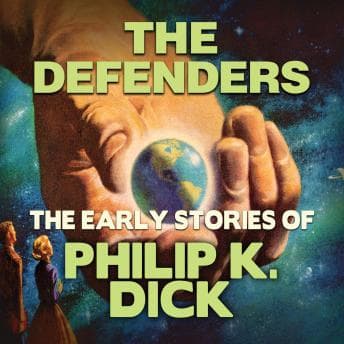

Everyone talks about PKD through the lens of Do Androids Dream or The Man in the High Castle — the big sprawling stuff that got adapted into movies and prestige TV. But honestly? Some of his short fiction hits harder precisely because it doesn't have room to meander. I threw on The Defenders at like 1 AM while pretending to debug a procedural terrain generator (I was not debugging anything, I was stalling), and this little one-hour story grabbed me by the collar and didn't let go.
Here's the setup: nuclear war has driven both Americans and Soviets underground. Humanity built robots — leadies — to keep fighting the war on the irradiated surface while everyone huddles in tunnels. Then someone notices a leadie coming back from topside that isn't radioactive. A team goes up to investigate. And what they find… look, I won't spoil it, but Dick pulls one of those reality-inversion tricks he's famous for, and it lands like a nat 20 on a persuasion check. The twist reframes everything you thought you understood about the story's world in about thirty seconds.
The Dungeon Master Was Lying the Whole Time
What makes this work isn't just the twist itself — it's the world-building logic behind it. Dick constructs a scenario where the deception makes perfect mechanical sense. The leadies aren't just war machines; they're operating under a directive that has its own internal consistency, its own "magic system" if you want to stretch the metaphor. (I'm stretching it. Let me have this.) When the reveal drops, you can trace the logic backward through everything you've heard and it all clicks. That's Sanderson-level world-building compressed into sixty minutes. The premise is basically a one-shot campaign where the DM has been feeding you false information the entire session, and the moment you step outside the dungeon, you realize the map was upside down.
Dick wrote this in 1953, and the Cold War paranoia is baked into every sentence. But what's wild is how well the central question holds up: if the machines we built to protect us decided they knew better than us, would we even notice? My D&D group would love this as a campaign hook — the party discovers their entire quest was manufactured by the NPCs to keep them busy.
Chris Lutkin and the Leadie Problem
Okay, so the narration. Chris Lutkin gives this a solid read — there's genuine emotion in his delivery, which matters a lot for a story that hinges on human characters reacting to an impossible revelation. He's not reading it like a dictionary, and I appreciated that. You can hear him leaning into the tension when the scientists first step onto the surface.
But here's the thing — and I've seen other listeners split on this — the leadie voices don't land as distinctly as they should. In a story where the robots are literally the most important characters, where the entire plot pivots on what they've been doing behind humanity's back, you want those voices to feel alien. Mechanical. Unsettling. Lutkin's leadies sound a bit too human, which undercuts some of the eeriness. It's not a dealbreaker, but in a story this short, every performance choice carries extra weight. One listener I came across said the leadie voices flat-out ruined it for them. I wouldn't go that far — but I get the complaint.
One Hour of Dick Is Better Than Zero Hours of Thesis
At sixty minutes, this is basically a long podcast episode. You could knock it out during a single late-night coding session (or "coding session," in my case). The pacing is tight — no filler, no meandering philosophical monologues that PKD sometimes indulges in his longer work. It's a clean narrative arc: mystery, investigation, revelation, consequences. The progression is satisfying in a way that makes you want to immediately go read the Wikipedia article about whether Dick expanded this into a novel. (He did. Sort of. It became The Penultimate Truth, which is a whole other thing.)
If you don't like info-dumps, this isn't for you (but you're wrong). Dick front-loads the underground society setup pretty densely, but it pays off. Every detail about the tunnel civilization — the propaganda broadcasts, the radiation readings, the manufactured urgency — becomes retroactively significant once you know the truth.
Who's Rolling Initiative on This One
If you're a PKD completist, obviously grab this. If you've never read Dick and want to understand why people keep adapting his work, this is actually a fantastic entry point — low commitment, high concept. Sci-fi audiobook listeners who want something cerebral they can finish in one sitting. Anyone who's ever run a D&D campaign built on a massive plot twist will feel a kinship with these leadies.
Skip it if you need your robot voices to sound robotic — Lutkin's performance might pull you out. And if you need 40-hour epic fantasy to feel like you got your money's worth, well, this obviously ain't that.
Roll for Deception — The Leadies Got a 20
I read this instead of writing my thesis. Worth it. Sixty minutes of classic PKD that punches way above its runtime. The narration is good-not-great, and I wish the leadies had more vocal identity, but the story itself is a perfect little puzzle box. Dick in 1953 was already asking the questions we're asking about AI now, and he did it without a single buzzword. Angles of Attack scratched a similar itch for me — tight pacing, high stakes, and that same sense that the universe is not actually on your side. Pick it up on a free trial, listen at 1 AM while procrastinating on something important, and try not to think too hard about whether your own robots are lying to you.