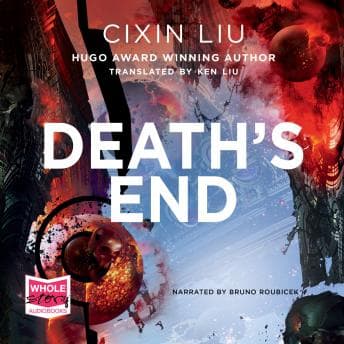

"The universe is a dark forest."
That line from the second book haunted me through all 29 hours of Death's End, and Cixin Liu takes that concept and just... keeps going. Past where you think the story can go. Past where you think physics can go. I was supposed to be debugging a procedural terrain generator for my thesis. Instead I sat in my apartment at 2 AM, board games stacked on every surface, staring at my ceiling while Bruno Roubicek described the two-dimensional collapse of the Solar System, and I genuinely forgot to breathe.
This book broke my brain. I mean that as a compliment.
The Cosmic Horror of Actual Physics
So here's the thing about Death's End that separates it from 99% of science fiction I've consumed: the scale. This isn't a story about humanity versus aliens anymore. It's a story about the structure of the universe and what civilizations do to it over billions of years. The Dark Forest theory from book two was already operating at a level most sci-fi doesn't touch, but Liu takes it further - pocket universes, dimensional warfare, the speed of light as a weapon. There's a sequence where an entire star system gets flattened into two dimensions like a painting, and the way it unfolds over hours of listening is genuinely one of the most terrifying things I've experienced in fiction. Not horror-movie terrifying. Existential-dread terrifying. The kind where you pause the audiobook and just sit there.
The magic system is chef's kiss - except there's no magic, it's all theoretical physics extrapolated to nightmare conclusions. This is Sanderson-level world-building if Sanderson decided to build across eleven dimensions and four billion years.
Cheng Xin as a protagonist is going to be polarizing. I've seen the discourse. She makes choices that are... let's say "empathetically human" in a universe that punishes empathy with extinction. Some readers hate her for it. I found it fascinating, actually - Liu is deliberately contrasting her soft-power approach against the cold game theory of cosmic survival. She's not incompetent; she's operating from a moral framework that the universe simply does not care about. That tension carried me through the middle section where the pacing dips.
Bruno Roubicek and the Narrator Wars
Okay, the narration situation with this trilogy is... complicated. Different narrators across different editions, people arguing about P.J. Ochlan versus Luke Daniels versus Bruno Roubicek. Here's my take: Bruno works. His voice has this measured, almost documentary quality that suits the clinical horror of Liu's prose. When he's describing the dimensional attack on the Solar System, or the lightspeed spacecraft sequences, the atmosphere lands. One listener called it "magnificent" and I get it - he treats the material with weight.
But. Steven Pacey walked so other narrators could run, and Bruno isn't running. He's walking at a steady, deliberate pace. The character voices don't have huge differentiation, which matters less here than it would in, say, a character-driven fantasy because Death's End is fundamentally a novel of ideas. The characters are vehicles for cosmic-scale concepts. Still, during the sections with Cheng Xin's personal relationships, I wanted more emotional texture from the performance. Some folks online said they couldn't finish the audiobook with Bruno - I didn't have that problem, but I can see where they're coming from if you're comparing to other versions.
At 29 hours, yes, it's a commitment. Yes, it's worth it. I'd honestly recommend 1.25x speed for the slower diplomatic sections in the middle third, then dropping back to 1x when things go cosmically sideways.
Where the Dark Forest Gets a Little Overgrown
The ending. Look, I have complicated feelings. Liu sprints through the final stretch - billions of years compressed into chapters that feel like they needed twice the breathing room. After spending hours meticulously building up the dimensional warfare and the pocket universe concepts, the conclusion rushes past implications that deserve their own novels. It's not bad, but it feels like Liu had six more ideas than he had pages to explore them. Some listeners called it "rushed and put together with what seemed easiest" and... yeah, I felt that. The scientific speculation in the last few hours gets thinner, more hand-wavy, right when I wanted it to get denser.
If you don't like info-dumps, this isn't for you (but you're wrong). Seriously though, this entire trilogy demands a reader who finds joy in long passages about orbital mechanics and sociological game theory. Death's End especially. There are stretches where you won't hear dialogue for twenty minutes. My D&D group would love this - the universe basically operates on dark cosmic rules that would make for the most brutal campaign setting imaginable. Speaking of brutal campaign settings built from rich lore, Critical Role: Vox Machina--Kith & Kin scratches a completely different itch but shares that same sense of a world where the rules are ancient and merciless and nobody's handing you a map.
Who Gets a Seat on the Lightspeed Ship
If you loved The Dark Forest, this is mandatory. If you bounced off the first book's pacing, this won't save you. If you want character-driven sci-fi with deep emotional arcs, look elsewhere - this is idea-driven fiction at its most ambitious and most uncompromising. Hard sci-fi readers who want their minds genuinely expanded? This is your endgame.
I read this instead of writing my thesis. Dr. Patel, if you're somehow reading audiobook reviews on the internet: the dimensional reduction sequence is relevant to procedural generation. Probably. I'll figure out how.
The Campaign's Final Session
This trilogy is the most ambitious thing I've encountered in science fiction. Death's End stumbles at the finish line - the ending needed another hundred pages it didn't get - but the peaks are so high they make most other sci-fi feel like it's playing in a sandbox. Bruno Roubicek delivers a solid performance that serves the material well, even if he won't make you forget your favorite narrator. The ideas in this book will rattle around in your skull for weeks. The two-dimensionalization scene alone is worth the 29-hour investment.
Just don't think too hard about it before bed. Trust me on that one.