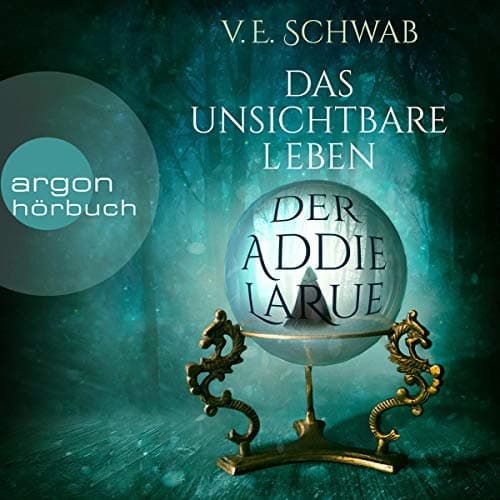

What would you trade for freedom - if the price was that no one would ever remember your name?
I was walking the lakefront with Denise last Saturday, late afternoon light doing that thing where it turns the water into hammered gold, and Addie LaRue was whispering in my earbuds about watching the Seine from a bridge in 1720-something. And I had this moment - this eerie doubling - where I thought about how many people have stood in that exact spot on the Chicago lakefront over the centuries and been completely forgotten. Schwab's novel does that to you. It crawls into the space between your thoughts and sets up camp.
Three Hundred Years of Being Nobody's Footnote
The premise is deceptively simple: in 1714, a young French woman named Addie makes a deal with a dark god (not the devil, exactly - something older, something that wears the face of the night sky) and receives immortality. The catch? No one can remember her. Not friends, not lovers, not the innkeeper she paid five minutes ago. She walks through three centuries of European and American history as a ghost with a pulse.
This reminds me of what Hemingway said about writing - that the dignity of movement of an iceberg is due to only one-eighth of it being above water. Schwab shows us fragments of Addie's life across centuries, and the weight of everything unseen - every forgotten conversation, every relationship that reset to zero by morning - presses down on you. There's a scene where Addie sits for a painter in 18th-century Paris, and she realizes she'll exist on canvas forever but the artist won't remember her face by dinner. That specific kind of loneliness? I teach kids who feel invisible every single day. Schwab nails the ache of it. I wrote about that same ache of invisibility — though in a very different key — when I reviewed Wednesday Wars, a book where a kid spends a whole school year convinced nobody sees who he actually is.
But here's the thing my students would appreciate: this isn't a sad sack story. Addie is stubborn, resourceful, and genuinely funny in her defiance. She treats her curse like a dare. She can't own things (they slip away from her), so she collects experiences. She can't be remembered, so she inspires art - becoming the unnamed woman in countless paintings and poems. The idea that influence can exist without credit? That's a concept I could build an entire semester around.
Eva Gosciejewicz Understands That Pause Is Punctuation
Let me talk about the German audiobook experience here, because this is Das unsichtbare Leben der Addie LaRue - not the English version. Eva Gosciejewicz narrates nearly twenty hours of material, and she carries the emotional register of a character who has lived three hundred years without ever quite breaking down. Her delivery captures something specific: the way Addie's hurt comes out sideways, as yearning rather than weeping. There's a quiet restraint that works beautifully for a character who has learned to keep her grief close.
I listened at 1.0x - obviously - because the prose deserves to be savored. Schwab has a way of writing sentences that loop back on themselves, echoing themes across centuries, and at speed you'd lose the architecture of it. The structure alternates between past and present, 1714 France and modern New York, and Gosciejewicz handles the tonal shifts between time periods with what felt like genuine understanding of the material rather than just competent reading.
The weakest stretch - and I want to be honest about this - comes in the middle sections where the modern-day romance with Henry takes center stage. Not because the narrator falters, but because the pacing shifts from centuries-spanning to weeks-spanning, and the change of rhythm feels jarring after you've spent hours watching Addie survive wars and revolutions. Henry is sweet, he's well-drawn, but he's operating at a different narrative velocity than the rest of the book.
The Real Antagonist Is a Love Story With Darkness Itself
What nobody warns you about is that the most interesting relationship in this book isn't Addie and Henry. It's Addie and Luc - the dark entity she made her bargain with. He visits her across centuries, and their conversations have this tension that sits somewhere between seduction and a chess match. He wants her to surrender. She refuses. And over three hundred years, something that started as predator-and-prey becomes... complicated.
Let's talk about what the author is really getting at here: this is a book about the cost of being seen. Addie wants to be remembered. Henry - when you learn his secret - wants to be loved for who he actually is. Luc wants to be chosen. Every character is bargaining for recognition, and the currency is always a piece of yourself.
Who Gets the Extra Credit (And Who Drops the Class)
If you loved The Night Circus or Schwab's own Shades of Magic series, this is their spiritual successor - same atmosphere of magic stitched into historical settings, but more intimate and more melancholy. Pick this up if you want something that sits with you for days after the last chapter.
But if you need constant forward momentum, or you're looking for something to half-listen to while grading forty essays on The Great Gatsby - skip it. (Not that I'd know anything about that.) This book demands your attention, especially in the time-jumping first half. It rewards patience, not multitasking.
Also worth noting: there's some sexual content and violence. Nothing gratuitous, but it's there. My students would ask if this counts as fantasy or romance or historical fiction, and the honest answer is yes.
The Annotation in the Margin
Nineteen hours and thirty-seven minutes. I started this on a Tuesday walk and finished it the following Sunday, grading papers at the kitchen table while Denise read beside me. When the final scene landed, I pulled out my earbuds and just sat there for a minute. That stuck-in-the-throat feeling other listeners describe? Accurate. It's not sadness exactly - it's the weight of realizing that being forgotten might be the most human fear there is, and Schwab spent four hundred pages proving it.
My students would hate the pacing. I love it. Worth pausing the faculty meeting for - and honestly, worth pausing everything else, too.









