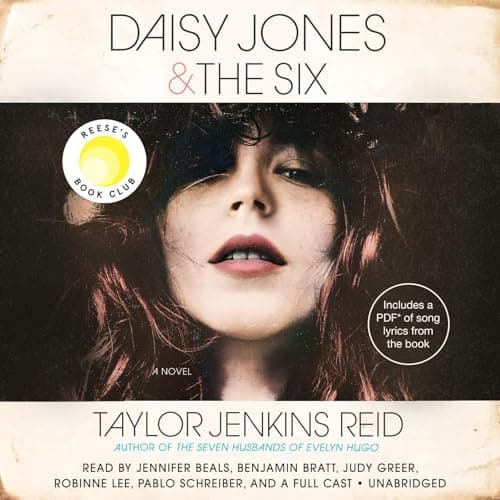

This audiobook is the rare case where the format isn't just good - it's the whole magic trick.
I listened to a chunk of Daisy Jones & The Six while chopping onions for post-shift adobo, half-dead tired, kids still asleep, house quiet for once. And I had that weird moment where I forgot these people weren't real. Not "realistic characters." I mean real enough that I wanted to look up old concert footage and argue with someone about which album was their best. That's what this production does.
The setup is an oral history about the rise and implosion of a 1970s rock band, with Daisy and Billy Dunne at the center of it like two lit matches thrown into the same room. If you read this in print, I'm sure it works. But in audio? This thing turns into a full-blown fake documentary for your ears.
This sounds like a lost band documentary
The smartest choice here is the full cast. Not because it makes things feel more vivid - that tells you nothing. What matters is that the interview format actually sounds like interviews. Jennifer Beals gives Daisy this husky, frayed confidence that feels lived-in, like a woman telling you the truth and lying to herself at the same time. Pablo Schreiber's Billy has that tight, coiled intensity of a man one bad sentence away from blowing up his whole life. Benjamin Bratt gives Graham a grounded, gritty warmth that keeps him from fading into the background, which could've easily happened in a cast this big.
And Judy Greer as Karen? Perfect. Dry, sharp, faintly amused by everyone else's nonsense. Her little sarcastic beats landed so well that I actually laughed out loud in my kitchen. Karen isn't just "the female band member" here. She sounds like someone who has spent years in rooms full of men making bad decisions and has receipts for every single one.
The scene where Daisy joins forces with the band has exactly the energy it needs - ambition, chemistry, ego, inevitability. You can hear the shift. Before that, you're listening to pieces of a music scene. After that, you're listening to a collision course.
And that's why this works better in audio than a lot of literary fiction ever could. The cast creates tension in the space between versions of events. Somebody says one thing, somebody else undercuts it two lines later, and suddenly you're not just following plot. You're reading body language without seeing bodies. It's catnip if you like messy people with selective memory.
When the music is the fever
Taylor Jenkins Reid understands that bands are basically dysfunctional families with better hair and worse coping skills. Daisy isn't just chaos in sunglasses. Billy isn't just the brooding genius. Camila isn't just the wife standing off to the side while the men self-destruct. Everybody wants something different from the same machine, and the machine is fame.
The 70s rock atmosphere is strong without turning into costume-party nostalgia. You get Sunset Strip mythology, the sex and drugs mess, the producer meddling, the way people confuse artistic chemistry with emotional destiny. My favorite part is that the book knows how seductive that myth is - and how much damage it does.
There's also a nasty little accuracy to addiction and ego here. Not medical accuracy, obviously - this isn't my lane the way a hospital thriller is - but human accuracy. The kind of psychological unraveling that does get medical details wrong, by the way, is on full display in Cujo — King understands human panic and denial at a gut level even when the clinical picture is fuzzy. The bargaining. The self-serving memory. The "I did this for the art" nonsense people use when they really mean "I wanted what I wanted." As someone who's actually worked plenty of nights around people and families in crisis, that emotional revisionist history felt very familiar. Everybody is the hero of their own incident report.
Camila, in particular, hit harder than I expected. She could've been written as a prop for Billy's story. She isn't. She understands the room, understands Billy, understands Daisy maybe more than either of them understands themselves. There's a quiet steel to her that the audio catches beautifully.
The one place I got yanked out of the groove
I need to be honest about the one production issue, because if you're picky about audio flow, you'll notice it. Most of the time, the full cast makes this feel like an actual Behind the Music special that wandered into your headphones. But every so often, there's a shift into longer connecting passages from Julia Whelan, and it can be a little jarring. Not bad. Just noticeable. Like a camera angle change in the middle of a really intimate interview.
It didn't ruin anything for me, but I felt the seam.
Pacing-wise, this isn't a thriller, so don't go in expecting some twisty propulsive engine. It moves by accumulation - anecdotes, contradictions, moments onstage and off, little cuts that eventually bleed into the breakup question hanging over the whole thing. If you need constant plot movement, you may get restless. If you enjoy watching personalities combust in slow motion? Night shift approved.
Also: this is not background-cleaning audio unless you're okay missing important texture. Too many voices, too many subtle shifts in who means what. I wouldn't put this on while charting something complicated, and I definitely wouldn't recommend it as "just toss it on" listening. It rewards attention.
Who should grab the aux cord (and who should pass)
Pick this up immediately if you love music documentaries, messy fame stories, fictional celebrity lore, or books that let character do the heavy lifting. If Daisy/Billy-style push-pull dynamics are your thing, you're probably done for.
Skip or borrow if you want a traditional novel structure, if interview transcripts on the page or in audio usually annoy you, or if you mostly listen while distracted. This one asks you to lean in.
My last chart note on this one
This is one of those audiobooks that makes the strongest possible argument for why audiobooks are their own art form. The book is good. The production is what turns it into an experience.
I finished it wanting to hear songs that do not exist. That's a pretty impressive trick.