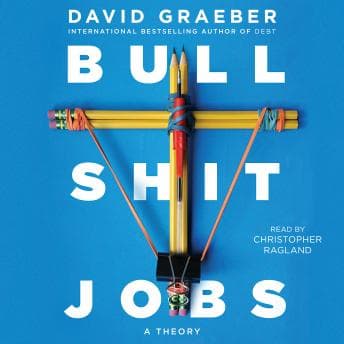

How much of your workday is actually... work?
I mean real, productive, makes-a-difference-in-the-world work. Not the meetings about meetings. Not the reports nobody reads. Not the email chains that exist purely to document that email chains exist. David Graeber spent 12 hours making me confront this question, and honestly? I'm still processing it during my morning commute three weeks later.
Here's the thing about Bullshit Jobs—Graeber's core thesis is solid gold. About 45 minutes of absolute clarity on why our economy produces so many meaningless roles. The problem? He takes nearly 13 hours to make a 3-hour argument. And yes, I caught the irony. A book about unnecessary work that contains a decent amount of unnecessary content. My 2.0x speed couldn't save this one.
The First Four Chapters Hit Different
Graeber's taxonomy of bullshit jobs is genuinely brilliant. Flunkies, goons, duct tapers, box tickers, taskmasters—I've worked with every single one of these at McKinsey and at the startups I consult for now. The flunky category especially hit home. How many executive assistants exist purely to make executives look important? How many middle managers exist to manage other middle managers?
The anecdotes are devastating. Real people describing their soul-crushing awareness that their work contributes nothing. A corporate lawyer who spent years on deals that never closed. A communications coordinator whose job was to make a newsletter nobody read. This is what my parents did instinctively—actual work, 14-hour days, real customers, real problems. Now there's an academic framework for why that felt more meaningful than what most of my MBA classmates ended up doing.
Christopher Ragland handles the early chapters well. His voice shifts nicely when reading these personal testimonies, giving each anonymous worker their own texture. Clear, accessible, good pacing. But here's where it gets weird—he's using an American accent for a book written by a professor at the London School of Economics, filled with UK-specific labor examples. Minor thing, but it kept pulling me out.
When Graeber Starts Filling Paper
Skip to chapter 5. Thank me later. Actually, no—listen to chapters 1-4, then skip to the conclusion. The middle section is where Graeber goes full academic, and I mean that as a criticism. He repeats the same arguments with different historical examples. Medieval peasants worked fewer hours than modern office workers. Yes, David, you made that point. Three times now.
The political jabs get heavier in the back half too. Look, I don't mind an author having a perspective—Graeber was literally a leading figure in Occupy Wall Street. For a more focused takedown of Wall Street's absurdities, Big Short: Inside the Doomsday Machine delivers the goods without the repetition. But when every third paragraph becomes a screed against finance capitalism, it starts feeling like padding. I've seen this fail at three different companies—the consultant who can't stop editorializing loses the room.
Ragland's narration also loses steam in these later chapters. The energy that made the anecdotes pop flattens into something closer to monotone. Can't entirely blame him—the material itself gets repetitive. But it made my highway commute feel longer than usual.
The Uncomfortable Truth He's Right About
Here's what I can't shake: Graeber died in 2020, but his argument is more relevant now than ever. Every company I consult for has layers of roles that exist purely for organizational theater. The DEI coordinator who has no budget. The innovation officer who innovates nothing. The strategy team that produces decks nobody implements.
And the psychological damage is real. People know when their work is meaningless. They feel it. The book's best insight isn't economic—it's about the spiritual violence of being paid to pretend you matter. My parents never had that problem. Dry cleaning is real. The clothes get clean or they don't. There's no pretending.
Jenny would say I'm being harsh. Jenny is right. But also—Graeber could've made this book 6 hours and lost nothing. The key takeaway is worth the listen. The other 7 hours? Not so much.
The ROI Calculation
Listen if: You've ever sat in an open-plan office wondering why your job exists, or you need vocabulary for the organizational dysfunction you already sense. I've already used "duct taper" in three client conversations.
Skip if: You want tight, efficient argumentation. This is a buffet, not a tasting menu—take what you need, leave the repetitive historical tangents.
Best consumed at 1.5x minimum, ideally during a commute where you can zone out during the padding and tune back in when the anecdotes return. If you've ever felt that creeping suspicion that your job is theater, Graeber will validate every dark thought you've had. Whether that's comforting or depressing is up to you.