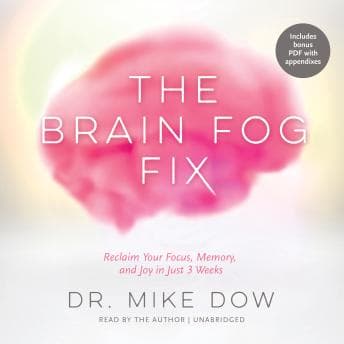

How many books about fixing your brain can you read before your brain starts to feel more broken from the sheer repetition?
I asked myself this somewhere around hour 3, standing on a packed Caltrain platform at 6:12 AM, coffee going cold in my hand, while Mike Dow explained that I should eat more omega-3s and get better sleep. Which—yes. I know. You know. Your grandma knows.
The 21-Day Plan That Could've Been a 21-Minute Blog Post
TL;DR: The science behind serotonin, dopamine, and cortisol is solid but surface-level, and the actionable advice lands squarely in "things you already know but aren't doing" territory.
Look, I don't want to be unfair here. Dow structures the book around a 3-week program targeting those three brain chemicals, and the framework itself is clean. Week one focuses on mood (serotonin), week two on energy and motivation (dopamine), week three on stress (cortisol). It's a reasonable architecture. If this were a system design, I'd say the abstraction layers make sense. The problem is the implementation details are mostly... eat better, sleep more, exercise, meditate, limit screen time, connect with people.
I kept waiting for the "fix" part to get specific. Like, give me dosages. Give me timing protocols. Give me the weird counterintuitive hack that justifies buying a book instead of reading a WebMD article. There are moments—he talks about the relationship between artificial sweeteners and dopamine receptor downregulation, which was genuinely interesting. And the section on how blue light from screens suppresses melatonin production isn't new, but he connects it back to a downstream serotonin deficit in a way that clicked for me. Those moments are scattered throughout, but they're islands in an ocean of advice that feels like it was optimized for the broadest possible audience.
Author-Narrated: The Double-Edged Sword
Mike Dow narrates his own book, which is always a gamble. He's got a calm, therapist-office-on-a-Tuesday energy that matches the content. Not bad. Not memorable. The pacing is steady—almost too steady for an early morning commute where you need some vocal variety to stay locked in. I bumped it to 1.75x around hour 2 and honestly should've started there.
Here's the real problem multiple listeners flagged, and I agree with: this book has worksheets and fill-in-the-blank exercises baked into the text. Dow will literally say things like "rate yourself on a scale of 1 to 10" and then pause. On audio. While you're standing on a train holding a grab bar. There's no companion PDF, no workbook link—just Dow reading instructions you can't follow in audio format. It's like someone ported a desktop app to mobile without rethinking the UX. The format doesn't match the medium.
That friction kept pulling me out. Every time he hit one of those interactive sections, I'd zone out and then have to rewind 30 seconds to figure out where the actual content resumed. On a commute, that's death.
Who This Actually Helps (And Who Should Skip)
If you've never really thought about the connection between diet, sleep, exercise, and mental clarity—if you're genuinely starting from zero on this stuff—this book is a decent onramp. Dow is warm without being preachy, and framing everything through brain chemistry gives the standard wellness advice a more scientific backbone, even if it's Intro to Neuroscience level. May Cause Miracles takes a similar structured-program approach but leans spiritual instead of scientific—same "here's your daily homework" energy, different wrapper.
But if you've read any two books in the self-improvement health space in the last five years? You've heard 80% of this. The ROI on this audiobook is low for anyone who's already dabbling in the optimization world. I've gotten more actionable intel from single podcast episodes of Huberman Lab.
Perfect for: background listening while cleaning, cooking. Skip for: commute (the worksheet sections will drive you nuts), anything requiring sustained attention.
The Commit Message: "Fix common-sense wellness advice; add brain chemistry wrapper"
I didn't hate this book. I just kept thinking about the opportunity cost—7 hours and 44 minutes I could've spent on something with a higher information density. Kevin asked me what I was listening to and I said "a book that's telling me to eat salmon and go outside" and he said "so... your mom?" And honestly? Yeah. Pretty much.
If Dow had cut this to 3 hours, axed the worksheets entirely for audio, and leaned harder into the neuroscience instead of the lifestyle prescriptions, this would've been a solid recommend. Instead it's a library borrow at best—stream it on Libby, cherry-pick the brain chemistry sections, skip the interactive bits.