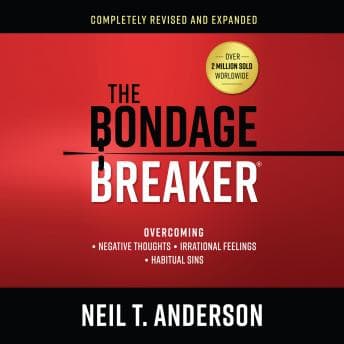

I was making dal makhani—the real kind, the one that takes four hours because my grandmother would haunt me if I used shortcuts—when I started this audiobook. By the time the lentils were properly creamy, I'd already paused three times to scribble notes in my research journal. Not because I was planning to review it. Because Neil Anderson was saying things about the psychology of spiritual bondage that made my academic brain sit up and pay attention.
Look, I'm going to be upfront here. I'm a psychology researcher, not a theologian. My relationship with religion is complicated in the way that being raised Hindu in New Jersey while reading Western philosophy texts tends to make things complicated. But Anderson's framework? It's actually psychologically coherent. And that's rarer than you'd think in this genre.
The Psychology Behind the Spirituality
Here's what got me: Anderson doesn't just throw Bible verses at problems and call it a day. He builds a systematic model of how negative thought patterns become entrenched—what he calls "strongholds"—and honestly, it maps surprisingly well onto cognitive behavioral frameworks. The idea that we're not fighting against our own brokenness but against external spiritual forces that exploit our wounds? That's a fascinating reframe.
From a purely psychological standpoint, this externalization can be therapeutic. It separates the person from the problem (narrative therapy 101) while still demanding personal responsibility for the solution. Anderson walks through case studies—real people locked in cycles of shame, addiction, irrational fear—and shows how identifying the "lie" at the root of each pattern becomes the key to breaking it.
Did I agree with every theological claim? No. Do I need to? Also no. What I appreciated was the internal consistency. This isn't feel-good spiritual advice that falls apart when you push on it. Anderson clearly spent decades refining this approach, and it shows.
Shawn Compton's Pastoral Steadiness
Okay, so the narrator. Shawn Compton has this quality that's hard to describe—respectful without being preachy, warm without being saccharine. For eight hours of content that deals with some heavy stuff (we're talking spiritual attacks, habitual sin, deep shame), that balance matters enormously.
He reads the case studies with genuine empathy. When Anderson describes someone trapped in a cycle of self-destructive behavior, Compton's delivery makes you feel the weight of it. But he never tips into melodrama. There's a steadiness there that feels pastoral in the best sense—like someone who's heard these stories before and still cares.
The pacing is deliberate, which works for this material. You're meant to sit with these concepts, not race through them. I listened at 1x speed, which I almost never do for nonfiction (my therapist says I need to slow down; she's probably right about that too). But rushing through "The Bondage Breaker" would defeat the purpose.
Who Should Listen—And Who Should Skip
Let me be direct: if you're not open to Christian theology, this isn't going to convert you. Anderson writes from a firmly evangelical perspective, and the entire framework rests on accepting certain premises about spiritual reality. Skip it if that's not your world.
But if you're a believer struggling with patterns you can't seem to break? Or if you're a counselor, pastor, or anyone working with people who frame their struggles in spiritual terms? This is genuinely useful material. Anderson's "Steps to Freedom in Christ" at the end are practical, specific, and designed for actual application.
I found myself thinking about clients I've worked with who might benefit from this framework—people for whom purely secular CBT felt incomplete because it didn't address the spiritual dimension of their experience. Psychology has historically been allergic to engaging with faith, and that's a blind spot. 50th Law approaches power and fearlessness from a completely secular angle, but both books share this understanding that transformation requires confronting forces larger than individual willpower.
My Research Notes, Summarized
The production quality is clean, no weird audio artifacts or volume inconsistencies. At 8 hours and 9 minutes, it's substantial but not overwhelming. Perfect for a week of commutes or—apparently—one very long cooking session.
Would I recommend it to my secular colleagues? Probably not without caveats. Would I recommend it to someone who asked me, "How do I break free from these patterns that feel bigger than me?" and who came from a faith background? Absolutely. Anderson understands something important about human nature: sometimes the cage isn't in our heads. Sometimes it's around them. And knowing the difference matters.