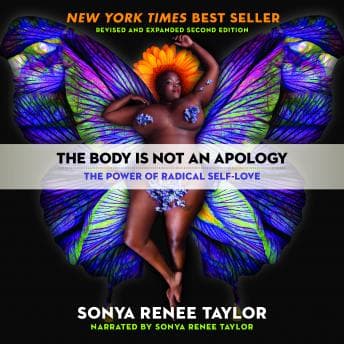

"Your body is not an apology. It is not a thing to be fixed."
I hit pause on my morning jog when Sonya Renee Taylor said that. Just stood there on the Charles River path like an idiot, catching my breath and thinking about every patient I've ever seen who walked into therapy believing their body was the problem. The research shows that body shame is one of the most pervasive forms of internalized oppression we carry—and here's Taylor, a poet and activist, articulating what takes most psychology textbooks three hundred pages to say.
The Psychology Behind the Manifesto
Look, I read a lot of self-help for my research. Most of it makes me want to throw things. The genre is littered with vague platitudes dressed up as wisdom, written by people who've clearly never opened a peer-reviewed journal. Taylor's work is different. She's essentially presenting a framework for cognitive restructuring—the process of identifying and challenging distorted beliefs—but she's doing it through the lens of social justice and systems theory.
What makes this character compelling is—wait, she's not a character. She's the author. But my brain keeps analyzing her like a case study because her approach is so psychologically sound. She traces body shame back to its origins in systems of oppression: racism, ableism, fatphobia, transphobia. Taylor's framework for understanding how systems create individual suffering reminds me of the structural analysis in New Jim Crow—both authors trace personal pain back to institutional design. This isn't just feel-good talk. The research on minority stress theory backs this up completely. When you're constantly receiving messages that your body is wrong, your nervous system stays in a state of chronic threat. Taylor gets this, and she articulates it in a way that's accessible without being dumbed down.
The five-hour runtime flew by. I finished it over three jogs and one very elaborate biryani-making session. (Don't ask how I got turmeric on my earbuds.)
When the Author IS the Narrator
Here's the thing about author-narrated audiobooks: they're a gamble. Some authors have no business reading their own work. Their pacing is off, their vocal range is limited, and you spend the whole time wishing they'd hired a professional.
Taylor? She nailed it. Her voice has this warmth that feels like a compassionate friend telling it like it is—which, honestly, is exactly what the listener reviews said and exactly what I experienced. There's a directness to her delivery that matches the content. She's not hedging. She's not apologizing. (The irony isn't lost on me.) When she talks about body terrorism—her term for the violence these systems inflict—you can hear that she's lived this. It's not academic distance. It's earned authority.
I get why some listeners found the narration style challenging. There isn't a ton of vocal variation. It's more like listening to a really good lecture than a performance. If you need dramatic range to stay engaged, you might struggle. But for me? The consistency worked. It felt intentional, like she was refusing to perform her pain for our entertainment.
What My Therapist Would Say About This Book
She'd probably ask me why I keep analyzing everything instead of just experiencing it. Fair point.
But here's what I found myself asking: why does radical self-love feel so threatening to people? Taylor addresses this directly. She argues that we've been conditioned to believe that self-criticism is the path to improvement—that if we just hate ourselves enough, we'll finally change. The research on self-compassion (Kristin Neff's work, specifically) shows the opposite is true. People who practice self-compassion are actually more motivated to change, not less.
Taylor takes this further. She connects individual healing to collective liberation. You can't dismantle systems of oppression while simultaneously believing those systems are right about your body. It's a fascinating case study in how personal psychology and political action intersect.
The second edition includes a new final chapter with specific tools and actions. This is where it gets practical. She's not just diagnosing the problem—she's offering interventions. As someone who spends her days thinking about therapeutic frameworks, I appreciated that she didn't leave us hanging in the theoretical.
Who This Is For (And Who Might Want the Print Version)
If you're interested in the intersection of psychology, social justice, and embodiment—this is essential listening. Particularly powerful for anyone who's ever felt like their body was a problem to be solved. Commuters, joggers, anyone who needs something meaningful while their hands are busy. Skip it if you want gentle affirmations without the systemic analysis; Taylor's not interested in making you feel good without making you think.
But I'll echo what some listeners mentioned: if you're the type who needs to pause and reflect, to underline passages and sit with ideas, the physical book might serve you better. This is dense material. Not in a boring way—in a "my brain needs a minute" way. I found myself rewinding sections to catch things I'd missed.
The audio quality is clean, no weird production issues. Taylor's pacing is steady. At 1.25x speed, it's still completely comprehensible if you're impatient like me.
Case Closed
Psychologically, this tracks. All of it. And that's not something I say often about self-help books.









