
"I am not a victim. I am a survivor."
That line hit me somewhere around hour twelve, and I had to pause my work completely. Just sat there with my stylus hovering over my tablet, Frida staring at me like I'd lost my mind. Maybe I had. This book does that to you.
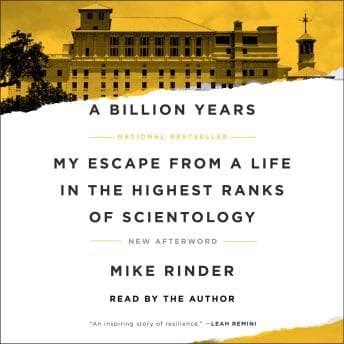
I started A Billion Years on a Wednesday morning, thinking it would be interesting background listening while I worked on a rebrand project. By Thursday night, I'd barely touched the project and had listened to nearly ten hours straight. Some books demand your full attention. This one grabbed me by the throat and wouldn't let go. Jane Eyre did something similar to me—that same relentless pull that makes you forget you have a life outside the story.
When the Person Telling the Story IS the Story
Here's the thing about Mike Rinder narrating his own memoir—you're not just hearing about Scientology's inner workings. You're hearing them from the guy who was literally their international spokesperson for decades. The man who helped negotiate their IRS tax exemption. Who worked directly with Tom Cruise and John Travolta. And now he's sitting in a recording booth, telling you exactly how the whole machine operates.
His voice is... complicated. Some people might find it dry—I get that. He's Australian-born with this measured, almost clinical delivery that can feel detached. But honestly? That restraint made the emotional moments hit so much harder. When he describes being confined to "the Hole"—this makeshift prison where top Scientologists were kept for months, sometimes years—he doesn't dramatize it. He just... tells you. The matter-of-fact way he recounts sleeping on a floor, being separated from his family, watching his colleagues break down—it's devastating precisely because he's not performing devastation.
Abuela would have been clutching her rosary through this entire book, whispering "Dios mío" every twenty minutes. The things this organization did to people. The way they separated families. The psychological manipulation dressed up as spiritual enlightenment. It's like a telenovela villain, except it's real and it's still happening.
The Weight of Fourteen Hours
Okay, let's talk about the length. Fourteen hours and twenty-three minutes is a commitment. And I won't lie—there are stretches in the middle where Rinder gets deep into organizational structures and internal Scientology politics that feel less immediately gripping than the personal betrayals. The section on his rise through the Sea Organization ranks is important context, but it's also where some listeners might zone out.
But here's why you push through: the escape. The aftermath. The moment when a fifty-two-year-old man who has known nothing but this organization since he was five years old finally walks away—and then has to figure out who he even is. That part broke me. Not dramatic ugly-crying, but this quiet, heavy sadness that sat in my chest for hours afterward.
The ending is particularly devastating because there's no neat resolution. His family is still in Scientology. They still won't speak to him. His own daughter has publicly denounced him. And he just... lives with that. Every day. The audiobook ends and you're left sitting with this man's ongoing grief, and it's the realest thing I've listened to in months.
Not Just a Victim—An Enforcer Who Came Clean
I've listened to a few Scientology exposés—they're kind of their own subgenre at this point. But Rinder's perspective is unique because he wasn't just a victim. He was an enforcer. He did the organization's dirty work. He intimidated journalists, attacked critics, helped cover up abuses. And he doesn't shy away from that.
There's this moment where he's describing tactics he personally used against people who left the church—the surveillance, the harassment campaigns, the deliberate destruction of relationships—and you can hear something shift in his voice. It's subtle, but it's there. This isn't a man who's processed and moved on. This is someone still reckoning with what he did and who he was.
That honesty is what elevates this beyond just "interesting exposé" into something that genuinely moved me. He's not asking for absolution. He's just telling the truth, finally, after decades of telling lies for a living.
Who This Will Wreck (And Who Should Skip It)
If you have any interest in cults, high-control groups, or just how smart people get trapped in systems that seem obviously problematic from the outside—this is essential listening. If you watched Leah Remini: Scientology and the Aftermath and wanted more depth, more insider perspective, this delivers.
Skip this if you need lighter fare right now. There's psychological abuse, family separation, and some genuinely disturbing accounts of what happened in that organization. Don't put this on during a casual afternoon of errands. Unspoken Sermons also requires that kind of intentional listening—different subject matter entirely, but the same need to sit with heavy ideas instead of treating them as background noise. Give it the focused attention it deserves.
And definitely don't start it thinking you'll just listen to a chapter or two. I made that mistake. My client deadline got pushed back a day because I couldn't stop listening to a man explain how he lost fifty years of his life to a lie—and found the courage to start over anyway.
Corazón Roto, But Hopeful
My heart. MY HEART. I finished this three days ago and I'm still thinking about it. Still thinking about what it means to wake up at fifty-two and realize everything you believed was constructed to control you. Still thinking about his daughter, his ex-wife, all the people he'll probably never speak to again.
Mike Rinder's voice might not be velvet and honey. It might not have the dramatic range of a professional narrator. But it's the voice of someone who lived this. Every hesitation, every careful word choice, every moment where he seems to be deciding how much to reveal—it's all authentic in a way a hired narrator could never replicate.
This is a rainy Sunday book. A sit-in-the-dark-and-think book. A remember-that-freedom-isn't-free book.
Abuela would have cried too. I know she would have.