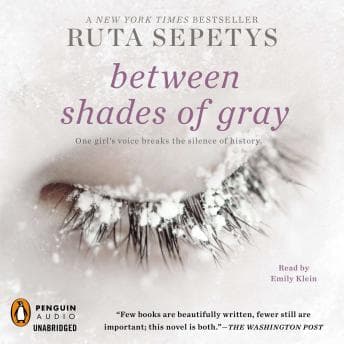

"They didn't just take our home. They took our names."
That line hit me somewhere around hour two, packed into a Caltrain car at 6:47 AM, and I had to actually pause the audiobook. Just... sat there staring at the back of someone's laptop like an idiot. This is not a book you casually listen to while debugging code. Fair warning.
So look, I knew nothing about Soviet deportations of Baltic people before this. Zero. My historical knowledge basically goes: WWII happened, Nazis bad, Allies won. The Soviet side of that horror? Completely absent from my American education. Between Shades of Gray filled in a gap I didn't even know existed, and it did it through a fifteen-year-old Lithuanian girl who draws.
The History They Don't Teach You
Ruta Sepetys does something clever here. She doesn't give you a textbook. She gives you Lina's mother rationing a single beet. She gives you a baby dying on a cattle car. She gives you the specific weight of Siberian cold on starving bodies. The research is clearly meticulous, but it never feels like homework. It feels like testimony.
The audiobook clocks in at just under 8 hours—perfect for about 4 commutes if you're not pausing to collect yourself like I was. The pacing is deliberate. Some might call it slow. I'd call it appropriate. You can't rush through a decade of survival in a labor camp. The story earns its runtime.
What surprised me most was how much hope threads through the darkness. Lina's art becomes this lifeline—she's literally drawing maps and hiding them in her work, trying to reach her father in another camp. It's resistance through creativity, which, okay, as someone who solves problems for a living, that hit different.
Emily Klein's Quiet Power
Here's where I'll be honest: Emily Klein's narration is divisive, and I get why. She's not theatrical. She's not doing big dramatic moments with swelling emotion. Her style is warm, clear, almost gentle—which sounds wrong for a book about Soviet labor camps, but actually works.
Klein's approach is like... okay, imagine your grandmother telling you about the worst thing that ever happened to her. She's not performing it. She's just remembering. That's the vibe. It makes the horror land harder because it's not sensationalized.
Her character voices are distinct without being cartoonish. The Lithuanian pronunciations are solid (I looked some up after—she did her homework). But I can see why some listeners wanted more dynamism. If you need your narrator to really act the emotional peaks, you might find this too restrained. I personally thought it worked. The restraint made me lean in rather than pull back. But your mileage may vary.
Queue This If...
Perfect for: Long commutes where you want something meaningful. Fans of The Book Thief (the comparison is earned). Anyone who wants historical fiction that teaches without lecturing. Parents looking for something to share with older teens—though heads up, there's violence, abuse, and death. It's not gratuitous, but it's not softened either.
Skip if: You need high-energy narration to stay engaged. You're in a mental space where heavy historical trauma will wreck you. You want a fast-paced thriller—this is a slow burn about endurance, not escape.
The ROI on this audiobook is weird to calculate. It's not "useful" in the productivity sense. It won't make you better at your job. But it made me better at understanding a chunk of history I'd never considered, and it did it through a story I won't forget.
Final Commit
Probably won't listen again soon. Not because it's bad—because it's heavy. This is a one-and-done experience that sticks with you. I finished it three days ago and I'm still thinking about Lina's drawings, her mother's impossible choices, the way hope and horror can coexist in the same frozen moment.
Kevin asked me what I was listening to and I just said "Soviet deportations" and he gave me that look he gives when I've gone off the deep end on something dark again. But then I explained the story and now he wants to listen too. So. That's my endorsement, I guess.
Not every audiobook needs to be escapism. Sometimes you need the ones that make you sit on a crowded train, staring at nothing, grateful for the life you have. Though honestly, Character Building gave me a similar gut-check about perspective, just through a completely different lens.