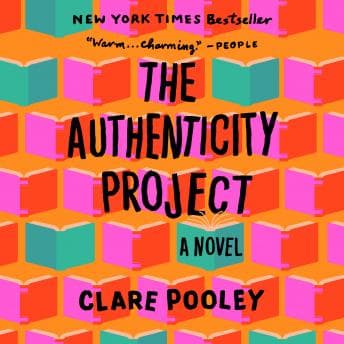

When did we all agree to pretend we're fine? I mean, really — when did that become the social contract? Because Clare Pooley's The Authenticity Project starts with a seventy-something artist named Julian Jessop who's tired of that contract, and he does something beautifully reckless: he writes the truth about his life in a green notebook and leaves it in a café.
I finished this one on a Sunday morning walk along the lakefront with Denise. She kept asking why I was smiling, and I kept saying "nothing," which is ironic given the whole book is about dropping the act. But there I was, grinning at Lake Michigan while a cast of London strangers passed around a journal full of confessions like it was the world's most therapeutic chain letter.
The Notebook Is a Gimmick — And Pooley Knows It
Let's be upfront. The premise — a notebook travels from person to person, each one writing their secret truth, and then they all find each other — is contrived. It's a device. Pooley isn't hiding that. What surprised me is how well she leans into it rather than apologizing for it. Julian's entry about the loneliness of outliving everyone you loved, about rattling around a house that used to hold a marriage and a career — that landed harder than I expected from a book marketed as "feel-good." This isn't Hemingway's iceberg theory; Pooley puts the feelings right on the surface. But there's a sincerity to it that I respect.
The ensemble works because each character's "truth" is a different flavor of self-deception. Monica runs her café with military precision because control is the only thing keeping her together. Alice curates an Instagram life so flawless it's basically fiction — and Pooley writes her inner monologue with the kind of exhausted desperation that any parent will recognize. Hazard (yes, that's his name, and yes, the book earns it) is a charming addict whose journal entry is basically a goodbye letter to cocaine. The range here is impressive, even if some characters get more depth than others.
Where it wobbles is the ending. The last couple of hours feel like Pooley is tying bows on every single thread, and some of those bows are tied a little too neatly. Life doesn't resolve that cleanly, and a book about radical honesty probably shouldn't either. I wanted at least one thread left frayed.
Anna Cordell Carries a Crowded Room
Here's what I kept thinking: this book has a LOT of voices. Julian is elderly, proper, British. Monica is wound tight. Hazard is charismatic and careless. Alice is younger, anxious, performing. And Cordell keeps them all distinct without turning anyone into a caricature. Her Julian has this weary warmth — you can hear the age in his voice without it becoming a parody of an old man. Her Monica is clipped and precise in a way that softens gradually as the story opens her up. It's subtle work.
The accents across the cast — and there are several, given London's diversity — are handled with care. Nothing felt forced or offensive, which with this many characters is genuinely difficult. I've listened to audiobooks where six characters sound like three people doing impressions. This isn't that. Cordell earns her keep.
The emotional beats land well too. There's a scene where Julian realizes what the notebook has actually set in motion, and Cordell gives him this quiet crack in his voice — not a full breakdown, just a fracture. The narrator understands that pause is punctuation. She lets moments breathe instead of rushing to the next plot point, which is exactly what a story about vulnerability needs.
Who Should Pick Up This Notebook
If you loved Eleanor Oliphant Is Completely Fine or A Man Called Ove, this is their spiritual successor — ensemble fiction where lonely people stumble into community despite themselves. Remember Me? operates in that same neighborhood — characters performing competence while quietly falling apart — though Pooley's warmth runs a few degrees warmer. It's warm without being saccharine. Mostly.
If you need your fiction dark, ambiguous, or structurally experimental — my students would hate this. I love it, but I'll admit it's comfort food, not a five-course meal. The contrivances will bother you if you can't relax into them.
This is perfect for walks, commutes, light housework — anything where you want company that makes you feel a little more generous toward strangers. It's ten and a half hours, and it moves. I never once felt the urge to check how much time was left, which is more than I can say for Principal Martinez's last all-staff meeting.
Worth Pausing the Faculty Meeting For
Pooley wrote a memoir about getting sober before she wrote this novel, and you can feel that honesty in the DNA of the book. The parts about addiction, about the gap between who we perform and who we are — those aren't written from the outside looking in. They have weight. The book isn't going to change your life, but it might make you slightly more honest at brunch. And honestly? That's enough. The prose deserves to be savored, and Cordell makes sure you do.









