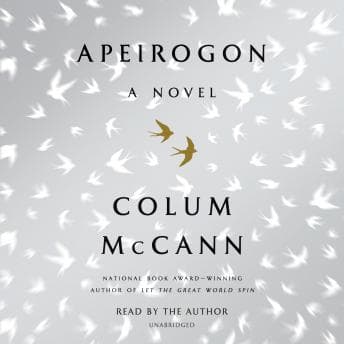

Fifteen hours. Fifteen hours of grief mathematics, and I'm still not sure I've processed half of it.
Look, I need to complain about something first. McCann structures this novel around 1,001 numbered fragments—yes, like Scheherazade, yes, like an apeirogon's infinite sides—and my brain, trained on Dickensian chapters and Faulknerian run-ons, kept wanting to impose order where McCann deliberately refuses it. I'd be grading essays at 11 PM, listening to fragment 247, and suddenly we're discussing the migratory patterns of birds over the Jordan Valley. Then fragment 248 snaps us back to a father identifying his daughter's body. The whiplash is the point. I know it's the point. But Principal Martinez, if you're reading this, I was definitely not paying attention during that Thursday meeting because I was too busy trying to hold two fathers' grief in my chest.
What Hemingway Knew About Silence
Here's what McCann understands that most performers don't: pause is punctuation. He reads his own work, and his Irish lilt carries these Mediterranean tragedies with a strange, perfect distance. He's not trying to become Bassam or Rami—he's the witness, the chronicler, the one who sat with these real men and listened. When he reads the sections about Smadar's death, about Abir's death, there's this restraint that somehow amplifies everything. He doesn't perform grief. He presents it. Lets you do the work.
The pacing is—and I don't use this word lightly—flawless. Fifteen hours could drag. Should drag, maybe, given the fragmentary structure. But McCann knows when to linger on a mathematical concept about infinite-sided shapes and when to deliver a single devastating sentence and move on. The central chapters, where Bassam and Rami essentially interview each other about their daughters, hit with the weight of testimony. This is why we still read the classics, why Antigone still matters—because grief and justice and the impossible calculus of violence never stop being relevant. Narrative of the Life of Frederick Douglass operates on that same principle—bearing witness to violence with restraint that amplifies rather than diminishes the horror.
The Sprawl Problem (And Why I Forgive It)
I've seen some readers call this repetitive. Sprawling. They're not wrong, technically. McCann circles back to images—birds, checkpoints, the rubber bullet, the suicide vest—with the obsessive return of trauma itself. If you're looking for plot momentum, you'll be frustrated. This isn't a novel that moves forward. It spirals. It accumulates.
But here's what I kept thinking during those late-night grading sessions: this is how grief actually works. You don't process your daughter's murder and move on to the next chapter of your life. You return and return and return. The structure isn't indulgent—it's mimetic. McCann is teaching you to think like someone who has lost a child to violence they can't control or understand.
My students would hate this. I love it.
Who Should Take This Walk (And Who Should Skip It)
This demands focused listening. Don't try it during your commute unless you're prepared to sit in your parked car for twenty minutes afterward, staring at nothing. Don't try it as background noise—the fragments require your attention to accumulate their power. I listened during lakefront walks with Denise, and we'd have to stop talking for long stretches, just processing.
If you loved Let the Great World Spin, this is its spiritual successor—same ambition, same willingness to braid disparate threads, same faith that readers can hold complexity. If you're looking for a straightforward narrative about the Israeli-Palestinian conflict with clear heroes and villains, look elsewhere. McCann refuses that comfort. Both fathers are heroic. Both have been shaped by systems that taught them to hate. Both chose something harder than hate.
Skip this if you need forward momentum, if fragmentary structure frustrates you, or if you're not in a place to sit with grief about children. Content warning: violence, the deaths of children. McCann doesn't sensationalize, but he doesn't look away either.
Worth Pausing the Faculty Meeting For
The prose deserves to be savored. At 1.0x—because the author chose those words and that rhythm—this is an audiobook that rewards patience. McCann's narration adds something a hired performer might have missed. He knows where the weight falls in his own sentences.
Is it perfect? The sprawl will lose some listeners. The structure asks a lot. But this is the kind of ambitious, humane fiction that reminds me why I became an English teacher in the first place—before the grading destroyed my eyesight and patience, before I started listening to audiobooks to survive. McCann took a real friendship between two grieving fathers and built a cathedral around it. Infinite sides, no beginning, no end. Just two men who chose to see each other as human.
That's worth fifteen hours. That's worth everything.









