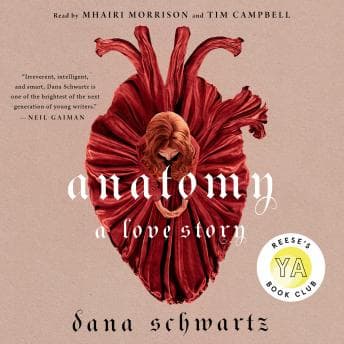

Denise and I were doing our Saturday morning lakefront walk - the one where we pretend we're exercising but really we're just strolling slow enough that joggers give us looks - and somewhere around North Avenue Beach, Mhairi Morrison's Scottish accent describing a body being dug up from an Edinburgh churchyard made me stop dead on the path. Denise had to pull me forward. "You're blocking the runners," she said. I didn't care. I was in 1817 Scotland and a woman was cutting open a cadaver in her bedroom, and the prose deserved to be savored.
Dana Schwartz's Anatomy: A Love Story is, on its surface, a YA gothic romance. A lady who wants to be a surgeon. A body snatcher with a conscience. Edinburgh in the age of grave robbing and Roman Fever. And look, I'll be honest - when I saw "Reese's YA Book Club Pick," part of my brain (the insufferable grad school part) flinched. My students would hate this. I love it. Well - mostly.
Hazel Sinnett Would've Survived My AP Lit Class
What makes this book work is Hazel. She's not the typical "girl ahead of her time" character who just sort of vaguely wants more from life. She's specific. She wants to pass a medical examination. She studies anatomy texts with the obsession of someone who genuinely loves the work, not just the idea of defying convention. When she makes her deal with Dr. Beecham - pass the exam on her own and he'll let her continue - there's no fairy-tale expectation that it'll be easy. She needs corpses. She needs to teach herself. And she needs Jack Currer, a resurrection man who digs up the dead for coin, to help her get them.
The relationship between Hazel and Jack unfolds slowly - some listeners find too slowly, and I understand that complaint. The first couple of hours spend a lot of time establishing Edinburgh's class structures, Hazel's family dynamics, the social machinery that makes it nearly impossible for a woman to study medicine. This reminds me of what Hemingway said about building the foundation before you show the iceberg. Schwartz is laying groundwork. But I'll admit there were moments during those early chapters where I caught myself glancing at the timer on my phone, which is never a great sign.
Once Hazel and Jack start working together, though? The book finds its heartbeat. There's genuine chemistry built not on longing glances (though there are some) but on shared purpose. They bond over anatomy and mortality and the absurd cruelty of a society that treats the poor as disposable. That's the real love story - not just between two people, but between a young woman and the knowledge she's been told she doesn't deserve.
Morrison's Voice Is the Edinburgh Fog
Let's talk about what the narrator is really bringing to this. Mhairi Morrison narrates the main story, and her Scottish accent doesn't just add flavor - it IS the atmosphere. When she voices Hazel's determination, there's an edge of stubborn pride in the delivery that feels historically grounded. When she shifts to Jack, there's a roughness, a wariness. You can hear class difference in the way she shapes vowels. Tim Campbell handles the newspaper clippings and medical journal excerpts, and his clipped, formal delivery against Morrison's warmth creates this wonderful contrast - the cold institutional voice of Edinburgh's establishment versus the beating human heart of the story.
The narrator understands that pause is punctuation. There are moments - particularly in the gothic sequences when bodies aren't staying where they're supposed to and strange men are skulking through graveyards - where Morrison lets silence do the heavy lifting. No sound effects, no music. Just a held breath before something terrible. Worth pausing the faculty meeting for, absolutely. (I was actually listening during one of those interminable Wednesday PD sessions. Sorry, Martinez.)
The Ending Problem
Now. I have to address this because I'd be lying if I didn't. The last hour or so takes a turn that I think Schwartz was building toward but that still lands like someone changed the channel. The story shifts from historical medical drama into territory that feels - how do I put this - like it belongs in a different book. The twist isn't bad exactly, but it arrives with the subtlety of a student who realizes their essay is due in ten minutes and suddenly introduces a thesis they haven't supported. You can feel the gears grinding as the genre shifts. Some readers will love it. Some won't. I found myself wishing the ending had trusted the quieter, human story as much as the first eight hours did. That same frustration with a third-act pivot hit me reading Dark Carousel, where the atmosphere is doing everything right until the plot decides it needs to prove something.
That said, this is a debut novel, and a remarkably confident one. Schwartz writes with the kind of historical specificity that doesn't feel like homework - Edinburgh's close-packed streets, the stink of the anatomist's theater, the casual brutality of a city where poverty is a death sentence and the dead are commodities. If you loved The Alienist for its period atmosphere, this is its spiritual successor in YA form.
Who Gets the Scalpel
This is for readers who want gothic atmosphere with actual substance underneath, who don't mind a slow build if it pays off emotionally, and who appreciate a heroine defined by ambition rather than romance. Skip it if genre shifts in the final act will ruin the whole experience for you, or if you need constant momentum. The audio production is genuinely excellent - the dual-narrator format works cleanly, and Morrison's performance alone is reason to choose the audiobook over print.
The Annotated Margin Note
Nine and a half hours. Not all of them perfect. But the ones that work - Hazel with a scalpel in her hand, Jack weighing the cost of another grave, Morrison's voice turning Edinburgh into something you can smell - those hours are genuinely good. My students would eat this up, and for once, I wouldn't even be mad about it.