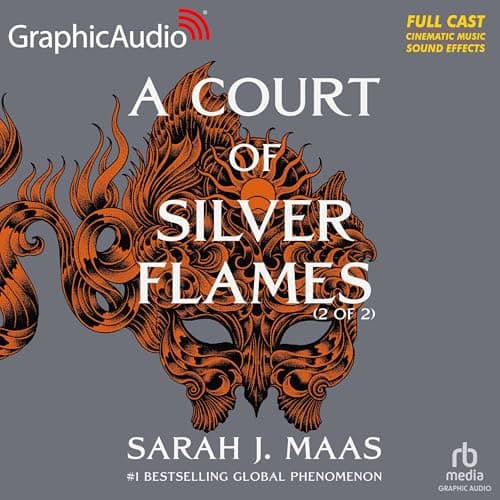

"I am the rock against which the surf crashes."
That line hit me at roughly the six-hour mark, and I was sitting cross-legged on my apartment floor surrounded by half-catalogued donations for the library's annual horror fiction sale, Shirley asleep on a pile of old Koontz paperbacks, and I had to pause the audio because something about the way Natalie Van Sistine delivered it — quiet, almost fractured — made my throat close up. Which is not what I expected from a romantasy about Fae warriors and magic staircases. And yet.
Look. I came to this as a horror person. My podcast is about dread and darkness and the things that crawl in the spaces between what's said and what's meant. A Court of Silver Flames is not horror. But Nesta Archeron's arc? The self-destruction, the numbness, the way she uses cruelty as armor because vulnerability might actually kill her? That's a different kind of haunting. And this dramatized adaptation understands that.
Nesta Archeron Deserves Better Than Your Hot Take
Here's what surprised me: I went in thinking this would be pure spice-and-swords entertainment — and there's plenty of that, don't get me wrong — but Part 2 of this dramatized adaptation lives and dies on Nesta's internal battle. The training sequences with Cassian aren't just "will they or won't they" tension. The sound design during the blood rite preparation scenes — clanging steel, the scrape of blade against whetstone — creates this visceral, almost claustrophobic pressure that mirrors what's happening inside Nesta's head. She's not just learning to fight. She's learning to exist in a body she didn't choose.
Van Sistine gets this. Her Nesta isn't softened for palatability. There's a brittleness in her delivery during the quieter scenes — the moments where Nesta is alone with her thoughts — that sounds like someone holding themselves together through sheer spite. And then Jon Vertullo's Cassian crashes in with this warm, almost reckless energy that creates genuine friction. Not just romantic tension. Actual friction. You can hear the difference between the moments where they're sparring verbally and the moments where the walls start coming down, and that's acting, not just reading.
The Full Cast Experiment (Does It Work Though?)
Twenty-five voice actors. That's not a cast, that's a small theater company. And I'll be honest — when I see numbers like that, my instinct is skepticism. Too many voices can fracture a narrative, turn it into an audio play where you're constantly trying to figure out who's talking instead of sinking into the story. I ran into exactly that fracture problem with Way of Kings, where the sheer scale of the cast occasionally cost me the thread of who I was supposed to be following — so when a production this size actually holds together, I notice.
But this production commits. The narrator commits. That's rare. The transitions between characters feel organic because the sound design does heavy lifting — there's a subtle shift in atmosphere when scenes move from the training ring to the quieter domestic spaces. Soothing musical interludes between battle sequences give your ears (and your nervous system) actual breathing room. The sword fights sound like sword fights, not like someone banging pots together in a studio. Colleen Delany anchors the narration portions with enough authority that the ensemble never feels chaotic.
My one gripe — and it's more of a dramatized adaptation issue than a performance issue — is that with this many voices, some of the secondary characters blend together. The Queens' Alliance subplot gets a little muddy when you're trying to track political machinations across multiple unfamiliar voices. It's Part 2 of a split adaptation, so context from Part 1 is assumed, and if you're jumping in cold you will be lost.
The Spice, The Sword, and The Sobbing
I should mention the content. There's explicit sexual content here — this is ACOTAR, after all — and the dramatized format makes those scenes... present. Like, very present. I was not expecting full sound-designed intimacy at ten o'clock on a Tuesday while sorting library donations. Shirley (my cat) was unimpressed. I was caught off guard. Fair warning.
But what actually got me — what I didn't expect to care about this much — was the emotional payoff. Nesta's healing isn't linear. She backslides. She lashes out. She earns nothing easily. And when the redemption moments land, they land because Van Sistine has been building to them across hours of carefully calibrated vulnerability. I listened in the dark for the final stretch. Mistake? Maybe. Worth it? Absolutely. Not because it was scary, but because the emotional weight demanded that kind of attention.
Who Should Listen (And Who Should Skip)
You want this if you've been following the ACOTAR series and want to hear Nesta's story given the full theatrical treatment it deserves. You want this if you believe romance and trauma recovery can coexist in the same narrative without cheapening either one. You want this if you're the kind of listener who closes your eyes and lets a full cast wash over you.
Skip if you need a standalone — this is Part 2 of 2, and it assumes you know these characters. Skip if dramatized adaptations with music and sound effects pull you out of the story rather than deeper in. Skip if you're looking for something you can half-listen to while doing dishes — this demands your focus or it gives you nothing.
My Podcast Listeners Are Going to Have Questions
I'm a horror person reviewing a romantasy, and I'm giving it high marks. My podcast listeners are going to love this — or at least the ones who understand that horror and romance share the same root: vulnerability as the price of survival. Nesta Archeron walks through her own personal hell in this book, and the dramatized format turns that walk into something you don't just read. You witness it. Horror-adjacent emotional devastation that respects the genre it's playing in — even if that genre isn't mine.









![House of Earth and Blood (2 of 2) [Dramatized Adaptation]: Crescent City 1 audiobook cover](/_next/image?url=https%3A%2F%2Fcovers.audiobooks.com%2Fimages%2Fcovers%2Ffull%2F9798890550910.jpg&w=1920&q=75)