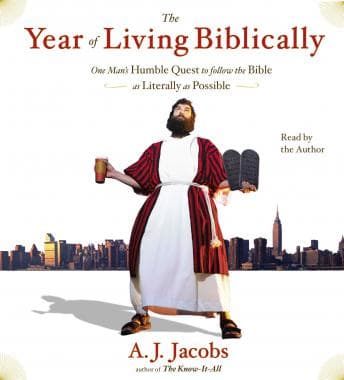

Look, I'm going to be honest with you - this is not the kind of book that usually makes me cry. And it didn't. But it did something else that caught me completely off guard: it made me miss my abuela in a way I wasn't expecting.
A.J. Jacobs spends a year following the Bible as literally as humanly possible - the Ten Commandments, sure, but also the weird stuff. The mixed-fiber clothing ban. The beard that grows so wild people mistake him for ZZ Top. The part where he throws pebbles at an adulterer in the park (yes, really). And somewhere between the sheep-tending in Israel and the hymn-singing with the Amish, I found myself thinking about Abuela's rosary and the way she'd clutch it during telenovela plot twists.
She would have had OPINIONS about this book. Strong ones. Probably involving a lot of head-shaking and muttering about gringos.
When the Author IS the Narrator
Here's the thing about author-narrated audiobooks - they're a gamble. Sometimes you get the person who lived the story bringing it to life with all the texture and emotion only they could provide. Sometimes you get... well, someone who maybe should've let a professional handle it.
Jacobs lands somewhere in between, and I need to be real about this. His delivery has this self-aware, slightly smug quality that I could see driving some people up the wall. There's definitely an "oh, aren't I clever" energy that creeps in, especially in the first couple hours. I caught myself rolling my eyes a few times while working on a logo redesign, which - not ideal when you're trying to get the kerning right.
But here's what saved it for me: the guy is genuinely curious. Underneath the cleverness, there's someone who actually wants to understand why people believe what they believe. And when he's talking about the Hasidic Jews in Brooklyn or the Jehovah's Witnesses he does Scripture study with, his voice softens. Gets warmer. That's when the narration works.
At 6 hours and 17 minutes, it's not a huge time commitment. I got through it in two days of design work - a brand identity project that needed a lot of color palette experimentation. The pacing felt right for that kind of focused-but-not-too-focused listening.
The Moments That Hit Different
Okay, so I didn't ugly-cry. But there were moments that got me. The way he talks about his wife's patience (and occasional exasperation) with his year-long experiment - that felt real. Marriage is weird and hard and beautiful, and he doesn't pretend otherwise.
And there's this part where he's wrestling with what it means to be a secular person engaging seriously with faith, and I just... felt that. Growing up with Abuela's Catholicism on one side and my parents' skepticism on the other, I've lived in that in-between space my whole life. Jacobs doesn't resolve it neatly - because how could he? - but he sits in the discomfort honestly.
The creationist museum visit in Kentucky is both hilarious and kind of heartbreaking. He's not mocking these people, even when their beliefs seem wild to him. There's a gentleness there that surprised me.
Who Should Press Play (And Who Should Maybe Not)
This book felt like a Sunday morning conversation with a really smart friend who's done something ridiculous and wants to tell you about it. If you're into memoirs where people do weird experiments and actually learn something? You'll probably dig this. I'm Glad My Mom Died has that same raw honesty about family and belief systems, though Jennette McCurdy's delivery is way less smug.
But - and this is a real but - if author-narrated audiobooks tend to annoy you, sample first. Jacobs's delivery is definitely an acquired taste. Some listeners apparently prefer the print version, and I get it. His voice has a specific energy that either works for you or really, really doesn't. Skip this one if you need your narrators polished and professional.
For me, listening at my usual 1.0x speed while Diego napped on my keyboard and Frida judged me from her perch on the bookshelf, it worked. Not perfectly. But enough.
Miss You, Abuela
I found myself thinking about faith differently by the end. Not in a "I'm going to start going to church" way, but in a "maybe I understand Abuela a little better now" way. And honestly? That's worth something.
Abuela would have loved arguing with this book.