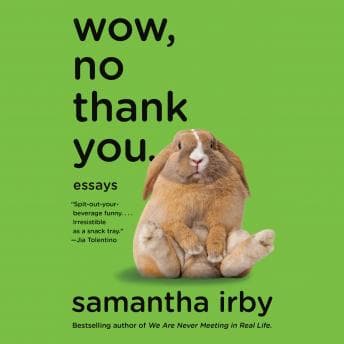
Samantha Irby is not who I assign to my students. Let me just get that out of the way.
I was grading a stack of sophomore persuasive essays at 11:30 PM — the ones where they argue that homework is unconstitutional, which, honestly, some of them make a better case than you'd expect — and I needed something in my ears that wasn't my own internal monologue screaming about comma splices. So I put on We Are Never Meeting in Real Life, expecting light, bloggy humor. Background noise. Something to keep me awake through essay number thirty-seven.
I did not grade another essay for forty-five minutes.
The Voice That Won't Let You Multitask
Here's the thing about author-narrated audiobooks: most of the time, you can tell the person is a writer, not a performer. The pacing is off. They swallow their best lines. They read their own prose like they're apologizing for it. Irby does none of that. She reads her own work like she's telling you this story at a bar at 1 AM and she doesn't care if the table next to you is eavesdropping. There's this deadpan flatness to her delivery — she'll describe something genuinely devastating, like the reality of losing her mother as a teenager or navigating her father's absence, and she won't signal to you that it's time to feel sad. She just... says it. Same tone she uses for describing a catastrophic date or her relationship with gas station snacks.
And that's what makes it land so hard. She trusts you to figure out when it hurts.
I teach kids about tone every semester. I tell them the words on the page are only half the equation — the other half is how those words sit in the air. Irby's narration is the best example of that principle I've encountered in years. The essay about scattering her estranged father's ashes in Nashville — it's funny, it's profane, it's structurally a mess in the way real grief is a mess — and her voice carries all of that simultaneously. No dramatic pauses where a professional narrator would insert them. Just Irby, talking, letting the contradictions pile up until you're laughing and then suddenly you're not.
What Montaigne Would Sound Like With a Blog and Crohn's Disease
Look, I know that comparison sounds ridiculous. But the personal essay as a form goes back centuries, and what Irby is doing — this brutally honest self-examination wrapped in humor so dark it borders on armor — has a lineage. She writes about her body failing her (she has Crohn's disease and discusses it with zero sentimentality), about growing up poor on Chicago's South Side, about the specific humiliation of being the friend who can't keep up with suburban-mom social dynamics. And she does it with the same fundamental project that drives the best essayists: Who am I, really, when I stop performing?
The difference is she'd never frame it that way. She'd frame it as "here's the time I ruined everything at a nice restaurant because my intestines declared war." But the question is the same one Didion asked, the same one Baldwin asked. Just with more profanity. Way more profanity. Mat Best does something structurally similar in Thank You for My Service — that same move where the humor is so thick you almost miss the grief underneath it, and the author-narrator is the only one who could have delivered it without it falling apart.
(My students would actually love this. I'm not assigning it. Principal Martinez would have my job.)
The nine-hour runtime is about right for an essay collection — long enough that you get the full range of who Irby is, short enough that no single essay overstays. Some pieces hit harder than others. The Bachelorette essay is pure comedy. The ones about her parents are something else entirely. The tonal whiplash is the point, and in audio form, with her voice carrying you between those registers, it works better than it probably does on the page.
Who Gets an A, Who Should Drop the Course
If you need your humor clean, skip this. The language is aggressively vulgar — and I say this as someone who has heard what teenagers say when they think no teacher is listening. If you want tidy narrative arcs with neat emotional resolutions, this isn't that either. Irby's essays end the way life ends things: abruptly, without lessons learned, sometimes mid-thought.
But if you've ever laughed at something because the alternative was crying about it — if you've ever used humor as a load-bearing wall in your emotional architecture — this is your book. And the audio version specifically, because Irby's voice IS the instrument here. Reading it in print, you'd supply your own internal narrator. You'd be wrong. Her timing is the text.
I finished it on a Saturday walk along the lakefront with Denise. She asked me why I kept stopping to laugh and then looking sad. I said I was listening to essays. She said, "You're always listening to essays." She's not wrong. But these ones earned every pause.
The Marginalia on This One Says "Keep"
Listen at 1.0x. I know, I always say that. But Irby's comic timing depends on the silences between sentences — speed it up and you lose the deadpan, and the deadpan is doing about sixty percent of the work. This is the rare audiobook where the author isn't just the best narrator for the material. She's the only possible one.