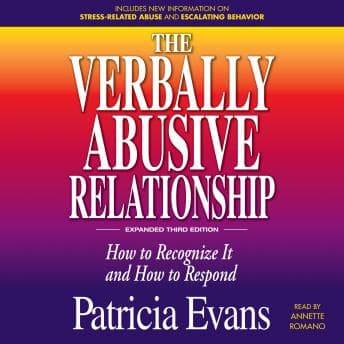

I was up at midnight stress-eating leftover kimchi jjigae and going through quarterly projections for a client who's burning cash like it's decorative when I decided to switch gears and finish this one. Not my usual lane - I review business books, not self-help relationship guides. But here's the thing: I've sat in enough boardrooms and founder meetings to know that verbal abuse isn't just a domestic issue. It's a management issue. It's a partnership issue. It's a "why did your entire engineering team quit in six months" issue. So yeah, Patricia Evans landed on my playlist.
Bottom line: This book has maybe 3-4 hours of genuinely useful framework buried inside 9.5 hours of repetition. The core insight - that verbal abusers operate from a "Power Over" reality while their partners operate from a "Personal Power" reality, and these two worldviews are fundamentally incompatible - is worth understanding. Everything else is Evans saying the same thing fourteen different ways.
The Framework My Parents Never Had Words For
Here's what got me. Evans breaks verbal abuse into categories: withholding, countering, discounting, trivializing, blocking, diverting, accusing, judging, criticizing, undermining, threatening, name-calling, forgetting, ordering, denial, and abusive anger. That's sixteen categories. And when she started walking through them with real examples - the husband who responds to "I felt hurt when you said that" with "You're too sensitive, that never happened" - I thought about every toxic founder-cofounder dynamic I've consulted on. Every passive-aggressive VP who says "I never said that" in meetings. The patterns are identical.
The "two realities" concept is the strongest piece. Reality I (Power Over) vs. Reality II (Personal Power). Evans argues that the abuser isn't just being mean - they're operating from a completely different model of what relationships are for. Control vs. mutuality. I've seen this fail at three different companies where the CEO literally could not comprehend that employees weren't extensions of their will. Evans puts clinical language around something my mom would've just called 사람이 아니야 - "that's not a person" - meaning someone who's lost their humanity in how they treat others.
The sample scripts for responding to verbal abuse are practical. "Stop it." "I don't accept that." "That's not funny to me." Short, direct, boundary-setting. This is what my parents did instinctively. Now it has a TED talk. But Evans earns her keep here because she explains WHY these responses work - they refuse to engage with the abuser's reality framework.
Where the 9.5 Hours Start to Hurt
Here's my problem. Evans has maybe 200 pages of material stretched across what feels like 400. By hour 6, I was hearing the same case studies rephrased. Woman calls in, describes abuse pattern, Evans categorizes it, offers response strategy. Rinse. Repeat. I get that repetition serves a therapeutic purpose - if you're IN an abusive relationship, hearing your experience validated twelve times might be exactly what you need. But from a pure information-density standpoint? My 2.0x speed couldn't save this one.
The two new chapters on "Outside Stresses" and "Levels of Abuse" feel bolted on. The outside stresses chapter basically says economic pressure and social media amplify abusive tendencies. Which... yes? But it reads like a magazine article grafted onto a clinical text. The levels chapter is more useful - mapping the escalation from subtle undermining to overt threats - but it could've been a single chapter insert, not a selling point for a whole new edition.
Annette Romano's narration is competent and steady. She reads the material with appropriate gravity without tipping into melodrama, which for this subject matter is the right call. No vocal fireworks, no dramatic interpretation - just clear, measured delivery. For a book that deals with heavy emotional content, that neutrality actually works. You want the material to land on its own weight. That said, 9.5 hours of that same measured tone does flatten out after a while.
Who Actually Needs This in Their Ears
If you're in a relationship where you constantly feel confused about what just happened in a conversation, where you find yourself apologizing for things you didn't do, where you've started questioning your own memory - skip to the chapter on "countering" and "denial" first. That's where Evans is sharpest.
If you're a manager, HR professional, or anyone who deals with interpersonal dynamics in organizations - chapters 3 through 7 have frameworks you won't find in any leadership book. Seriously. The pattern recognition alone is worth it. I made a similar note in my review of Good Leaders Ask Great Questions — Maxwell approaches interpersonal dynamics from the opposite direction, but the gap between what leaders think they're communicating and what people actually hear is the same blind spot Evans is diagnosing.
If you already know you're in a verbally abusive situation and need an exit strategy, this book is heavier on recognition than action. It'll validate your experience but won't hold your hand through leaving.
Jenny would say I'm being harsh. Jenny is right. This book has helped millions of people name something they couldn't name before. That matters more than my complaints about information density. But I also think Evans could respect her readers' time more - especially people in crisis who need answers, not repetition.
The Consulting Fee
The key takeaway is worth the listen. The other 7 hours? Not so much. Evans' core framework - the two realities, the sixteen categories, the response scripts - is genuinely powerful stuff. I just wish someone had edited this the way McKinsey edits a deck: what's the one thing the client needs to walk away with? Give them that in half the time. Speed recommendation: 1.75x minimum, and don't feel guilty skipping ahead when you hear the same pattern for the fourth time.









