
"It's like having Ye Wenjie reading the book, her voice full of tragedy."
Someone on Reddit said that, and honestly? They nailed it. I was lying on the couch at 1AM last Tuesday — Kevin was already asleep, I'd just rage-closed my laptop after a particularly stupid Kubernetes issue — and Rosalind Chao's voice hit me with this weight of sadness during the Cultural Revolution opening that made me forget I was even angry. That opening section, where Ye Wenjie watches her father beaten to death during a political rally, is one of the most devastating sequences I've encountered in hard sci-fi. And Chao delivers it with this quiet, restrained grief that feels earned rather than performed.
TL;DR: Worth your commute, but barely — this one demands your full attention in ways most audiobooks don't.
The Science Actually Holds Up (Mostly)
Look, I'm a software engineer, not a physicist, but I know enough to appreciate when an author does the homework versus when they're hand-waving. Liu Cixin's treatment of the three-body problem — the actual orbital mechanics problem, not just the title — is genuinely rigorous. The virtual reality game sequences where Wang Miao enters the Trisolaran civilization and watches their chaotic eras destroy entire civilizations because three suns refuse to behave predictably? That's real physics extrapolated into worldbuilding, and it's the kind of thing that makes my brain light up.
But here's where I need to be honest about the audiobook format specifically: this book has sections that are dense. The nanomaterial countdown plotline, the explanation of the sophon unfolding into lower dimensions — these are concepts that in print you can re-read three times and stare at the ceiling. At 1.5x on a packed Caltrain at 6:15AM? I caught myself rewinding more than I have for any book this year. I actually dropped to 1.25x for the physics-heavy chapters, which I almost never do.
The unfamiliar Chinese names are a real factor too. If you're not familiar with Chinese naming conventions, keeping Wang Miao, Ye Wenjie, Wei Cheng, and Shen Yufei straight by audio alone takes effort. I grew up around Mandarin speakers (shoutout to half my CS cohort at UW), so this wasn't an issue for me, but I get why some listeners struggle.
Rosalind Chao's Ye Wenjie Problem — In the Best Way
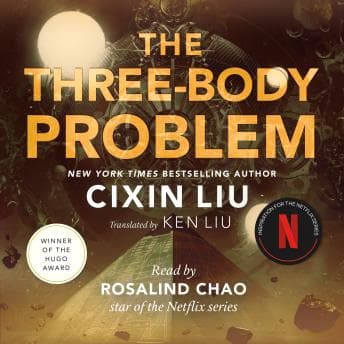
So here's the interesting thing about this narration: Rosalind Chao literally plays Ye Wenjie in the Netflix show. And you can feel it. Her performance skews heavily toward Ye Wenjie's emotional register — tragedy, regret, this bone-deep weariness of someone who made a civilization-ending decision and would maybe do it again. When she voices Ye Wenjie's sections, it's electric. That scene where Wenjie sends the signal from Red Coast Base, knowing full well what she's inviting? Chao reads it with this eerie calm that's more terrifying than any dramatic delivery would be.
The tradeoff: her Da Shi (the chain-smoking, foul-mouthed detective) is serviceable — brisk and no-nonsense — but doesn't have the same lived-in quality. And Wang Miao, our supposed protagonist, sometimes feels like a vehicle between the actually interesting parts rather than a character Chao is particularly invested in voicing. It's a single-narrator production with no sound effects or music, which is fine, but it means the narrator has to carry everything. Chao carries about 75% of it really well and the rest is... competent.
This is basically the narrator equivalent of a function that's optimized for one code path but handles the edge cases with generic fallbacks.
Who Should Queue This Up (And Who Should Grab the Paperback Instead)
Perfect for: focused listening sessions, road trips where you can actually concentrate, insomnia at 1AM when your brain won't shut off anyway.
Skip the audio for: commute listening if you're the type who zones out between stations. This is NOT a background book. If you're doing dishes or half-asleep, you'll miss critical plot mechanics and then the ending won't land.
If you watched the Netflix show and want the actual story with all its hard-science teeth intact — the show simplified a LOT — this is your move. If you've never touched the series and you're debating between this Rosalind Chao version and the older Luke Daniels narration, I'd say Chao wins on emotional authenticity for the Chinese characters, Daniels might win on broader character differentiation. Your call.
The ROI on this audiobook is high but front-loaded — the first third (Cultural Revolution through the VR game reveal) is absolutely gripping. The pacing reminded me of To Light a Candle — another trilogy-opener that spends serious real estate on world-building infrastructure before the payoff arrives, and rewards the patience in roughly the same proportion. The middle section where it becomes more of a procedural investigation dips in energy. The ending ramps back up to genuinely unsettling. Classic trilogy-opener structure: it's a setup book, and it knows it.
Debugging My Rating
I'm giving the book itself a 4.5. Chao's narration specifically gets a 3.5 — really strong in spots, just not consistent enough across all characters to hit the highs I expect from my favorite narrator performances. (Sorry Rosalind, you're no Ray Porter. But then, who is?) The 14-hour runtime is about right for the content density. I finished it across maybe five listening sessions over a week, which is slow for me, but I was genuinely paying attention the whole time rather than my usual half-zombie state.
Kevin's already asking if I'm doing The Dark Forest next. Obviously yes. But I'm giving my brain a palate cleanser first — probably something narrated by Ray Porter where I can just coast at 1.5x and not have to think about orbital mechanics.