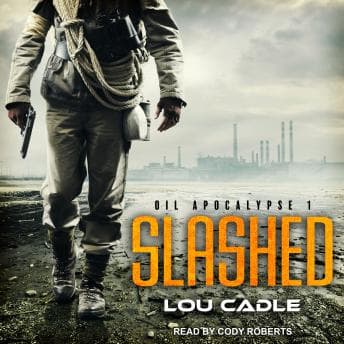

Look, I need to rant about something first: why does every post-apocalyptic novel act like the protagonist's dad had some preternatural sense that society was about to collapse and spent years training his kid in survival skills? Dev's father "made sure" he could fight. Of course he did. It's the prepper-dad trope, and Slashed leans into it hard. But here's the thing - despite my eye-rolling at 6:47 AM on the Caltrain, squished between a guy with a massive backpack and someone's elbow, I kept listening. And that says something.
TL;DR: Worth your commute, with caveats. A solid post-oil collapse setup that moves fast enough for early-morning brain fog but stumbles on dialogue and occasionally reads like a checklist of apocalypse clichés.
The Premise Is Basically One Second After But For Peak Oil
The hook is simple: oil supply gets cut off by a distant war, and society unravels in weeks. Devlin Quinn turns sixteen right as grocery shelves empty out and cities start burning. It's a familiar scaffolding - infrastructure collapse, desperate people fleeing urban centers, small-town folks deciding whether to help or hunker down. Lou Cadle doesn't reinvent the wheel here, and at 7 hours 24 minutes, it doesn't overstay its welcome. I finished this in exactly 3 commutes (round trips), which is the sweet spot for a book like this.
What works: the pacing of the collapse itself. Cadle clearly understands supply chain dependencies - the way fuel shortages cascade into food shortages into water shortages into violence. There's a systems-thinking quality to how the domino effects play out that scratched my engineer brain in the right way. The author apparently lived through earthquakes and volcanic eruptions, and you can feel that real-world disaster experience in the small details - how quickly normalcy bias kicks in, how people hoard the wrong things first.
What doesn't work: the dialogue. Multiple listeners have flagged this, and they're right. Conversations between characters sometimes feel like they were written by someone who's read a lot of books about people talking but hasn't eavesdropped on actual humans recently. There's an artificiality to how Dev interacts with other survivors that kept pulling me out of the story. People in crisis don't speak in complete, expository sentences about their tactical plans. They panic. They talk over each other. They say dumb things. The characters here are a bit too... competent and articulate for a world that just fell apart.
Cody Roberts: The Narrator Schrödinger's Box
Okay so the narrator situation is genuinely weird. I've seen reviews praising Roberts for giving each character a distinct voice - including solid female voices that don't sound like a dude doing a falsetto bit. And I've seen reviews calling him robotic and disjointed. Having listened to the whole thing, I think both camps are right? It depends on the scene.
During action sequences and tense moments, Roberts hits a good rhythm. You can follow who's talking without the "he said / she said" tags, which is exactly what you need in audio. His female voices are notably non-cringey, which - sadly - is still worth calling out in 2024. But during longer expository stretches or quieter dialogue scenes, there's this strange... cadence. Like he's reading each sentence as its own isolated unit rather than flowing through a paragraph. It gave me slight uncanny valley vibes during a couple of chapters, that feeling where the technical execution is fine but something's just a hair off.
He's no Ray Porter (who is?), but he's serviceable. I'd put him solidly in the "doesn't ruin it, doesn't elevate it" category.
Who's Going to Love This (And Who Should Keep Scrolling)
Perfect for: train, gym. Skip for: deep work, bedtime (not quite engaging enough to keep you from drifting off, not boring enough to actually help you sleep - the worst of both worlds).
If you burned through One Second After, the Going Home series, or Franklin Horton's stuff, this slots right in. It's comfort-food post-apocalypse. The ROI on this audiobook is decent - 7.5 hours of competent collapse fiction that doesn't ask too much of you intellectually. Days of Blood & Starlight occupies a similar comfort-food niche for me — familiar scaffolding, competent execution, easy to consume on a tired Tuesday morning without feeling like you wasted your commute. It's book one of the Oil Apocalypse series, so yes, there's sequel bait, but it wraps up its immediate arc well enough that you won't feel cheated.
If you need sharp dialogue, deep character work, or anything that subverts the prepper-kid-survives-the-end genre? This isn't it. The clichés are real. The unnecessary detail complaints I've seen are valid - there are stretches where Cadle describes tactical minutiae that could've been trimmed by 30%.
I bumped this to 1.5x (my default) and it felt right. At normal speed I think the pacing issues would've been more noticeable. At 1.75x the action scenes blur together.
The Commit Message: "fix: adequate apocalypse, known dialogue bugs"
It's a 3-star audiobook that's easy to consume and hard to remember a month later. I don't regret the listen - it got me through a particularly brutal Monday commute where the train was 20 minutes late and I was running on 4 hours of sleep after a deployment went sideways. Sometimes that's exactly what you need: fiction that moves, doesn't demand much, and scratches the "what if everything broke" itch that every infrastructure engineer secretly has. But I'm not rushing to grab book two.