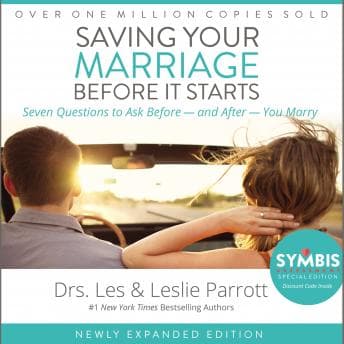

Can a 3-hour audiobook actually save your marriage if you haven't even had one yet?
Kevin and I aren't engaged (yet? maybe? we're busy people), but when this popped up as a recommendation after I binged three relationship psychology podcasts during a particularly brutal on-call week, I figured — why not. It's shorter than most meetings I sit through at work. I threw it on during a Saturday morning grocery run and honestly finished it before I'd even put the laundry away.
The Premarital Counseling Session You Didn't Schedule
TL;DR: Worth your commute if you're in a serious relationship and come from a Christian background. Otherwise, proceed with caution.
So here's what this actually is: it's basically a couples therapy intake session compressed into audiobook form. Dr. Les Parrott (and occasionally Leslie, though Les does the heavy lifting on narration) walks through seven questions designed to surface the assumptions you're dragging into marriage — stuff about conflict styles, money baggage, and sexual expectations. The framework is solid in places. The section on identifying your "emotional elevator" — how you escalate from minor irritation to full meltdown and where your partner's floor-by-floor stops differ from yours — that stuck with me. It's a genuinely useful mental model.
But here's where I need to be upfront: this book has a strong Christian orientation. And I don't mean "sprinkled with faith references." I mean the foundational assumption is that marriage is a covenant before God, and several of the seven questions are framed through that lens. If that's your worldview, this will feel like coming home. If it's not, you'll spend chunks of the listen mentally filtering content to extract the secular relationship advice underneath.
I'm somewhere in the middle — grew up going to church in Seattle, now firmly in the "spiritual but will also read John Gottman's research papers for fun" camp. So I could toggle between the frameworks. But I noticed it.
The ROI Problem (3 Hours vs. One Blog Post vs. The Entire SYMBIS Ecosystem)
The ROI on this audiobook is... complicated. At 3 hours 21 minutes, it's already lean. But a surprising amount of that runtime is spent pointing you toward the his/her workbooks, the SYMBIS Assessment tool, and the video curriculum. It starts to feel less like a standalone book and more like the free tier of a SaaS product — useful enough to hook you, but constantly nudging you toward the paid features.
This is my biggest gripe. When Parrott discusses the concept of "trading places" — genuinely trying to adopt your partner's emotional perspective during conflict rather than just intellectually acknowledging it — that's good stuff. Practical. Actionable on your next Tuesday night disagreement about whose turn it is to deal with the Caltrain parking situation. But then instead of going deeper into the technique, we pivot to "and you can explore this more in the workbook." It's the relationship advice equivalent of a startup book that could've been a blog post, except here it's a blog post that wants to be a subscription service.
The gender roles discussion also hasn't aged perfectly. Some of the frameworks around "what wives need" vs. "what husbands need" feel like they were written in a pre-2010 world. Listeners who are in egalitarian relationships or, you know, not heterosexual, will find significant portions just... not applicable.
Les Parrott: Therapist Energy, Not Narrator Energy
Les narrates this himself, and it shows — in both good and not-great ways. Good: he sounds like your warm, competent couples counselor who genuinely believes in what he's telling you. His pacing is conversational, like he's sitting across from you in an office with a box of tissues on the side table. Not great: there's zero vocal variety between sections. The money management chapter sounds exactly like the intimacy chapter sounds exactly like the conflict chapter. At 6 AM on the train, that sameness would put me to sleep. I bumped it to 1.75x and it improved — tighter, more energetic, and honestly the content density supports that speed since a lot of the concepts are repeated.
No sound effects, no music, no co-narration from Leslie (which feels like a missed opportunity given the his/her framing of the whole book).
Who This Is Actually For (Be Honest With Yourself)
Perfect for: Christian couples doing premarital counseling who want a digestible audio companion to the workbooks. Also solid for anyone in a serious relationship who wants a quick framework for surfacing hidden assumptions — just know you'll be doing some mental filtering.
Skip for: anyone looking for research-heavy relationship science (go get Gottman's Seven Principles instead — the data actually holds up), same-sex couples (you're essentially invisible here), or anyone allergic to upselling. On the upselling front, Becoming Bulletproof managed to deliver a complete, standalone framework without once making me feel like I'd just downloaded a freemium app — a bar this book sadly doesn't clear.
I texted Kevin the "emotional elevator" concept and he immediately said "you're the person who goes express to the penthouse." He's not wrong. So at least one framework survived the grocery store test.
Debug Level: Useful Library, Incomplete Documentation
This is a solid v1.0 of marriage prep content that really wants you to upgrade to the full platform. If you're in the target audience, it's a fine 3-hour investment — quick, clear, actionable in spots. But it's not the standalone resource the title promises. It's the README that points you to the docs.