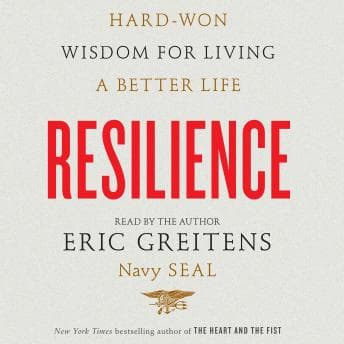

I was halfway through making chana masala — the kind that takes two hours because I insist on toasting whole spices even when it's just me eating — when Eric Greitens said something that made me put down the wooden spoon. He was talking about how resilience isn't bouncing back. It's moving through. And I thought: finally, someone in the self-help space who understands that the "snap back" metaphor is psychologically bankrupt.
But here's the thing. I came into this audiobook expecting a Navy SEAL chest-thumping manual. The kind where someone who ran through fire tells you to just be tougher. And parts of it are that, sure. But what surprised me — genuinely surprised me — is how much Greitens reads. The man quotes Epictetus and Viktor Frankl and the Bhagavad Gita in the same breath as his own combat experiences. The epistolary structure — letters written to his struggling SEAL buddy Zach Walker — gives the whole thing an intimacy that most self-help books would kill for and can't manufacture.
Letters to Zach, or: When Structure Does the Heavy Lifting
The framework here is deceptively simple. Greitens is writing to a friend. Zach Walker, former SEAL, now drowning in PTSD and alcohol in a small logging town. And because it's structured as correspondence, there's this beautiful constraint: Greitens can't lecture for forty pages straight. He has to circle back. He has to acknowledge that Zach might not have taken his advice. He has to be human about it.
Psychologically, this tracks in ways most self-help doesn't. The research actually shows that people process advice better when it's embedded in relationship — when there's a "you" being addressed who has a real face, real problems, real resistance. Greitens isn't talking to an abstract audience of people who bought his book. He's talking to Zach. And because we're eavesdropping on that conversation, our defenses drop.
I found myself asking: why does this format work so much better than the standard chapter-per-topic approach? Because it mirrors therapy. It mirrors the way insight actually arrives — not in neat packages, but in messy, recursive conversations where you keep coming back to the same wound from different angles.
The Rhodes Scholar SEAL Problem
Here's where I get complicated about this book. Greitens is clearly brilliant. Rhodes Scholar, Navy SEAL, humanitarian work in refugee camps. The man has lived multiple lives. And he reads the audiobook himself, which means you get his voice — measured, sincere, occasionally intense in that quiet way that's more convincing than shouting.
But eleven hours is a lot. And some of the philosophical citations start to feel like a graduate seminar where the professor is a little too proud of his bibliography. There were stretches — maybe around hour six or seven — where I wanted him to stop quoting Marcus Aurelius and just talk to Zach again. The best moments are when Greitens drops the erudition and gets raw: his own struggles after deployment, the specific weight of watching friends die and then having to figure out what breakfast cereal to buy at a suburban grocery store. That contrast — battlefield to cereal aisle — is more powerful than any Stoic maxim.
As a narrator, Greitens is steady. Not dynamic. He doesn't do voices or dramatic shifts because he doesn't need to — it's his story, his letters, his voice. There's a clarity to his delivery that works for the reflective content, but I'll be honest, it can feel monotone during the more philosophical passages. I bumped it to 1.25x during the denser sections and it helped.
Who Needs This (and Who Doesn't)
If you're going through something — transition, loss, that particular flavor of purposelessness that hits when the structure you built your identity around disappears — this book has real utility. Greitens isn't peddling toxic positivity. He's not telling you to visualize your best life. He's saying: suffering is real, and here's how people across centuries have walked through it without being destroyed. The contrast with something like Atomic Habits is instructive here — James Clear is brilliant at the mechanics of behavior change, but Greitens is operating in a different register entirely, less interested in optimizing you than in helping you survive yourself.
If you want quick actionable tips, a listicle in audiobook form, this will frustrate you. It's reflective. It asks you to sit with ideas. My therapist would have thoughts about this book — specifically, she'd probably appreciate that Greitens treats resilience as a practice rather than a personality trait. That distinction matters more than most people realize.
The elephant I should address: Greitens' later political career and the controversies surrounding it. I'm reviewing this audiobook as a text about psychology and resilience, not as an endorsement of anyone's character. The ideas in these letters stand or fall on their own merits, and psychologically, most of them stand.
The Case Study I Didn't Expect
What makes this book compelling is Zach. Not Greitens — Zach. The invisible recipient of these letters. The man we never hear from directly but whose presence shapes every word. This is a fascinating case study in how we construct meaning for someone else while secretly constructing it for ourselves. Every letter Greitens writes to Zach is also a letter to himself. And maybe that's the most honest thing about it.