
This book could've been a blog post. But honestly? It's a pretty good blog post stretched into 4 hours, and I mean that as more of a compliment than it sounds.
I finished this in exactly three commutes—Monday through Wednesday of a particularly brutal on-call week. And here's the thing: at 6:47 AM on a packed Caltrain car, sandwiched between a guy eating a breakfast burrito and someone's oversized backpack, I was actually taking mental notes. That's the ROI test for business audiobooks, and this one passed.
The iPhone Launch Moment Hit Different
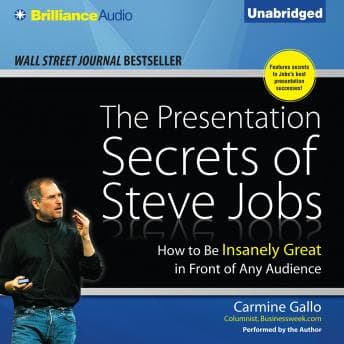
Gallo does this thing where he recreates Steve Jobs' keynote moments, and when he gets to the 2007 iPhone launch—"An iPod, a phone, and an internet communicator"—you can hear him genuinely geeking out. The enthusiasm isn't performative. He's a communications coach who clearly studied these presentations frame by frame, and that obsession comes through in how he narrates.
The framework itself is straightforward: create a headline (what's the one thing you want people to remember?), develop an antagonist (every presentation needs a villain), reveal a hero (your product/idea), and deliver a "holy smokes" moment. It's basically design thinking but for presentations. The same clarity-over-complexity principle drives How To Win Friends And Influence People—both books are about stripping communication down to what actually works. If you've ever sat through a 47-slide deck wondering why your soul was leaving your body, this book explains exactly what went wrong.
When the Author IS the Narrator
Author-narrated business books are hit or miss. Usually miss. But Gallo being a former TV correspondent actually works here—the guy knows how to project and pace. No weird mouth sounds, no monotone reading. When he quotes Jobs, he doesn't do a cringey impression, he just captures the cadence. The confident pauses. The "one more thing" energy.
That said, at 4 hours 18 minutes, this is firmly in 1.75x territory. Gallo repeats his core concepts multiple times (rule of three, rule of three, rule of three—see what I did there?), and some of the examples feel padded. Do I need three separate anecdotes about slide design? Probably not. But at accelerated speed, it flows.
The Stuff That Actually Stuck
Three things I've already used in actual work presentations since finishing this:
The Twitter test—If you can't describe your idea in 140 characters (yes, the old limit), you don't understand it well enough. I used this to cut my last team sync from 12 slides to 4.
The 10-minute rule—Brains check out after 10 minutes. Jobs knew this and broke his keynotes into segments with demos, videos, guest speakers. My on-call postmortem now has a live debugging demo in the middle. People actually stayed awake.
Practice in real conditions—Jobs rehearsed for weeks. Not reading notes, actually performing the full presentation. I tried this once for a promotion pitch. Felt ridiculous. Got the promotion. That kind of obsessive preparation reminded me of the meticulous detail work in Bad Blood—except there, the performance was hiding fraud instead of selling innovation.
The book also gets into visual design—why Jobs used almost no bullet points, why his slides had one image and maybe six words. This is where reading the physical book might have an edge, since you can't exactly see the slide examples. But Gallo describes them well enough that you get the principle.
Who This Is (and Isn't) For
If you've watched every Jobs keynote on YouTube and read his biography twice, you might find this redundant. The examples are all public—the iPod launch, the iPhone reveal, the Macworld presentations. Gallo's contribution is organizing them into a teachable system, not revealing secret footage.
Also skip if you're looking for something to challenge you. This isn't contrarian or complex. It's a practical playbook. You know exactly what you're getting: Steve Jobs did X, here's how you can do X too.
Perfect for anyone who gives presentations at work and wants a framework that doesn't require a PhD to implement. Skip if you need intellectual stimulation or already have your keynote game dialed in.
Best Consumed at 1.75x Between Stops
This is a commute listen, full stop. The concepts are simple enough that you won't miss anything while dodging other passengers, but useful enough that you'll want to implement them. I actually paused to send myself a voice memo about restructuring my next architecture review.
The irony isn't lost on me that a book about presentation excellence is best consumed while half-conscious on public transit. But that's the thing about good frameworks—they should be simple enough to absorb anywhere, then powerful enough to transform how you work.
Worth a credit if you give any presentations at work. Worth two listens if you give a lot of them.