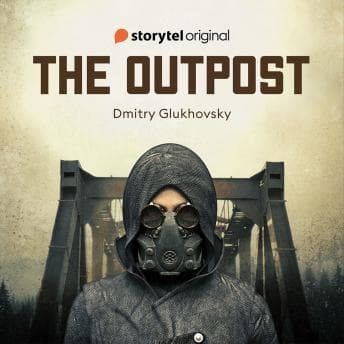

"The bridge is death."
Somewhere around hour three, that line hit me like a critical fail on a saving throw. I was debugging a procedural generation algorithm at 2 AM (not working on my thesis, obviously), and Glukhovsky's post-apocalyptic Moscow had completely hijacked my brain. The Stormlight Archive was paused. My advisor would be proud. Or concerned. Probably concerned.
Here's the thing about Dmitry Glukhovsky - the man who gave us Metro 2033 understands something fundamental about world-building that most authors miss. He doesn't just create settings; he creates ecosystems of despair. The Moscow Empire isn't some generic wasteland. It's a poisoned, shrunken Russia where the Volga River has become a radioactive moat separating the known world from... whatever's on the other side. And for years, nothing has crossed that bridge. Until something does.
The Magic System Is... Wait, There's No Magic System
Okay, so this isn't Sanderson. There are no hard rules about how the radiation works or why certain weapons were forbidden. But Glukhovsky does something equally impressive - he builds a society that feels internally consistent. The Moscow Empire's paranoia, the border outpost's isolation, the slow creep of dread as we realize the bridge might not be keeping things out so much as keeping people in. It's less Mistborn and more Roadside Picnic, if Roadside Picnic had been written by someone who'd actually lived through the collapse of Soviet infrastructure. That same commitment to atmospheric world-building over action shows up in Eye of the World, though Jordan's taking you on a much longer journey.
The world-building here is dense. Not Malazan dense (nothing is Malazan dense), but this is a 10-hour commitment that rewards attention. If you don't like info-dumps, this isn't for you (but you're wrong). Glukhovsky takes his time establishing the political geography, the social hierarchies of this diminished empire, and the specific flavor of Russian fatalism that permeates everything.
Andrew Buchan: Brilliant or Exhausting? Yes.
Here's where things get complicated. Buchan's narration is... a lot. And I mean that in both directions.
When he's on, he's on. His character differentiation is genuinely impressive - distinct voices for different ages, genders, disabilities. There's a desperation in his delivery that captures the dystopian atmosphere perfectly. Around hour six, there's this extended sequence of tension at the outpost that had me forgetting to eat dinner. (My D&D group would love this - the pacing is pure survival horror campaign energy.)
But. And this is a significant but.
Buchan commits to the emotional extremes in a way that some listeners will find exhausting. There's a lot of whining. A lot of crying. Blubbering. Shouting. Some singing that I'm still not sure was strictly necessary. He's not phoning it in - he's doing the opposite of phoning it in. He's showing up at your door with a mariachi band when you asked for a text message.
I personally found it worked more often than it didn't. The post-apocalyptic atmosphere calls for heightened emotions, and Buchan delivers that. But I can absolutely see why some listeners would find it excruciating. If you prefer your narrators understated, this will drive you up the wall. Steven Pacey walked so other narrators could run, but Buchan is doing a full sprint while screaming.
Who Should Cross This Bridge (And Who Should Turn Back)
You'll love this if: You're a Metro 2033 fan. You appreciate Russian-flavored dystopia with actual political commentary. You want world-building that takes itself seriously. You can handle a narrator who commits fully to emotional moments.
Skip it if: You need fast pacing. You find emotional narration grating. You're looking for action-heavy post-apocalypse rather than atmospheric dread. You want your audiobooks to be background noise - this demands attention.
Worth Pausing Sanderson For?
Look, I'm not going to pretend this is a perfect audiobook. The narration is polarizing in a way that makes recommendation tricky. But Glukhovsky's vision of a collapsed Russia is compelling in that specific way great speculative fiction manages - it feels uncomfortably plausible. The progression is satisfying, building from isolated outpost drama to something much larger.
At 10 hours, it's a commitment but not an unreasonable one. I read this instead of writing my thesis. (Listened. Whatever. Dr. Patel doesn't need to know.) The bridge is death, but crossing it might be worth it.
Just maybe bump it to 1.25x if Buchan's emotional intensity starts wearing on you. That's not a criticism - it's a survival strategy.